

Network Security Domain 3: VPNs and IPsec

Presentation
•
Instructional Technology
•
9th Grade
•
Medium

Charles Carr
Used 10+ times
FREE Resource
14 Slides • 27 Questions
1
Network Isolation Part 1
VPNS and IPSec
2
VPN: Virtual Private Network
An encrypted (private) connection over the (public) Internet from a device to a network or a network to a network.
A VPN uses tunneling (via port forwarding or by encapsulating data using one protocol inside of another protocol) to encrypt data at the sending end and decrypt it at the receiving end
A VPN concentrator (gateway) handles encryption an decryption either as a standalone device (hardware) or as a feature integrated into the firewall (software)
Protects the data in transit from eavesdropping or other undesirable situations.
3
Fill in the Blanks
4
Multiple Choice
Tunneling prevents what type of attack?
Trojan
Brute Force
DOS
eavesdropping
5
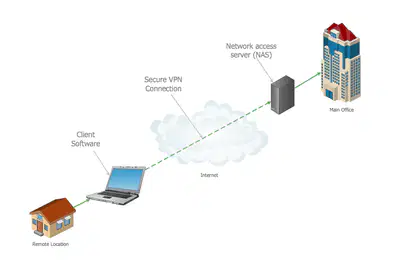
Remote Access VPN
(Client to Site)
How it works
A user installs a VPN client software on their device
The software authenticates the user and creates an encrypted tunnel to the VPN gateway
The gateway acts as the VPN server, allowing the user to access the network
6
Multiple Choice
Remote Access VPNs require the installation of VPN client software at the remote site and host location.
True
False
7
Fill in the Blanks
8
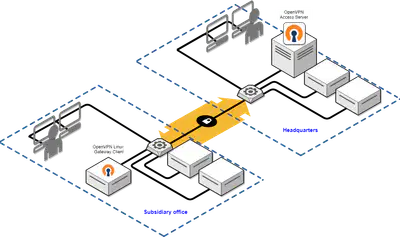
Site to Site VPN
Use case:
Primarily used by businesses with multiple locations to connect their networks and securely share data across different sites, enabling secure data transfer between different network locations and a cost-effective alternative to dedicated private lines.
How it works:
VPN gateways at each site encrypt data before sending it over the internet, and the receiving site decrypts it upon arrival, providing seamless and secure access to shared resource.
9
Multiple Choice
For Site-to-Site VPN to function correctly, the host must have VPN client software installed.
True
False
10
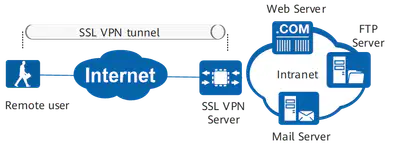
How SSL VPN works:
A user connects to the SSL VPN gateway using a web browser
The VPN gateway presents a secure page for the user to authenticate
If the user authenticates, the SSL VPN creates an encrypted connection between the user's device and the network
The user can then access the network's applications, files, and services
SSL VPN - uses SSL or TLS encryption to provide authentication and confidentiality at the application layer between the user's browser and the network. (HTTPS)
11
IPsec VPN- a secure network connection that uses IPsec protocols to encrypt data at the Network layer as it travels over the internet (Popular with Unix, Linux, MacOS, and Windows)
How it works
Two devices establish a mutual authentication
The devices exchange cryptographic keys
The devices encapsulate data packets, encrypting them and adding an IPsec header
The data is sent over the internet to the VPN server
The VPN server decrypts the data using the correct cryptographic key

12
13
Multiple Choice
Uses TLS or its predecessor
Encryption to provide authentication and confidentiality
Common for HTTPS based websites.
Allows for browser-based VPN connection
SSL VPN
IPSec VPN
Both SSL and IPSec VPNs
Neither SSL or IPSec VPNs
14
Provides authentication, integrity and confidentiality through encryption of IP packets. Include anti-replay
Encapsulating Security Payload (ESP)
Provides data integrity and transport protection services. Designed to be inserted into an IP packet to add authentication data and protect the contents from modification, but does not encrypt the packet.
Authentication Header (AH)
IPsec Protocols - stands for Internet Protocol Security, is a network security protocol that encrypts data transmitted across IP networks
Internet Key Exchange (IKE)
Manages the key negotiation process for establishing a secure communication channel (Security Association (SA)) over an untrusted network.
Exchanges encryption keys to create a secure tunnel between a client and a server through which they can send encrypted traffic based on the Diffie-Hellman key exchange.
15
Multiple Choice
Used for remote logins
Popular with Unix, Linux, MAC OS, and Windows.
SSL VPN
IPSec VPN
16
Fill in the Blanks
17
Multiple Choice
This IPsec protocol enables 2 systems or devices to establish a secure communication channel over an untrusted network by utilizing a series of key exchanges.
ESP
IKE
AH
EAS
18
Multiple Choice
AH (Authentication Headers) use a hash to protect the date contents of communication from modification. This hash supports which pillar of the CIA triad?
Integrity
Confidentiality
Reliability
Authentication
19
Multiple Choice
Which IPSec protocol provides authentication, integrity, and confidentiality through encryption of IP packets.
AH
ESP
IKE
ESPIKAH
20
Hosts behind one gateway communicate securely with multiple hosts behind the other gateway.
For example, users of systems in a branch office can securely connect with any systems in the main office (i.e. printer server, file server, mail server)
The IPsec tunnel is established between the two gateway hosts, and the entire IP packet including the IP header is encapsulated into a new UP packet. Generally considered more secure
Tunnel Mode
Two hosts that need to interact with one another (temporarily) set up a directly connected IPsec VPN connection.
For example, to enable a remote IT support technician to log in to a remote server to do maintenance work.
Encrypts only payload (data) of the IP packet, not the header and requires both endpoints of the VPN tunnel to be hosts.
Transport Mode
IPSec Modes - IPsec has two modes of operation
21

22
Multiple Choice
In this mode, two hosts (temporarily) set up a directly connected IPsec VPN connection.
The circuit is usually torn down after the session is complete.
Tunnel Mode
Transport mode
Transit Mode
Traffic Mode
Travel Mode
23
Multiple Choice
Users in a branch office can securely connect with any systems in the main office if the branch office and main office have secure gateways acting as IPsec proxies in this mode.
Transit Mode
Transport Mode
Tunnel Mode
Travel Mode
Tube Mode
24
Multiple Choice
This type of circuit enables multiple hosts behind one gateways to securely access multiple servers behind the another gateway.
Transport Mode
Transit Mode
Traffic Mode
Tunnel Mode
Tube Mode
25
Multiple Choice
This IPSEC mode might be set up to enable a remote IT support technician to log in to a remote server to do maintenance work.
Transit Mode
Transport Mode
Tunnel Mode
Travel Mode
Tube mode
26
27
Air Gapping
isolating a computer or network and preventing it from establishing an external connection.
An air-gapped computer is physically segregated and incapable of connecting wirelessly or physically with other network devices.
Air-gapped networks are used to protect many types of critical systems from hackers or other malicious threat actors. (stock market, military, industrial power systems, and government industries)
Air gaps are also used for backup and recovery. (i.e. Ransomware attack)
28
Multiple Choice
What is air-gapping?
29
Multiple Choice
What does a VPN do?
A VPN speeds up internet connections by creating warp fields.
A VPN is a type of antivirus software used to protect against antivirus attacks
A VPN is used to block websites, thereby preventing pharming attacks
30
Multiple Choice
What is one reason you might air-gap a device?
31
Multiple Choice
What is a real-life situation where air-gapping might be used to enhance security?
32
Exit Slip
You are almost there!
Today, hopefully, you learned about VPN's and IPsec. If you not, you must be living in a tunnel. Get it? VPN? Tunnel? Well, if you paid attention today you would know that was a funny little network security joke. Anyway, answer the following 6 questions to show how well you understood the lesson. Good luck!
33
Multiple Choice
What is the purpose of a VPN?
To provide privacy and security for internet users through data encapsulation.
To enhance internet speed for users through the use of fiber optics
To provide free internet access worldwide through satellite technology.
To block all internet traffic completely thus ensuring security.
34
Multiple Choice
What is IPsec?
IPsec is a group of hardware devices used for networking.
IPsec is a suite of programming languages designed to secure websites.
IPsec is a suite of different types of firewalls used to protect data.
35
Multiple Choice
What are the three main IPsec protocols?
SSL, TLS, and SSH
L2TP, ARP, and DHCP
KIA, HA, and SPI
TSL, AH, and VPNIS
AH, ESP, and IKE
36
Multiple Choice
What is one main difference between IPsec Transport mode and IPsec tunnel mode?
37
Multiple Choice
What is the main difference between an SSL VPN and an IPsec VPN?
IPsec VPNs are only used for remote access, while SSL VPNS are only used for local connections.
SSL VPNs use SSL/TLS for secure connections, while IPsec VPNs use IPsec protocols.
SSL VPNs do not provide encryption, while IPsec VPNs provide too much encryption
38
Multiple Choice
What is one difference between IPsec Transport mode and IPsec Tunnel mode?
39
Multiple Choice
If you were using a site to site VPN which IPsec mode would you most likely use?
Enterprise mode
Traffic mode
40
Multiple Choice
Which IPsec protocol provides data integrity and confidentiality through encryption.
Internet Key Exchange (IKE)
41
Congratulations!
You are VPN credible!
Did you get all 5 right? Or at least 4? If you did, give yourself a pat on the back and stunt on your neighbor. If not, turn the VPN in your brain on next lesson a create a secure tunnel to Mr. Carr's lecture.
Network Isolation Part 1
VPNS and IPSec
Show answer
Auto Play
Slide 1 / 41
SLIDE
Similar Resources on Wayground

39 questions
Math 1 Unit 6 Statistics Day 1
Presentation
•
7th - 9th Grade
40 questions
WELCOME TO DENMARK
Presentation
•
KG
36 questions
FORM 4 POEMS
Presentation
•
10th Grade
36 questions
MATERI DIGITAL TALENT SCHOLARSHIP 2023
Presentation
•
10th Grade
33 questions
3/21 Dot Plots, Histograms, Box Plots, Stem & Leaf
Presentation
•
8th Grade
34 questions
Second Conditional
Presentation
•
9th Grade
37 questions
Rome Vocabulary
Presentation
•
9th Grade
32 questions
La nouvelle
Presentation
•
KG
Popular Resources on Wayground
19 questions
Naming Polygons

Quiz
•
3rd Grade
10 questions
Prime Factorization
Quiz
•
6th Grade
20 questions
Math Review
Quiz
•
3rd Grade
15 questions
Fast food
Quiz
•
7th Grade
20 questions
Main Idea and Details
Quiz
•
5th Grade
20 questions
Context Clues
Quiz
•
6th Grade
20 questions
Inferences
Quiz
•
4th Grade
19 questions
Classifying Quadrilaterals
Quiz
•
3rd Grade
Discover more resources for Instructional Technology
10 questions
Fact Check Ice Breaker: Two truths and a lie
Quiz
•
5th - 12th Grade
10 questions
Video Games
Quiz
•
6th - 12th Grade
5 questions
A.EO.1-4 Quizizz Day 1
Quiz
•
9th - 12th Grade
10 questions
Logos
Quiz
•
6th - 9th Grade
100 questions
Biology EOC Review
Quiz
•
9th - 12th Grade
5 questions
A.EO.1-4 Quizizz Day 2
Quiz
•
9th - 12th Grade
12 questions
Name that Candy
Quiz
•
KG - 12th Grade
50 questions
ELA EOG Prep 7th Grade
Quiz
•
KG - University