Tectonic Plate Theory Guided Lesson
Presentation
•
Science
•
6th - 8th Grade
•
Easy
+11
Standards-aligned
Bobby Menendez
Used 2+ times
FREE Resource
24 Slides • 24 Questions
1
2
3
Multiple Choice
The year Wegener first had the idea for continental drift
1975
1950
1888
1912
4
5
Multiple Choice
Which of the following statements best describes the relationship between continental drift and plate tectonics?
The theory of plate tectonics was developed before the theory of continental drift.
Plate tectonics disproved the theory of continental drift.
Plate tectonics helped explain how continental drift occurred.
The theory of plate tectonics developed independently from the theory of continental drift.
6
7
8
Multiple Choice
The large coal fields found in Pennsylvania provide evidence that the climate of the northeastern United States was much warmer during the Carboniferous Period. This change in climate over time is best explained by the
movements of tectonic plates
effects of seasons
changes in the environment caused by humans
evolution of life
9
10
11
12
13
14
15
Multiple Choice
16
Multiple Choice
17
Multiple Choice
Look at the image.
What can be inferred from this fossil evidence?
Lystrosaurus eggs were probably transported by birds to different land areas in the Southern Hemisphere.
Even though the Lystrosaurus was a land species, it was capable of swimming great distances across the open ocean.
Millions of years ago, South America, Africa, India, and Antarctica were much further apart from each other than they are now.
Millions of years ago, South America, Africa, India, and Antarctica were once joined together in a much larger landmass.
18
19
20
21
22
23
Multiple Choice
24
Multiple Choice
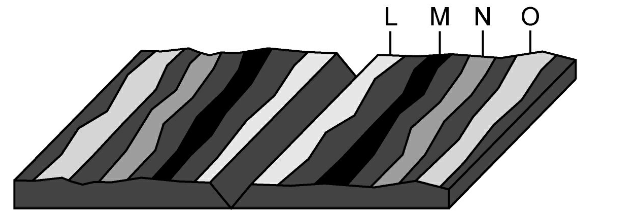
One piece of evidence that supports the Theory of Plate Tectonics is found in the observation of rocks on either side of the Mid-Atlantic Ridge, shown in the picture provided. Plate Tectonic theory is supported because as you move out form the Mid-Atlantic Ridge, the rocks -
have higher iron content.
become thicker and thicker.
are increasingly older.
are made of smaller particles.
25
26
27
28
Multiple Choice
The process of ___________ continually adds new crust to the ocean floor along both sides of the mid-ocean ridge.
plate tectonics
seafloor spreading
continental drift
convection
29
Multiple Choice
30
Multiple Choice
Sea-floor spreading begins at the
Deep ocean trench
Mid-ocean ridge
Continent's edge
31
Multiple Choice
32
Multiple Choice
Why does oceanic crust sink below the continental crust during subduction
oceanic crust is less dense
oceanic crust is more dense
oceanic crust is older
oceanic crust is warmer
33
Multiple Choice
The image shows a diagram of the ocean floor near a mid-ocean ridge. Where would the oldest rock be found?
34
Multiple Choice
An important Earth process is the phenomenon known as seafloor spreading. It begins as a rift that forms when an area of Earth's crust becomes hotter and less dense, resulting in the appearance of cracks. As the rift opens wider, new crust forms between the separating fragments. However, despite the creation of new crust due to the seafloor spreading, Earth's diameter remains about the same. What can you conclude from this?
There are also areas on Earth's surface where crust is destroyed.
Seafloor spreading occurs at a very slow rate.
New crust is usually eroded as quickly as it is created.
When the seafloor becomes wider, continents become narrower.
35
36
37
38
39
40
Multiple Choice
. In 1915, German scientist Alfred Wegener proposed the theory of continental drift. Wegener found that continents were slowly drifting around the surface of Earth. Later scientists were able to explain the processes that drive continental drift by looking at the phenomenon of —
radio carbon dating
global warming
conduction in the atmosphere
seafloor spreading
41
Multiple Choice
One of their main sources of data evidencing continental drift theory is a —
group of samples of new oceanic crust from ocean basins
set of seismology readings from deep sea trenches
large group of similar plant and animal fossils
set of surveys showing the distribution of island arcs
42
Multiple Choice
43
Multiple Choice
What type of evidence was NOT used by Alfred Wegener to support his continental drift hypothesis?
evidence from ancient climates and plants
evidence from landforms
evidence from fossils
evidence from human ancestry and DNA lineage
44
Multiple Choice
There have not been any earthquakes reported in the interior of the content of Africa. Why?
The mountains in Africa do not cause pressure to build up in the lithosphere.
The entire continent of Africa is located on a single continental tectonic plate.
The landmass of Africa is too small to form earthquakes.
The plate boundary inside Africa is too small to form earthquakes.
45
Multiple Choice
The map below shows the present day locations of South America and Africa. Remains of Mesosaurus, an extinct fresh water reptile have been found in similarly aged rock layers formed from lake sediments.
Which statement represents the most logical conclusion from this evidence?
Mesosaurus migrated across frozen oceans from Africa to South America during an ice age.
The continents of South America and Africa were once joined when the Mesosaurus lived.
The continents of South America and Africa once had underground waterways where the Mesosaurus travelled from continent to continent.
The continents of South America and Africa had very different climates from each other which caused the Mesosaurus to migrate from season to season.
46
Multiple Choice
Which below is a possible cause of tectonic plate motion?
ocean tides
the sun
convection currents
current weather patterns
47
Multiple Choice
The YOUNGEST rocks on the seafloor are located?
Closest to the mid-ocean ridge
Farthest from the mid-ocean ridge
48
Multiple Choice
How long did it take the continents to move from Pangaea into their current position?
Hundreds of years
Thousands of years
Millions of years
Show answer
Auto Play
Slide 1 / 48
SLIDE

Similar Resources on Wayground
39 questions
Light Waves
Presentation
•
6th - 8th Grade
43 questions
Atoms Lesson
Presentation
•
KG
42 questions
Spheres of the Earth
Presentation
•
6th - 8th Grade
42 questions
Types of Chemical Reactions
Presentation
•
6th - 8th Grade
46 questions
Prokaryotic and Eukaryotic Cells
Presentation
•
6th - 8th Grade
42 questions
Big Bang Theory Notes
Presentation
•
6th - 8th Grade
44 questions
Air Pressure adn Weather Notes and Questions
Presentation
•
6th - 8th Grade
44 questions
Plant Cells Meet Their Needs
Presentation
•
6th - 8th Grade
Popular Resources on Wayground
19 questions
Naming Polygons
Quiz
•
3rd Grade
10 questions
Prime Factorization
Quiz
•
6th Grade
20 questions
Math Review
Quiz
•
3rd Grade
15 questions
Fast food
Quiz
•
7th Grade
20 questions
Main Idea and Details
Quiz
•
5th Grade
20 questions
Context Clues
Quiz
•
6th Grade
20 questions
Inferences
Quiz
•
4th Grade
19 questions
Classifying Quadrilaterals
Quiz
•
3rd Grade
Discover more resources for Science
16 questions
Interactions within Ecosystems
Presentation
•
6th - 8th Grade
12 questions
PS.8.1.2, PS.8.1.3, PS.8.1.5 Review
Quiz
•
8th Grade
20 questions
Rocks and The Rock Cycle
Quiz
•
6th Grade
20 questions
Moon Phases and Eclipses
Quiz
•
6th - 8th Grade
16 questions
Photosynthesis and Cellular Respiration Review
Quiz
•
7th Grade
20 questions
Human Body Systems
Quiz
•
6th Grade
22 questions
6th & 8th Grade Science Material SOL Review
Quiz
•
6th - 8th Grade
15 questions
Punnett Squares
Quiz
•
6th Grade