
VNSA3 Heart lesson

Presentation
•
Science
•
11th Grade
•
Easy
+2
Standards-aligned

Matt Badham
Used 7+ times
FREE Resource
4 Slides • 9 Questions
1
A&P Recap - The Cardiovascular system
2
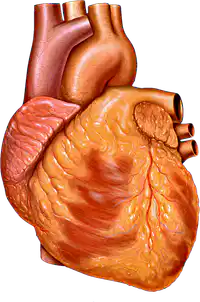
Can you label the anatomical features of the heart?
Remember that drawings of the heart are flipped on a horizontal axis - i.e. Right is left and left is right.
Atria are on top because A is pointing up ^ and Ventricles on the bottom because V is pointing down v
3
Hotspot
To demonstrate this, click on the right ventricle and the left atria
4
Hotspot
Now consider which chamber of the heart pumps the systemic blood flow. Pulmonary meaning to and from lungs, systemic meaning the rest of the body.
5
Labeling
Label valves and vessels
Cranial Vena Cava
Mitral Valve
Aortic Valve
Pulmonary Artery
Pulmonary Veins
Aorta
Pulmonary Valve
Tricuspid Valve
Caudal Vena Cava
6
Now consider the electrical activity of the heart.
Starting from the Sinoatrial Node in the wall of the right atrium (just like how the cycle of the heart starts at the right atrium) starts with the contraction of atria. Then to the AV node (between Atria and Ventricles).
This then travels via the bundle of his, to the Purkinje fibres in the walls of the ventricles causing them to contract.

7
Labeling
Label the conductive anatomy of the heart
Purkinje fibres
Bundle of His
Sinoatrial (SA) Node
Atrioventricular (AV) Node
8
The Avian Heart is very similar to the Mammalian heart. The reptilian heart is different in that it has 3 chambers. 2 Atria and 1 Ventricle. Just think of a love heart.


9
Multiple Choice
Which of the following is NOT a type of blood vessel?
Artery
Capillary
Vein
Ventricle
10
Multiple Choice
What is the function (job) of the platelets?
To form clots (i.e. scabs) when you have cuts and grazes.
To transport oxygen to the muscles
To carry dissolved sugars.
To produce antibodies
11
Multiple Choice
Which blood vessel has valves to prevent the back-flow of blood?
Veins
Arteries
Capillaries
12
Multiple Choice
Arteries have thick muscular walls?
true
false
13
Multiple Choice
The blood vessel that has the largest diameter is
vein
artery
capillary
A&P Recap - The Cardiovascular system
Show answer
Auto Play
Slide 1 / 13
SLIDE
Similar Resources on Wayground

11 questions
Chapter 4: Section 1: Living Things in an Environment
Presentation
•
KG
11 questions
Renewable and Nonrenewable Resources
Presentation
•
11th Grade
12 questions
Enzymes
Presentation
•
10th Grade
10 questions
Quiz
Presentation
•
KG
11 questions
Constellation Project
Presentation
•
11th Grade
9 questions
Reading Strategies
Presentation
•
6th - 8th Grade
10 questions
Limits
Presentation
•
11th Grade
8 questions
The building blocks of life
Presentation
•
11th Grade
Popular Resources on Wayground
10 questions
How much do you know about our Portrait of an Eagle?

Quiz
•
10th Grade
10 questions
Fast Food Slogans
Quiz
•
6th - 8th Grade
21 questions
Continents and Oceans
Quiz
•
6th Grade
20 questions
Parts of Speech
Quiz
•
5th Grade
16 questions
Subject & Predicate
Quiz
•
5th Grade
25 questions
Multiplication Facts
Quiz
•
5th Grade
12 questions
Map Skills
Quiz
•
3rd Grade
22 questions
Continents and Oceans
Quiz
•
5th Grade
Discover more resources for Science
22 questions
Periodic Table Review
Quiz
•
9th - 12th Grade
14 questions
Periodic Trends

Interactive video
•
11th Grade
7 questions
Newton's Laws Video Quiz
Interactive video
•
9th - 12th Grade
10 questions
Electron configuration and Orbital Notation
Quiz
•
11th Grade
17 questions
Unit 3A: Cells Vocab
Quiz
•
9th - 12th Grade
89 questions
Unit 1 (Ch 2 & 3) Test Review - Water/Ocean Currents
Quiz
•
9th - 12th Grade
58 questions
Biomolecule Test Corrections
Quiz
•
9th - 12th Grade
20 questions
Unit 2: Cell Energy Review
Quiz
•
9th - 12th Grade