

RAK Science Training March 2024

Presentation
•
Science
•
12th Grade
•
Practice Problem
•
Easy

Hassan Soliman
Used 1+ times
FREE Resource
58 Slides • 13 Questions
1

Engineering Optics
Waves, mirrors and lenses
March 2024
2

Outcomes + Agenda
05
06
07
08
01
02
03
04
Index
Starter
Light; its characteristics and
propagation
Engineering applications:
reflection, refraction
Reflection
Images formed in curved
mirrors
Refraction of light
Laws of refraction
3


30 minutes
Reflection ,curved
mirrors
15 minutes
Break
20 minutes
Refraction of light
30 minutes
Law of refractions
30 minutes
Applications-
lenses
10 minutes
Plenary
Training workshop activities
30 minutes
Light and its
propagation
30 minutes
Outcomes +
Agenda +Starter
4


At the end of the workshop, the participant is expected to be
able to:
Explain the nature of light.
Implement some practical
activities to enable the
student to better
understand the process of
refraction of light .
Identify some conceptual
errors related to reflection
and refraction .
Define the meaning of
reflection, refraction,
and total internal
reflection.
Employ some technological
applications in teaching
physics concepts in the
lesson .
Apply the laws of reflection
and refraction to solve
mathematical problems.
Learning outcomes
5


Everyone will now compete to design the best telescope that can
outperform Galileo’s Telescope.
Tools needed:
•Cardboards, about 24 inches long.
•Convex lenses with different sizes.
•Strong glue, scissors and pencil.
If the convex lenses are the same size, the telescope will not work.
The lenses are fixed on a 1 m long wooden ruler, use clay
(playdough) to adjust the distance between the lenses.
Activity: Shall we challenge Galileo?
20 min.
6


Scientists and light
20 min.
In your groups, select one of the scientists below and find out the
most important contributions to the development of light “optics”.
Discuss the findings with your colleagues.
7
Open Ended
select one of the scientists below and find out the most important contributions to the development of light “optics”.
8


Light is essential for photosynthesis and energy production in plants.
Many tools and devices that are used whether in examining or analyzing plants, soil
and water depend on different regions of the electromagnetic spectrum for the
scientific basis of their working methods, such as:
•Optical microscope
•Flame photometer
•Atomic Absorption
•Surveying and land leveling devices using laser
•Remote sensing equipment (agriculture)
Light, its properties and how it travels
Why do we study light?
9


Physicists are usually interested in knowing the components of matter
and the laws that describe the various interactions between them.
Several theories have emerged trying to explain the nature of light and
how it propagates.
Isaac Newton's research is the actual beginning of understanding the
nature of light, as Newton's interest in mechanics constituted a strong
motivation to explain the nature of light on a purely mechanical basis.
Light and the nature of its propagation
Light, its properties and how it travels
10

Many scientists have tried to provide models and theories
that explain the nature of light.
From Newton to Huygens to Maxwell and Einstein.
The theory of Einstein comprises of both photonic
theories (wave theory and particle theory).
Theories explaining the nature of light
Light, its properties and how it travels
11


1704
Wave-particle dualism / Louis
de Broglie
All matter, including light, exhibits
wave and particle properties at the
same time
1690
Quantum theory/Albert Einstein
Light exhibits both wave-like and particle-
like behavior at the same time. It can be
described as packets of energy called
photons.
1864
Electromagnetic wave theory/James
Maxwell
Light is an electromagnetic wave, made up of
electric and magnetic fields that oscillate together
1905
Wave Theory/Christian
Huygens
Light is a wave that propagates
through a medium called the aether
1924
Particle theory/Isaac
Newton
Light is made up of tiny particles
called particles
The most known theories about the
nature of light
12


1.
Light does not need a medium of
transmission as it travels in a vacuum.
2.
Light travels in straight lines
Properties of light
Light, its properties and how it travels
13


3.
Light has the property of independence of rays
When light rays intersect, none of them affects the other, but rather
continues in its direction.
This property is known as the principle of independence of light
rays.
4.
Light travels at a constant speed in a homogeneous medium:
The speed of light in a vacuum: 2.9979X 10⁸
Properties of light
Light, its properties and how it travels
14


Calculate the distance light travels in a year.
Example (1)
5 min.
15
Multiple Choice
Calculate the distance light travels in a year.
9.5 x 10^14 m
9.5 x 10^13 m
9.5 x 10^12 m
16


•Reflection of light
•Refraction of Light
•Interference
•Diffraction
•Polarization
•Distraction
In this workshop ,we are going to discuss refraction and reflection of light.
Engineering applications on the
behavior of light
17


•The process of sight occurs by bouncing light
from the object to be viewed into the eye.
•From the above, we deduce that reflection of
light is: the bouncing of a light wave off a
reflective surface.
First :Reflection of light
18


1.
Regular/Specular Reflection
•All reflected rays are parallel
•This reflection occurs when rays fall on
a smooth polished surface such as a
mirror.
Types of reflection
First :Reflection of light
19


2.
Diffuse Reflection
•Reflected rays: random directions (non-
parallel).
•The reflective surface is not polished nor
smooth (rough).
Types of reflection
First :Reflection of light
The reflection process takes place according to laws that regulate this phenomenon. What
are these laws?
20


“The incident and reflected ray ,as well as the
axis perpendicular to the reflecting surface from
the point of incidence all lie in one plane
perpendicular to the reflecting surface.”
First law of reflection
First :Reflection of light
21


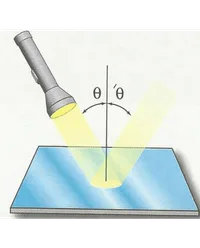

Angle of incidence = angle of reflection
𝜃i=𝜃r
First :Reflection of light
The second law of reflection
22


The figure shows two mirrors with an angle of
1200 .
A beam of light fell on the mirror (M1) at an
angle of 650with the normal.
Find the direction of the ray reflected from
mirror (M2).
Exercise (2)
5 min.
23
Multiple Choice
What is the angle for the ray deflected from mirror M2?
55
65
45
35
24


In your group, think if the two laws
of reflection apply in the case of
irregular reflection?
Think
3 min.
25

“image” you
“real” you
Plane mirrors
First :Reflection of light
26


•If the angle is between the two mirrors is 900,the
reflected rays return to the light source so that
they are parallel to their original path (Retro-
Reflection Phenomenon)
•We notice that each of the two rays was reflected
three times until it bounced parallel to the original
ray.
Applications on the second law for reflection
First :Reflection of light
27


Curved mirrors are mirrors whose surface consists
of a small part of a sphere. Images are formed in
these mirrors according to the law of reflection, but
the nature of the image in this case is different,
and curved mirrors are divided into two types.
•Concave mirrors
•Convex mirrors
Images formed by reflection in
curved mirrors
M
M
Origin axisY
Concave
mirror
Convex
mirror
Nq
Nq
Secondary axisY
Q
Q
28


The location and nature of the images formed by curved mirrors
can be determined by drawing two of three rays that can be
easily drawn and are shown, respectively, as follows:
1.
A ray passing through the center of curvature is reflected
back on itself.
2.
A ray parallel to the original axis and reflected at the focus.
3.
A ray passing through the focus is reflected parallel to the
original axis.
Images formed by reflection in
curved mirrors
29


When the mirror is convex ,where its
focus is virtual ,all images formed of the
object are virtual images, and the
following figure shows one of these
cases.
Images formed by reflection in
curved mirrors
All images formed arevirtual images
F
C
30


Use the following simulation to study the characteristics of the
images formed in curved mirrors (convex and concave), then
summarize the most important characteristics in the table:
Technology activity
Object position
Characteristics
The object is very far away
The object is far more than twice the focal length
The object is twice as far away from focal length( At the center of curvature)
The object is at a greater distance than the object focal length and smaller than twice the focal length
The object is placed at less than the focal length
5 min.
31
Open Ended
https://phet.colorado.edu/sims/html/geometric-optics/latest/geometric-optics_all.html
Using the above link, briefly describe the characteristics of each object position.
32


B
M
B
M
B
M
B
MB
Object position
The drawing
Image properties
The object is very far away
As small as possible / real
at the focus
The object is atmore than twice the
focal length
Real / inverted /miniature
Between the focus and the center
of curvature
The obejct is tat wice as far away
from focal length (At the center of
curvature)
Real / inverted / equal to the body
at the center of curvature
The object is at a greater distance than the object’s focal length and smaller than twice the focal length
Real/inverted/magnified
At a farther distance from the
center of the curvature
The object is at less than the focal
length
Virtual / moderate / magnified
You see inside the mirror
Images created by concave mirrors
33

Break
34


It is the change in the path of light when
it moves from one transparent medium
to another transparent medium.
Second :Refraction of light
35


Think - Share - Discuss
Interpret: The speed of light in air 3.00 x
108m/s But this speed decreases to
approximately 2 x 10⁸m/s when light enters the
glass.
What causes refraction of light?
Second :Refraction of light
5 min.
36


What causes refraction of light?
Second :Refraction of light

37
Multiple Choice
What causes the refraction of light?
If light falls from a less dense medium to a more dense medium, it will be refracted near the normal.
If light falls from a medium with greater density to a medium with less density, it will be refracted away from the normal.
The angle q2Known as the angle of refraction.
When light enters inside the glass the light is absorbed by the atom A which causes the electrons to vibrate and move.
These electrons emit light rays towards the atom B where light is absorbed again, which allows slowing down of light rays.
Both answers are correct
38


The angle of refraction depends on:
Characteristics of the two media
Angle of incidence, according to the relationship:
sin 𝜃2
sin 𝜃1
= constant
where
v1:The speed of light in the first medium
V2: The speed of light in the second medium
Second :Refraction of light
v2
v1
=
39


Index of refraction (n):
Where (n) :
-has no unit
-n >1 because v is always less than c.
Index of refraction
𝑛 = 𝑙𝑖𝑔ℎ𝑡 𝑠𝑝𝑒𝑒𝑑 𝑖𝑛 𝑎𝑖𝑟 𝑜𝑟 𝑣𝑎𝑐𝑢𝑢𝑚
𝑙𝑖𝑔ℎ𝑡 𝑠𝑝𝑒𝑒𝑑 𝑖𝑛 𝑚𝑒𝑑𝑖𝑢𝑚
𝑣
Second :Refraction of light
=
𝑐
40


When a wave travels from the first
medium to the second medium, the
wavelength changes while the frequency
remains constant.
𝜆1𝑛1 = 𝜆2𝑛2
Index of refraction
Second :Refraction of light
41


The first law:the incident ray, the refracted
ray, and the normal to the interface of two
media at the point of incidence all lie on the
same plane.
Laws of refraction
Second :Refraction of light
42


The second law (Snell’s law):
𝑛1 𝑠𝑖𝑛 𝜃1 = n2sin 𝜃2
Special case:
If light falls from air with index of refraction (n1=1) to
the medium with index of refraction(n2=n), then:
Laws of refraction
Second :Refraction of light
43


Using Snell’s law, track the path of the light
rays in the two figures (A) and (B) ,and
explain:
1- In which of the two figures is the ray
refracted approaching the normal?
2- In which of the two figures is the angle of
refraction greater than the angle of
incidence?
Exercise (3) - Individually
B
A
5 min.
44


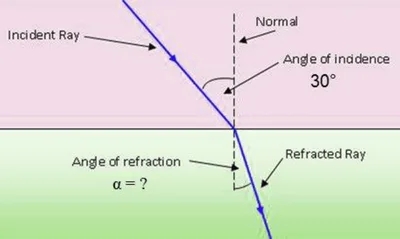
A light ray traveling through the air, fell on
a glass surface n=1.52 at an angle of 30
degrees, as in the figure, find the angle of
refraction.
Question
5 min.
45
Multiple Choice
A light ray traveling through the air, fell on a glass surface n=1.52 at an angle of 30 degrees, as in the figure, find the angle of refraction.
19.2
31.5
9.2
12.9
46


A light ray traveling through the air, fell on
a glass surface n=1.52 at an angle of 30
degrees, as in the figure, find the angle of
refraction.
Question
5 min.
47


Calculate the speed of light emitted at a
plastic disc with index of refraction n=1.55
and wavelength of light in air = 780 nm.
Calculate the wavelength of light inside
the plastic disc.
Question
5 min.
48
Multiple Choice
Calculate the speed of light emitted at a plastic disc with index of refraction n=1.55 and wavelength of light in air = 780 nm.
1.24 x 10^8 m/s
1.94 x 10^5 m/s
1.94 x 10^8 m/s
1.24 x 10^5 m/s
49
Multiple Choice
Calculate the wavelength of light inside the plastic disc with index of refraction n=1.55 and wavelength of light in air = 780 nm.
405 nm
503 nm
305 nm
803 nm
50

Calculate the speed of light emitted at a
plastic disc with index of refraction n=1.55
and wavelength of light in air = 780 nm.
Calculate the wavelength of light inside
the plastic disc.
Question
5 min.
51


A ray of light fell from the water (n1=1.33) at an
angle(θ1=600) on a glass surface (n2=1.52)
Find:
1- The direction of the reflected beam (Θr = ?)
2- The direction of the refracted ray (Θ2= ?)
Question
5 min.
52
Multiple Choice
What are the values for Θr and Θ2 ?
Θr = 60°
Θ2 = 49.27°
Θr = 40°
Θ2 = 49.27°
Θr = 60°
Θ2 = 69.27°
53
A ray of light fell from the water (n1=1.33) at an
angle(θ1=600) on a glass surface (n2=1.52)
Find:
1- The direction of the reflected beam (Θr = ?)
2- The direction of the refracted ray (Θ2= ?)
Question
5 min.

54


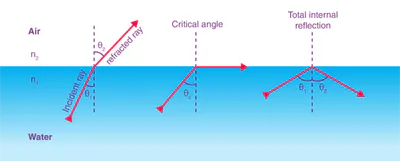
The first law: the incident ray, the
refracted ray, and the normal to the
interface of two media at the point of
incidence all lie on the same plane.
Total Internal Reflection
55


• The angle of incidence (in the denser medium)
corresponding to the largest possible angle of refraction (90 degrees) is called the critical angle.
• If the angle of incidence exceeds the critical angle,
the ray is refracted within the same medium of
incidence ,this is known as total internal reflection.
• The critical angle Θc by substituting Θ2 with 90o in
Snell’s law:
n2>n1
1
2
2
1
2
1
2
2
1
1
sin
sin
90sin
sin
sin
sin
n
n
n
n
n
n
n
n
c
c
c
=
=
=
=
Total Internal Reflection

56


If light falls from inside sea
water(n1=1.33) to the air outside (n2=1).
Calculate the critical angle.
Solution:
Question
Sinθc=1÷1.33=0.75188
θc=sin-1(0.75188)=48.70
1
2
sin
n
n
c =
5 min.

57


When hit by light rays, convex and concave
lenses reflect light differently.
Images Formed by Refraction
58


Use the following simulation to study the characteristics of the
images formed in curved mirrors (convex and concave), then
summarize the most important characteristics in the table:
Technology activity – In pairs
Object position
Characteristics
The object is very far away
The object is far more than twice the focal length
The body is twice as far away from focal length( At the center of curvature)
The object is at a greater distance than the object focal length and smaller than twice the focal length
The object is placed at less than the focal length
5 min.
59
Open Ended

Use the following simulation to study the characteristics of the images formed in curved mirrors (convex and concave), then summarize the most important characteristics in the table: https://phet.colorado.edu/sims/html/geometric-optics/latest/geometric-optics_all.html
60


• Using the following figure, we find that
there is a relationship between the
position of the object S, the location of
the image S’ and focal length f. The
similarity of the two triangles FP'Q',
FOA we find that:
• The similarity of the two triangles OP’Q’
and OPQ we find that:
• By comparing (1) and (2) we find that:
General law - Mirrors and Lenses
)1(
'
'
'
''
f
fs
y
y
FO
FP
OA
QP
−
=
=
)2(
'
'
'
''
S
S
y
y
PO
OP
PQ
QP
=
=
f
S
S
Sf
S
f
S
f
fS
S
S
1
'
1
1
'
1
1
1
1
'
'
'
=
+
−
=
−
=
−
=

61

Although the previous equation was derived for the lens, we can derive it for the
diverging lens, as well as for the convex and concave mirror.
When using this law, the following must be taken into account:
1.
Focal length f is positive in the case of the concave mirror and the convex lens, and it is negative in the case of the convex mirror and the concave lens.
2.
Distance of the object S is positive if the body is real, and it is negative if the object is virtual.
3.
Distance of the image S’ is positive if the image is real and negative if the image is virtual.
4.
All distances S’-S- f are measured from the center of the mirror or lens.
General law - Mirrors and Lenses
62


Place an object of length 5cm 40cm away
from a concave mirror with a focal length
of 15cm.
Calculate the distance and length of the
image as well as the magnification in the
mirror
cm
y
y
S
S
y
y
m
cm
S
S
f
S
f
S
S
35
40
24
'
40
24
5
'
'
'
24'
..........
600
25
40
1
15
1
1
1
'
1
1
'
1
1
=
=
=
=
=
=
=
−
=
−
=
=
+
Question
5 min.

63
Multiple Choice
Place an object of length 5cm 40cm away from a concave mirror with a focal length of 15cm.
Calculate the distance and length of the image.
Distance = 24 cm
Length = 5 cm
Distance = 14 cm
Length = 5 cm
Distance = 24 cm
Length = 3 cm
Distance =14 cm
Length = 3 cm
64
Place an object of length 5cm 40cm away
from a concave mirror with a focal length
of 15cm.
Calculate the distance and length of the
image as well as the magnification in the
mirror
cm
y
y
S
S
y
y
m
cm
S
S
f
S
f
S
S
35
40
24
'
40
24
5
'
'
'
24'
..........
600
25
40
1
15
1
1
1
'
1
1
'
1
1
=
=
=
=
=
=
=
−
=
−
=
=
+
Question
5 min.

65


The magnification of the lens or mirror can be
expressed in the equation below:
Magnification of Lenses and Mirrors
S
S
y
y
m
'
' =
=

66
Digital Platforms Evaluation- Science Teachers
2024
https://forms.office.com/r/7Rfka8HNgP
67


Exit card
• Something new I learned today. . . . . . . . .
• Something I would love to know more
about. . . .
• One of the benefits I gained from today's
training. . . . .
3 min.
68
Open Ended

Please complete the exit ticket
69
Poll
Please rate today's training session out of 5
1
2
3
4
5
70


References
• https://www.pbslearningmedia.org/collection/universe/topic/waves/
• Principles of Optics: 60th Anniversary Edition 7th Edition
• https://www.bartleby.com/subject/science/physics/concepts/mirrors-
and-lenses
71

Thanks
Engineering Optics
Waves, mirrors and lenses
March 2024
Show answer
Auto Play
Slide 1 / 71
SLIDE
Similar Resources on Wayground

66 questions
Blood
Presentation
•
12th Grade
64 questions
Review of Physical Science Content
Presentation
•
12th Grade
69 questions
Anatomy & Physiology: Muscular System Review
Presentation
•
11th - 12th Grade
67 questions
Magnetism Review
Presentation
•
11th - 12th Grade
63 questions
Untitled Presentation
Presentation
•
KG - University
69 questions
Physiology
Presentation
•
11th - 12th Grade
69 questions
Muscle Terminology
Presentation
•
11th - 12th Grade
63 questions
Growth and Development W1
Presentation
•
KG - University
Popular Resources on Wayground
20 questions
STAAR Review Quiz #3

Quiz
•
8th Grade
20 questions
Equivalent Fractions
Quiz
•
3rd Grade
6 questions
Marshmallow Farm Quiz
Quiz
•
2nd - 5th Grade
20 questions
Main Idea and Details
Quiz
•
5th Grade
20 questions
Context Clues
Quiz
•
6th Grade
20 questions
Inferences
Quiz
•
4th Grade
19 questions
Classifying Quadrilaterals
Quiz
•
3rd Grade
12 questions
What makes Nebraska's government unique?
Quiz
•
4th - 5th Grade
Discover more resources for Science
46 questions
Unit 4 Geosphere Test Review
Quiz
•
9th - 12th Grade
10 questions
Explore Genetic Drift and Its Effects-March madness week 4
Quiz
•
9th - 12th Grade
20 questions
9B Fossil Record Vocabulary.S26
Quiz
•
9th - 12th Grade
13 questions
Amoeba Sisters: Biomolecules

Interactive video
•
9th - 12th Grade
20 questions
Climate Change
Quiz
•
6th - 12th Grade
26 questions
Adaptation and Natural Selection
Quiz
•
9th - 12th Grade