

Greek Plays

Presentation
•
English
•
10th Grade
•
Medium
+9
Standards-aligned

Gladys Villamor
Used 19+ times
FREE Resource
4 Slides • 10 Questions
1

2
3
Multiple Choice
What form of dialogue do Greek plays typically use?
Prose dialogue
Verse drama
Silent mime
Improvisational dialogue
4
Multiple Choice
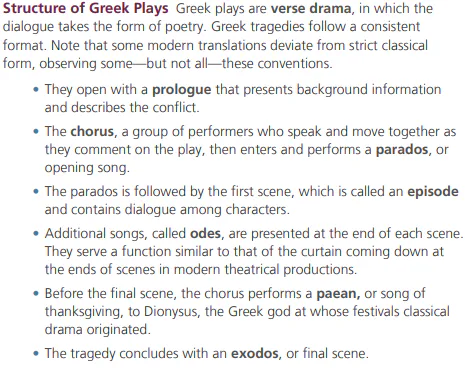
What is the purpose of the prologue in Greek plays?
To present the final scene
To introduce the actors
To present background information and describe the conflict
To thank the audience
5
Multiple Choice
What is the chorus in Greek plays?
The main character
A group of performers who speak and move together
The audience members
The narrator of the play
6
Multiple Choice
What is an episode in the context of Greek plays?
The final scene
A song performed by the chorus
The first scene following the parados
A dance performed by the actors
7
Multiple Choice
What are odes in Greek plays?
Additional songs presented at the end of each scene
The opening song of the play
The name of the Greek god honored by the plays
The final scene of the play
8

9

10
Multiple Choice
According to Aristotle, what is a tragedy?
A comedy play that ends with a happy resolution.
A serious play recounting related events in the life of a renowned and prosperous person who experiences a downfall.
A historical account of wars and victories.
A mythological story with a focus on heroic deeds.
11
Multiple Choice
Who is often the central character in a Greek tragedy?
The antagonist.
The tragic hero or protagonist.
A supporting character with a minor flaw.
A comedic relief character.
12
Multiple Choice
What can the tragic flaw of the protagonist be attributed to?
A magical curse.
Innate character weakness or a simple mistake.
The will of the gods.
The actions of the antagonist.
13
Multiple Choice
What role does the antagonist play in a Greek tragedy?
Provides comic relief to the audience.
Helps the protagonist achieve their goals.
Is in conflict with the protagonist and contributes to their downfall.
Guides the protagonist to make the right decisions.
14
Multiple Choice
What is dramatic irony in the context of Greek tragedies?
When the audience knows less than the characters on stage.
When the characters on stage are aware of their own fate.
A contradiction between what a character thinks and what the audience knows to be true.
The use of irony to create comedic situations.
Show answer
Auto Play
Slide 1 / 14
SLIDE
Similar Resources on Wayground

10 questions
Lessons 11–12 Fitness for fun
Presentation
•
10th Grade
12 questions
Central Idea
Presentation
•
10th Grade
9 questions
Run-Ons
Presentation
•
10th Grade
10 questions
Types Of Nouns
Presentation
•
10th Grade
11 questions
future perfect
Presentation
•
9th Grade
11 questions
GLOBALIZATION
Presentation
•
10th Grade
13 questions
An Opinion Essay
Presentation
•
10th Grade
12 questions
COMMUNICATION
Presentation
•
10th Grade
Popular Resources on Wayground
10 questions
How much do you know about our Portrait of an Eagle?

Quiz
•
10th Grade
10 questions
Fast Food Slogans
Quiz
•
6th - 8th Grade
21 questions
Continents and Oceans
Quiz
•
6th Grade
20 questions
Parts of Speech
Quiz
•
5th Grade
16 questions
Subject & Predicate
Quiz
•
5th Grade
25 questions
Multiplication Facts
Quiz
•
5th Grade
12 questions
Map Skills
Quiz
•
3rd Grade
22 questions
Continents and Oceans
Quiz
•
5th Grade
Discover more resources for English
20 questions
Context clues
Quiz
•
10th Grade
15 questions
ENG 10 Grammar: 18.1 Prepositions or Adverbs P. 34
Quiz
•
10th Grade
10 questions
Making Inferences and Drawing Conclusions

Interactive video
•
6th - 10th Grade
10 questions
Crafting an Effective Thesis Statement
Interactive video
•
6th - 10th Grade
10 questions
Exploring Coordinating Conjunctions with FANBOYS
Interactive video
•
6th - 10th Grade
10 questions
Distinguishing Theme and Main Idea
Interactive video
•
6th - 10th Grade
20 questions
Subject Verb Agreement
Quiz
•
10th Grade
10 questions
Identifying Simple, Compound, and Complex Sentences
Interactive video
•
6th - 10th Grade