

Nuclear Test Review Slides

Presentation
•
Chemistry
•
9th - 12th Grade
•
Practice Problem
•
Easy

Shayne Walker
Used 3+ times
FREE Resource
4 Slides • 3 Questions
1
Nuclear Reactions: Reactions that affect the nucleus of the atom.
Examples: Fusion, Fission, Alpha Decay, Beta Decay, Positron Decay, Gamma Decay
Chemical Reaction: Reactions involving the electrons of atoms. These do not affect the nucleus!
Examples: Ionic Bonding, Covalent Bonding
2
Alpha Decay: The parent nucleus releases 2 protons and 2 neutrons (alpha particle)
Beta Decay: A neutron turns into a proton, releasing an electron (beta particle)
Nuclear Decay: Reactions which release radiation

Gamma Decay:
An excited nucleus releases energy (gamma ray)
Positron Decay: A proton turns into a neutron, releasing a positive charge (positron)


3
Match
Match the following diagrams to the appropriate type of nuclear decay:
Alpha Decay
Beta Decay
Gamma Decay
Positron Decay
Alpha Decay
Beta Decay
Gamma Decay
Positron Decay
4
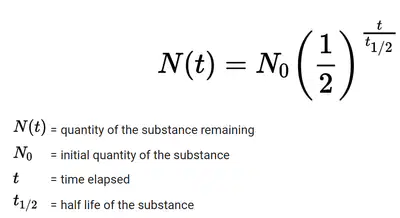
Half-life is a measure of how long it takes for a material to decay by half. For carbon-14, it takes about 5700 years for half the sample to decay.
Half-Life

5
Math Response
Scientists aim to predict how much Carbon-14 will remain in a small sample after a set period of time. Currently, they have 1.0 gram of Carbon-14 (N0). The known half-life of Carbon-14 is 5700 years (t½).
Using the half-life equation, predict how many grams of Carbon-14 will remain after 8000 years of decay N(t).
(Round to 2 significant digits)
6
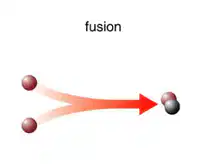
Two light nuclei fuse to form a single large nucleus.
Releases more energy than both fission and chemical reactions.
Electromagnetic forces cause nuclei to repel, making fusion difficult on earth.
The gravitational force of the sun pushes nuclei close enough together to lock together and fuse
Fusion
A free neutron collides with an unstable heavy nucleus, splitting it into two lighter nuclei and free neutrons.
Fission tends to occur in chain reactions, meaning that one fission reaction tends to trigger another.
Releases more energy than chemical reactions, but less than fusion reactions.
Fission

7
Reorder
Organize the following reaction types from lowest to highest energy (left to right)
Chemical Reactions
Fission Reactions
Fusion Reactions
Nuclear Reactions: Reactions that affect the nucleus of the atom.
Examples: Fusion, Fission, Alpha Decay, Beta Decay, Positron Decay, Gamma Decay
Chemical Reaction: Reactions involving the electrons of atoms. These do not affect the nucleus!
Examples: Ionic Bonding, Covalent Bonding
Show answer
Auto Play
Slide 1 / 7
SLIDE
Similar Resources on Wayground

6 questions
Decomposition Reactions
Presentation
•
10th Grade - University
6 questions
People in Art History
Presentation
•
9th - 12th Grade
4 questions
Balancing Redox in Basic Solution
Presentation
•
10th - 11th Grade
7 questions
Key Signature Review
Presentation
•
9th - 12th Grade
3 questions
tiền tố (prefixes)
Presentation
•
9th - 12th Grade
7 questions
How to tell time
Presentation
•
KG
10 questions
Burning Fuels and Combustion
Presentation
•
9th - 12th Grade
4 questions
Chem Unit 1 Summative Exam CER Portion
Presentation
•
9th - 12th Grade
Popular Resources on Wayground
24 questions
PBIS-HGMS Day 10

Quiz
•
6th - 8th Grade
10 questions
HCS SCI 03 Summer School Review 3
Quiz
•
3rd Grade
11 questions
Home Scope
Quiz
•
7th - 8th Grade
15 questions
HCS SCI 05 Summer School Assessment 3 Review
Quiz
•
5th Grade
35 questions
Lufkin Road Middle School Student Handbook & Policies Assessment
Quiz
•
7th Grade
18 questions
Geo 11.3 Area of Circles and Sectors
Quiz
•
9th - 11th Grade