Search Header Logo
SOL FINAL REVIEW

SOL FINAL REVIEW

Assessment

Presentation

Biology

10th Grade

Hard

Created by

M Weech

Used 4+ times

FREE Resource

13 Slides • 84 Questions

1

media

2

Open Ended

Are you ready for your SOL?

3

Multiple Choice

Cell theory is a result of the contributions of several different scientists, and applies to all living things. Which of the following explains why cell theory will not ever become the law of cells?

1

Cells of different organisms are so diverse that it is impossible to come up with a law that would apply to all of them.

2

Because cells undergo change as mutations occur within them, developing anything beyond a cell theory would be impractical.

3

Scientific theories are well-tested explanations, while laws are well-tested descriptions of natural phenomena; one cannot become the other.

4

Scientific theories can only become laws if all possible cases can be tested; it would be impossible to test all living things to see if they have cells.

4

Multiple Choice

What structures are common in all prokaryotic and eukaryotic cells?

1

cell wall, ribosomes and nucleus

2

cell membrane, nucleus, mitochondria

3

cell membrane, cytoplasm and ribosomes

4

chloroplast, cell membrane and cytoplasm

5

Multiple Choice

Which statement correctly explains a difference between the cells of prokaryotes and the cells of eukaryotes?

1

Eukaryotic cells have a nucleus and membrane-bound organelles; prokaryotic cells lack these features.

2

Eukaryotic cells have fewer distinct parts than prokaryotic cells because they are less evolved.

3

Eukaryotic cells do not have cell walls or vacuoles; prokaryotic cells have both of these features.

4

Eukaryotic cells reproduce using DNA; prokaryotic cells use RNA only to reproduce.

6

Match

Question image

Match the following

L

B

I

N

C

Mitochondria

Cytoplasm

Vacuole

Lysosome

Nucleus

7

Match

Match the following

portion of the cell that includes the fluid and organelles outside the nucleus

involved in cell division; only in animal cells

"intracellular highway" that moves molecules from one part of the cell to another

storage area inside a cell

powerhouse of the cell; responsible for cellular respiration

cytoplasm

centrioles

endoplasmic reticulum (ER)

vacuole

mitochondria

8

media

9

Multiple Choice

___________ have 2 functions in the cell membrane.
1.) They act like gatekeepers, only let certain things in. 
2.) Enzyme receptors embedded in the membrane.
1
Carbohydrates 
2
Proteins 
3
Phospholipids 
4
Cholesterol

10

Multiple Choice

___________ form the two layers of the cell membrane. 
1
Carbohydrates 
2
Proteins 
3
Phospholipids 
4
Cholesterol

11

Multiple Choice

"Water Fearing" 
1
Hydrophobic
2
Hydrophilic 
3
Hydroelectric 
4
Hydroloric

12

Multiple Choice

"Water Loving"
1
Hydrophobic
2
Hydrophilic 
3
Hydroelectric 
4
Hydroloric

13

Multiple Choice

What is embedded in the phospholipid bilayer?
1
Proteins
2
Salt
3
Water
4
Worms

14

Multiple Choice

Question image

What is the role of cholesterol molecules in the cell membrane?

1

provide flexibility

2

provide rigid support

3

make cells hydrophobic

4

transport molecules in and out of cell

5

recognize other cells

15

Multiple Choice

During osmosis
1
water moves from high to low concentration
2
large or oddly shaped molecules move across a cell membrane
3
water moves when energy is used
4
proteins are built

16

Multiple Choice

When both inside and outside of a cell have the same amount of water it is said that the cell has reached a state of
1
Osmosis
2
Diffusion
3
Equilibrium

17

Multiple Choice

Question image
What is the definition of  Selective Permeability?
1
The movement of materials across the cell membrane that requires NO ENERGY from the cell.
2
The movement of materials through (or across) the cell membrane
3
The ability of the cell membrane to allow some things to pass through while preventing other things from passing through.
4
The movement of molecules from an area of high concentration to a area of low concentration 

18

media

19

Multiple Choice

A person should never drink salty water because their cells would
1
shrink
2
expand

20

Multiple Choice

A person would never have pure water put into their veins in a hospital because their cells would...
1
Shrink/Dehydrate
2
Expand

21

Match

Match the following processes to the illustration:

Diffusion

facilitated diffusion

active transport

exocytosis

endocytosis

22

Match

Match the following

oxygen & carbon dioxide move into and out of blood and lungs

insulin produced and pushed out of cell in vesicles

cell pulls in glucose to produce ATP

white blood cells engulf and destroy invading bacteria

water moves out of plant cells when plant watered with salt solution

diffusion

exocytosis

active transport

endocytosis

osmosis

23

media

24

Multiple Choice

DNA and RNA are examples of 
1
Carbohydrates
2
Lipids
3
Proteins
4
Nucleic Acids

25

Multiple Choice

Waxes, oils and fats are examples of
1
Carbohydrates
2
Lipids
3
Proteins
4
Nucleic Acids

26

Multiple Choice

Why are lipids insoluble in water?  
1
lipids are polar
2
lipids are non-polar
3
lipids have a negative charge
4
lipids are building blocks of protiens

27

Multiple Choice

Which of the following is an INCORRECT match of the carbohydrate with its function?
1
sugar transport in plants--disaccharides
2
energy storage in plants--starches
3
energy storage in plants--lactose
4
sugar transport in humans--glucose

28

media
media

​ Enzymes

29

Denaturation = to lose shape

  • Structure (shape) = function

  • If enzymes lose their shape they no longer function correctly

  • Lower enzyme function = slower reaction rates

  • Factors that can affect shape & function of enzymes: Temperature And pH

media

30

Multiple Choice

Question image
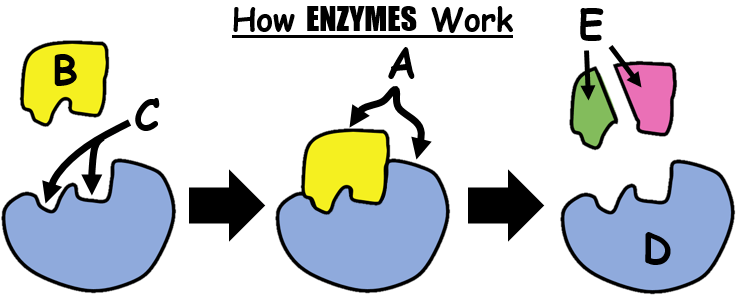
Letter D...
1
active site
2
enzyme
3
substrate
4
products

31

Multiple Choice

Question image
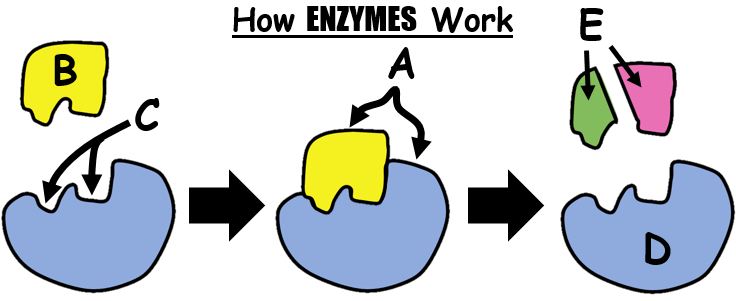
In the diagram, what is letter A? 
1
product
2
substrate
3
enzyme-substrate complex
4
active site

32

Multiple Choice

After the enzyme and substrate bind together and perform the reaction, what does the substrate become?
1
a substrate
2
an enzyme
3
a product
4
an active site

33

Multiple Choice

At very high temperatures, most enzymes do not increase the rate of the reactions they regulate. What is the most likely reason for this lack of enzyme activity at very high temperatures?

1

The enzyme denatures and can no longer function properly.

2

The enzyme would have already broken down at a much lower temperature.

3

The products would have already been used up in the reaction by the time it reaches that high temperature.

4

The enzyme would have already sped up the rate of reaction as much as it could and would not be affected by the increase in temperature.

34

Multiple Choice

What happens when enzymes are heated to a high temperature?
1
The enzymes die.
2
The shapes of the enzyme are altered denature
3
The enzymes' amino acid sequence changes.
4
The enzymes remain the same

35

Multiple Choice

Question image

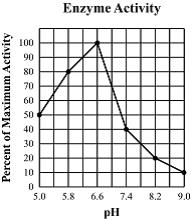
Which of the following conclusions can be drawn from this graph?
Optimum = best

1
The optimum pH of the enzyme is 6.6.
2
The optimum pH of the enzyme is 5.8
3
The enzyme’s activity increases as pH increases 5.0 to 9.0
4
The enzyme’s activity is greater around pH of 8.0 .

36

Multiple Choice

As food travels through the digestive system, it is exposed to a variety of pH levels. The stomach has a pH of 2 due to the presence of hydrochloride acid (HCl), and the small intestine has a pH ranging from 7 to 9. HCl converts pepsinogen into pepsin, an enzyme that digests proteins in the stomach. Which of the following most likely happens to pepsin as it enters the small intestine?
1
 It becomes inactive.
2
It begins to replicate.
3
 It's shape changes to engulf large proteins.
4
It's activity increases to digest more proteins.

37

Multiple Choice

Question image
The activity of which enzyme decreases in both acidic and basic environments?
1
chymotrypsin
2
pepsin
3
 cholinesterase
4
papain

38

Multiple Choice

Question image
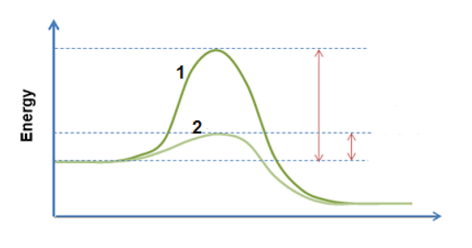
Which line represents an enzyme-catalyzed reaction? 
1
Line 1
2
Line 2

39

media

40

Multiple Choice

A possible explanation to a problem that has not yet been tested. 
1
data
2
theory
3
hypothesis
4
fact

41

Multiple Choice

An experiment is performed on plants to see how different liquids affect plant growth. Each plant in the experiment is given a different liquid; water, apple juice, or milk. Each plant has the same amount of soil, sunlight, and listens to the same music. In this investigation, the independent variable is ...
1
The type of plant
2
The amount of sunlight
3
The type of music
4
The type of liquid

42

Multiple Choice

Testing a hypothesis often involves a(n):
1
answer
2
experiment
3
problem
4
safety check

43

Multiple Choice

An experiment is performed on plants to see how different liquids affect plant growth. Each plant in the experiment is given a different liquid; water, apple juice, or milk. Each plant has the same amount of soil, sunlight, and listens to the same music. In this investigation, what are the controlled variables?
1
Type of plant, amount of music, and sunlight
2
Water, apple juice, milk
3
Plant growth

44

Multiple Choice

Question image

Mr. S. sets up an experiment to see how the mass of a ball affects the distance it rolls off a ramp. Identify the independent variable.

1

distance traveled by the ball

2

height of the ramp

3

mass of the ball

4

weight of the ball

45

Multiple Choice

Question image

Why do scientist use the scientific method?

1

To make sure they get credit for their discoveries.

2

To make sure their results are valid and can be performed by other scientists.

3

So that other scientist don't get mad at them

46

Multiple Choice

A scientist hypothesizes the the temperature at which an alligator's egg is incubated will determine whether the alligator will be male or female. The dependent variable is
1
the size of the baby alligators
2
the gender of the baby alligators
3
the incubator
4
the temperature

47

Multiple Choice

When you decide whether or not the data supports the original hypothesis, you are
1
drawing conclusions
2
forming a hypothesis
3
asking questions
4
making observations

48

Multiple Choice

Question image
In this graph, what is the independent variable? 
1
Population
2
Day
3
Species 5

49

Multiple Choice

An experiment is performed on plants to see how different liquids affect plant growth. Each plant in the experiment is given a different liquid; water, apple juice, or milk. Each plant has the same amount of soil, sunlight, and listens to the same music. In this investigation, what is the dependent variable?
1
Type of plant
2
Water, apple juice, milk
3
Plant growth
4
Color of the plant's leaves

50

Multiple Choice

There are two types of data. Which type of data involves descriptions that cannot be counted or measured?
1
qualitative
2
quantitative

51

Multiple Choice

What is NOT an example of qualitative data?

1

The names of chemicals found in a breakfast cereal

2

Types of shoes worn by pedestrians on a city street

3

The zip codes in which each high school student resides

4

The average high daily temperature for the month of July

52

Multiple Choice

Question image

The graph below shows atmospheric carbon dioxide levels since the year 1880.Which of the following conclusions can be drawn from this graph

1

Atmospheric carbon dioxide levels are responsible for global temperature change.

2

Atmospheric carbon dioxide levels have been rising at about the same rate for the past century.

3

Atmospheric carbon dioxide levels have remained the same over the past century.

4

Atmospheric carbon dioxide levels have been rising at an increasingly higher rate as the past century has progressed.

53

Multiple Choice

An experiment was carried out to determine whether drinking caffeinated soda increases pulse rate. The pulse rates of two groups of people at rest were measured. Group A was then given caffeinated soda and group B was given caffeine-free soda. One hour after drinking the soda, the pulse rates were measured. The participants in the experiment were all the same age, and they were all given the same amount of soda. The dependent variable in this experiment is the

1

type of soda given to each group

2

amount of soda given to each group

3

pulse rate of each group

4

age of participants in each group

54

Multiple Choice

A testable question should include what two things?

1

A hypothesis and question

2

A question and a dependent variable

3

An independent variable but no dependent variable

4

An independent variable and a dependent variable

55

media

56

Multiple Choice

What do you need to be able to see bacteria?

1

Microscope

2

Telescope

3

Sunglasses

4

3D Glasses

57

Multiple Choice

Question image

Which of these statements is true?

1

A virus is unicellular, it has only one cell.

2

A virus may sometimes be multicellular, have many cells.

3

A virus has no cells

58

Multiple Choice

A viruses are considered

1

Living

2

Non-living

59

Multiple Choice

Viruses require a host cell to

1

Breathe and eat

2

Replicate

3

Move and sleep

4

Make protein and carbohydrates

60

Multiple Choice

Which of the following is true?

1

Viruses and bacteria are both prokaryotes.

2

Bacteria are eukaryotes and viruses are prokaryotes.

3

Some bacteria are prokaryotes and some are eukaryotes.

4

All bacteria are prokaryotes.

61

Multiple Choice

A disease causing microorganism such as fungi, protozoans, parasites, bacteria, and viruses.

1

Pathogen

2

Infectious Disease

3

Virus

4

Bacteria

62

Multiple Choice

A substance that blocks the production of bacteria or treats bacterial infections is called?
1
Asprin
2
Antibiotic
3
Band-Aid

63

media

64

Multiple Choice

Question image

What kingdom does yeast belong to?

1

Kingdom Animalia

2

Kingdom Plantae

3

Kingdom Protista

4

Kingdom Fungi

5

Kingdom Eubacteria

65

Multiple Choice

Question image
What species is bird C?
1
Dunliin
2
Osprey
3
Bald Eagle
4
Baird's Sparrow

66

Multiple Choice

Question image
What bird is the closest relative to bird K?
1
D
2
J
3
H
4
B

67

Multiple Choice

Question image
Do salamanders have claws?
1
Yes
2
No
3
Maybe

68

Multiple Choice

Most inclusive taxon (Bacteria, Archaea, Eukarya)

1

KIngdom

2

Domain

3

Eukaryote

4

Dichotomous key

69

Fill in the Blank

An organism that makes its own food is called a ____________. Another word for producer.

70

Multiple Choice

Organisms that belong to the same _________ share the MOST DNA.
1
family
2
kingdom
3
genus
4
species

71

Multiple Choice

Mainly single celled eukaryotic cells that are plant-like, fungus-like, or animal-like (Example: algae, and amoeba)

1

Kingdom Bacteria

2

Kingdom Plantae

3

Kingdom Fungi

4

Kingdom Protista

72

Fill in the Blank

__________ is the second highest taxon including Archaebacteria, Eubacteria, Protista, Fungi, Plantae, Animalia.

73

Multiple Choice

Which organism is most closely related to Quercus rubrum?

1

Acer rubrum

2

Quercus macrophylla

74

Multiple Choice

Which of the following taxa contain the fewest members?

1

phyllum

2

family

3

genus

4

class

75

Multiple Choice

Which kingdoms have some organisms that can make their own food (autotrophic)?
1
Plantae and Animalia
2
Fungi and Plantae
3
Protista and Plantae

76

Multiple Choice

Organisms whose cells have NO nucleus are classified as...
1
Eukaryotic
2
Prokaryotic
3
Dead

77

Multiple Choice

Question image
Which domain is capable of living in extreme environments like hot springs, geysers, or very salty waters?
1
Bacteria
2
Archaea
3
Eukarya

78

Multiple Choice

Question image
According to this cladogram, birds are LEAST related to: 
1
Amphibians
2
Sharks
3
Ray Finned Fish
4
Crocodiles

79

media

80

media

81

Multiple Choice

Question image

In this image, the yellow shaded bones all appear similar in structure. However, their functions differ. Which describes the function of the yellow bones in the bat?

1

Fingers to grasp objects

2

Leg to walk on

3

Wing for flying

4

Fin for swimming

82

Multiple Choice

Which of these statements is true about DNA and evolution?

1

Two species that have the same DNA provide evidence that evolution has taken place.

2

Two species with very similar DNA likely evolved from a common ancestor.

3

Each living species has DNA made from different ingredients, showing that organisms have evolved.

4

DNA from related species is identical, providing evidence that all organisms have evolved in the same way.

83

Multiple Choice

Snakes have tiny leg bones that are not used for movement. What type of inference do scientists make when they observe these types of structures, which are reduced in size and function?

1

Snakes have adaptations for walking if the environment changes.

2

Snakes share a common ancestor with animals that use legs for walking.

3

Snakes share a common ancestor with organisms that have no leg bones.

4

Snakes have the same DNA as organisms that have no leg bones.

84

Multiple Choice

What genetic change allows organisms to survive natural selection in their environments? 
1
learned behavior
2
acquired traits
3
analogies
4
adaptations

85

Multiple Choice

This scientist came up with the idea of natural selection.
1
Jean Baptiste Lamarck
2
Gregor Mendel
3
Charles Darwin
4
Thomas Malthus

86

Multiple Choice

How many cells are produced as a result of meiosis?

1

2

2

4

3

6

4

8

87

Multiple Choice

Question image
Comparing human hemoglobin of chimpanzees, horses, kangaroos, and chickens, reveal that humans have the fewest amino acid differences with 
1
Kangaroos
2
Horses
3
chickens
4
chimpanzees

88

Multiple Choice

Question image

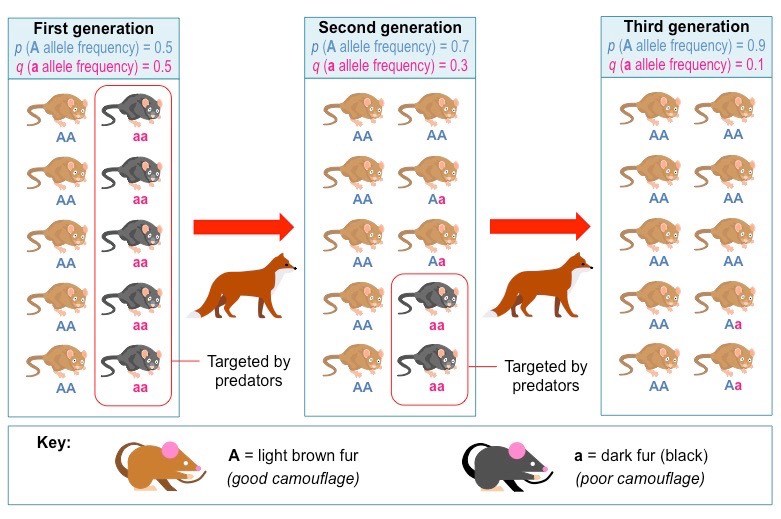
The allele frequencies of the mouse population in the picture are changing over time. Which is true?

1

The population is evolving.

2

The population is not evolving.

3

The population will go extinct.

4

The population's genetic variation is increasing.

89

Multiple Choice

When scientists compare the amino acid sequences for the red blood cell protein hemoglobin between various species, what can they determine about the evolutionary relationship between the species?

1

It can be determined how efficient hemoglobin is for different species.

2

It can determine relatedness between members of the same species.

3

It can provide evidence about the relatedness of different species.

4

It can show which species evolved first.

90

media

91

Multiple Choice

Question image

What is the order of the three phases in interphase?

1

G1, G2, S

2

S, G1, G2

3

G1, S, G2

4

G1, G2, G3

92

​ Cell Division

media

93

Multiple Choice

Both mitosis and meiosis

1

produce gametes

2

are involved in making new cells

3

occur in bacteria

4

produce Somatic cells

94

Multiple Choice

Question image

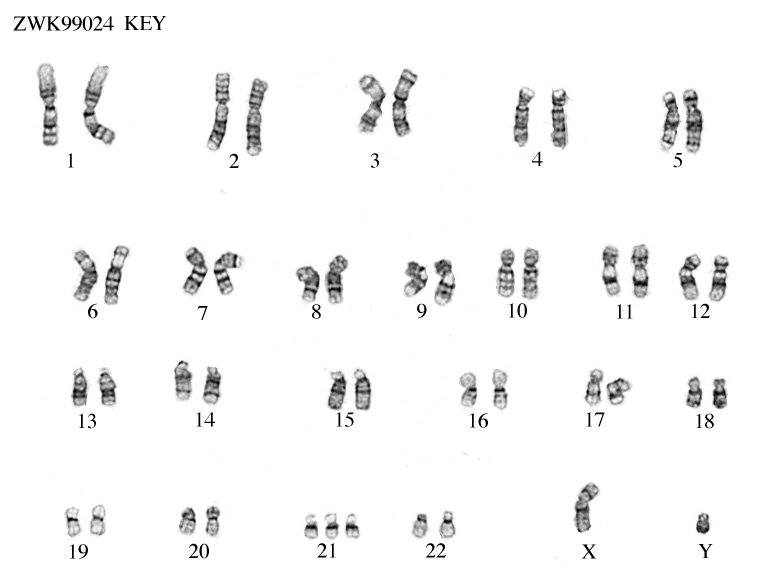
What is the mutation in this persons chromosomes?

1

There is only one X

2

7 is shaped like a hockey stick

3

There's an extra 21

4

1 is too curved

95

Fill in the Blank

What can happen if a person has too many or too few chromosomes? They will make too much or too little _______ which can result in a genetic disorder

96

Multiple Choice

What does diploid mean?

1

Two copies of chromosomes

2

1 copy of chromosomes

3

46 copies of chromosomes

4

23 chromosomes

97

Fill in the Blank

Question image

What is the combination of these two chromosomes called?

media

Show answer

Auto Play

Slide 1 / 97

SLIDE