Search Header Logo
Module 15 - Ecology Unit Review - Honors

Module 15 - Ecology Unit Review - Honors

Assessment

Presentation

Biology

9th - 12th Grade

Medium

NGSS
MS-LS2-4, MS-LS2-3

Standards-aligned

Created by

Susan Dodge

Used 2+ times

FREE Resource

13 Slides • 48 Questions

1

Ecology Review - Honors Bio

2

Ecology = the study of organisms and their relationship
with the environment (biotic and abiotic)

Biotic = living things, organisms in an ecosystem
- examples: fungi, bacteria, animals, plants, protists


Abiotic = non-living things in an ecosystem
- examples: rocks, temperature, water, rainfall, pH, minerals, nutrients

media
media
media
media
media

BE ABLE TO IDENTIFY biotic and abiotic factors in an ecosystem

3

Multiple Choice

Which thing is abiotic?

1

water

2

fungus

3

tree

4

human

4

Multiple Choice

Biotic can be defined as

1

the living parts of an ecosystem

2

non-living parts of an environment

3

rocks and water

4

snakes and water

5

​Organism - an individual of a certain species
Population - all organisms of the SAME SPECIES in a place
Community - all organisms of ALL species in a place. All the living things!
Ecosystem - the community + all the abiotic factors in a place

Biome - group of ecosystems that share similar climates and organisms
Biosphere - our entire planet & all its organisms.

​Organization of Life

media
media
media
media

BE ABLE TO put the terms in order from smalles to largest. Know their definitions.

6

Multiple Choice

Question image

The term used to include all of the living things PLUS all the non-living things together in a specific environment...

1

community

2

biosphere

3

habitat

4

population

5

ecosystem

7

Reorder

Put these in order from smallest to largest.

Organism

Population

Community

Ecosystem

Biome

1
2
3
4
5

8

ENERGY flows through an ecosystem.

  • The first source of energy = Sun!

  • With each energy conversion, HEAT is lost.

  • only 10% of energy moves from one trophic level to the next

MATTER (molecules and elements like carbon, nitrogen, oxygen, hydrogen) is recycled in an ecosystem.

media

EXPLAIN what gets recycled and what gets lost as heat in an ecosystem.

9

Multiple Choice

Matter, including nitrogen, is recycled in an ecosystem.

1

True

2

False

10

Multiple Choice

  1. Which of the following processes DECREASES the level of CO2 in the atmosphere?

1

Plant Respiration

2

Animal respiration

3

Burning of fossil fuels

4

Photosynthesis

11

Multiple Choice

The primary source of ENERGY for all terrestrial (land) and most aquatic (water) ecosystems is the _________.

1

moon

2

sun

3

batteries

4

12

Multiple Choice

How do most producers make their own food?

1

Using light energy to make carbohydrates

2

Using chemical energy to make carbohydrates

3

Changing water into carbon dioxide

4

Breaking down remains of organisms.

13

Multiple Choice

How would you classify plants?

1

Herbivore

2

Omnivore

3

Primary Consumer

4

Primary Producer

14

Trophic Levels & Food Chains – 
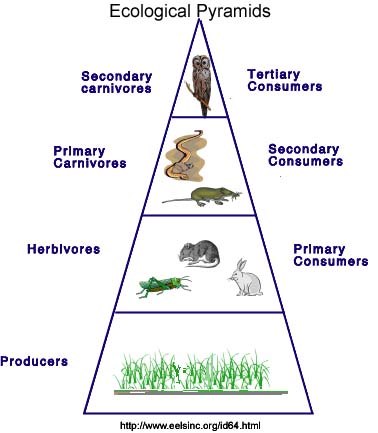
Trophic level is the position an organism occupies in a food chain. It's energy level.
- It refers to food or feeding.
- Only 10% of energy gets passed on to next level.
Food chains show the energy flow from one organism to another.


- Producers (Autotrophs) are at the FIRST TROPHIC LEVEL
**** plants do photosynthesis

- Primary Consumers (Heterotrophs) are the SECOND TROPHIC LEVEL
****consumers eat things to get energy

- Secondary consumers are at the THIRD TROPHIC LEVEL


- Decomposers don't have a trophic level. They RECYCLE matter.

media
media
media

15

Multiple Choice

Which of the following is defined as a consumer that must get its food from a different source than itself?

1

Producer

2

Heterotroph

3

Autotroph

4

Homotroph

16

Multiple Choice

What is the purpose of a decomposer?

1

remove nutrients from dead matter and waste and return it to the soil; to recycle matter

2

Eat living organisms

3

Use dead matter to perform photosynthesis to make carbohydrates

4

convert energy from chemicals into glucose.

17

Match

Question image

Match the following:

Producer/Autotroph

Secondary Consumer

Tertiary Consumer

Apex Predator

Herbivore

Plant

Bird

Snake

Owl

Grasshopper

18

Multiple Choice

Question image
Use the diagram to answer the question.
The Mayfly is a food source for which 3 organisms?
1
Frog, Dragon Fly and snake
2
Frog, trout and dragon fly
3
Frog, salamander and trout
4
Frog and phytoplankton

19

Multiple Choice

Question image

The largest population of organisms found in a food web would be:

1
Primary Consumers
2
Producers
3
Decomposers
4
Tertiary Consumers

20

Food Web

  • Most organisms eat more than JUST one organism.

  • Food webs are more complex and involve lots of organisms.

  • Food webs show ALTERNATIVE PATHWAYS other possible pathways through which an organism can obtain energy.

  • herbivores = eat plants

  • carnivores = eat other animals

  • omnivores = eat plants and animals

  • apex predator - at the top of the food web!

media

21

Multiple Choice

Question image

Which of the following would be the Apex Predator?

1

Hammerhead Shark

2

Octopus

3

Phytoplankton

4

Orca

22

Multiple Choice

Question image

Which of the following is a food chain in the food web?

1

Rabbit, mountain lion, fox

2

Grass, grasshopper, frog, snake, hawk

3

Grass, caterpillar, robin, mountain lion

4

Tree, deer, mountain lion, fox

23

Multiple Choice

Question image
What may happen if the snowshoe hare was removed from the food web pictured?
1
The insects in the habitat would increase.
2
The shrew population would decrease due to being only hawk food source.
3
The willow tree population would decrease.
4
Foxes would dies due to no food source. 

24

​Each level above only gets 10% of the energy from whatever it eats.

media

25

Multiple Choice

How much energy is passed from one trophic level to the next?

1

.1%

2

1%

3

10%

4

100%

26

Multiple Choice

Question image

In the energy pyramid pictured here, if the producers generate 100 units of energy, how much of that energy would be passed on to the herbivores?

1

100 units

2

50 units

3

10 units

4

1 unit

27

Multiple Choice

Question image

If there is 2000 kcal (units) of energy at the producer level in this particular ecosystem, how many kcal of energy will be available for hawk?

1

2000 kcal

2

200 kcal

3

20 kcal

4

2 kcal

5

0.2 kcal

28

A place where an organism lives or can be found

​​Habitat

​An organism’s niche would also take into account its behavior. You can think of an organism’s niche as its job/role in the environment.

A beaver is an ecosystem engineer.
  It cuts down trees and dams up a river which will flood the forest with a pond.  Eventually the trees will dies, new species of plants and wildlife will arrive to take advantage of the new conditions.

​​Niche

media
media

29

Multiple Choice

The non-living part of the natural environment where an animal, plant or other organism lives…

1

niche

2

habitat

3

community

4

ecosystem

30

​Species Interactions: Symbiosis

​Mutualism: Both species benefit by the interaction between the two species. +,+

media
media

​Commensalism: one organism benefits and the other is neither harmed or benefited (+,0)

​Parasitism: one organism benefits and the other is harmed. (+, -)

media
media

31

​Species Interactions

Predators eat prey.

Their populations can change over time.

media

Competition - conflict over resources like food or space.

Competition also happens within a species.

media
media
media

32

Multiple Choice

Question image

What is the general term used to describe the interaction between two different organisms that are living in close physical association?

1

photosynthesis

2

symbiosis

3

habitat

4

prey

5

omnivore

33

Multiple Choice

Question image

The animal in an ecological relationship that results in another animal being hunted, killed, and eaten…

1

autotroph

2

habitat

3

predator

4

herbivore

5

producer

34

Multiple Choice

The flock of white seagulls that are fighting over a single food source (Nemo & Dory) depicts which ecological relatioship?

1

Intraspecies Competition

2

Mutualism

3

Parasitism

4

Commensalism

35

Multiple Choice

Question image

Remora fish hitch a ride on sharks, feeding on scraps without harming the shark.  This ecological relationship is known as -

1

predator-prey because the pearlfish is prey to the remora

2

mutualism because only the shark benefits in this ecological relationship

3

parasitism because the remora causes harm to the host

4

commensalism because only the remora benefits while the shark is not affected

5

competition because the two species are fighting for living space

36

Multiple Select

Question image

Sea lions and orcas both chase after and fight for the same food source (penguins). The two ecological relationships depicted in this scene are -

1

Mutualism

2

Parasitism

3

Predator-Prey relationship

4

Competion

37

Multiple Choice

Question image

Clownsfish live in sea anemones. Clownfish benefit by receiving protection and shelter from the sea anemone. The clownfish, in return, scares away predators of the sea anemone and provides nutrients for the sea anemone through its excrement (waste). The symbiotic relationship between the clownfish and the sea anemone is known as -

1

parasitism

2

commensalism

3

predator-prey

4

competition

5

mutualism

38

Multiple Choice

Question image

What ecological relationship is depicted between Pumba (warthog) and the bugs?

1

Competition, because pumba is in competition with the bugs for food sources

2

Mutualistic, because Pumba and the bugs benefit each other

3

Predator-Prey, because Pumba is a predator that consumes bug as prey

39

Multiple Choice

Question image

According to the graph, what is causing the deer population to decrease

1

They got sick

2

The wolf population is decreasing

3

The wolf population increased

4

They ran out of food

40

​evaporation, precipitation, transpiration (plants only), condensation

Water Cycle

* CO2 - carbon dioxide - is removed from the atmosphere by plants during photosynthesis.

*CO2 is made by organisms during cellular respiration and released back into the atmosphere.


* Carbon is trapped in fossils fuels, which we burn, releasing CO2 into the atmosphere.

*CO2 traps heat in the atmosphere.

Carbon Cycle

​nitrogen is "fixed" by bacteria in soil to make nitrates that plants can take in their roots. Nitrogen is used to make proteins

​​Nitrogen Cycle

​​Phosphorus Cycle
important in
fertilizers,
for plant growth,

DNA & ATP

media
media
media
media
media

41

Multiple Choice

Question image
The process of plants losing water through their leaves is called ____.
1
condensation
2
evaporation
3
transpiration
4
exhaling

42

Multiple Choice

Question image

Which cycle are fossil fuels (oil, coal, natural gas) part of?

1

carbon

2

water

3

nitrogen

4

phosphorus

43

Multiple Choice

Question image

Which one of these does not add CO2 to the atmosphere?

1

cooking with gas

2

planting trees

3

burning wood

4

riding in a bus

44

Multiple Choice

Question image
Identify the cycle pictured.
1
The Water cycle
2
The Carbon cycle
3
The Nitrogen cycle
4
The Phosphorus cycle

45

Multiple Choice

Question image

Identify the cycle pictured.

1

The Water cycle

2

The Carbon cycle

3

The Nitrogen cycle

4

The Phosphorus cycle.

46

Multiple Choice

How do non-human living things participate in the nitrogen cycle?

1

Bacteria decompose organic matter (decomposition)

2

animals move nitrogen during consumption

3

Bacteria convert waste into ammonia (ammonification)

4

All of the above

47

Multiple Choice

What is the main thing that carries out Nitrogen Fixation?

1

Lightning

2

Bacteria

3

Plants

4

Humans

48

Multiple Choice

How does carbon dioxide return to the atmosphere?

1

Photosynthesis

2

Combustion and Cellular Respiration

3

Consumption

4

Decomposition

49

Multiple Choice

Describe how humans negatively impact the Carbon Cycle (short answer- need detail)

1

Cutting down trees

2

Eating plants

3

Combustion (putting CO2 into the atmosphere)

4

Cellular Respiration

50

Multiple Choice

Both plants and animals do cellular respiration.

1

true

2

false

51

POPULATION GROWTH

media

​Limiting factors, both biotic and abiotic, can limit (influence) the growth of a population. 
- examples: competition, predators, food, water, drought, fire

52

Multiple Choice

Question image

Which type of growth is best illustrated by this rabbit population?

1

exponential

2

logistic

3

S-shaped

4

predator-prey

53

Multiple Choice

Question image
What would the carrying capacity of this graph be
1
530
2
400
3
500
4
480

54

Multiple Choice

Question image

What point on the graph represents the carrying capacity?

1

A

2

B

3

C

4

D

55

Multiple Choice

Question image

In a forest ecosystem, which of the following is the best example of a limiting factor for a rabbit population?

1

The squirrel population

2

The amount of sunlight

3

Amount of grass available

4

Rabbits have no limiting factors

56

Ecological Succession

media

Primary Succession: Occurs on newly formed or exposed land where no previous community existed, like on bare rock or after a volcanic eruption. Pioneer species, like lichens and mosses, are the first to colonize these areas, gradually building soil and creating conditions for other species to follow.

Secondary Succession:

Happens in areas where a previous community has been disturbed but the soil remains intact, such as after a fire or logging. This process is generally faster than primary succession because the soil already contains nutrients and seeds. 


The final, most mature stage is called a Climax Community.

57

Multiple Choice

What is the term that describes a steady and stable community?

1

peak community

2

turf community

3

climax community

4

disturbed community

58

Multiple Choice

Which of the following is the correct order of ecological succession?

1

grass - shrubs - lichens - trees

2

lichens - shrubs - grasses - trees

3

lichens - grasses - shrubs - trees

4

grasses - lichens - shrubs - trees

59

Multiple Choice

What is an example of an area that is likely to undergo primary succession?

1

Glaciers melt and leave exposed rock

2

Plants die from drought and decompose

3

Land is bulldozed and soil remains

60

Multiple Choice

___ are the first organisms to colonize an area and begin the process of ecological succession.

1

foundational organisms

2

introductory organisms

3

primary organisms

4

pioneer species

61

Multiple Choice

What is the main difference between primary and secondary ecological succession?

1

Primary begins WITHOUT soil; Secondary begins WITH soil

2

Primary is the first state and secondary is the second stage

3

Primary builds plant community; secondary builds animal community.

4

Primary begins WITH soil; Secondary begins WITHOUT soil

Ecology Review - Honors Bio

Show answer

Auto Play

Slide 1 / 61

SLIDE