

TOEFL Reading Section - Stated and Unstated Detailed Information

Presentation
•
English
•
11th Grade
•
Practice Problem
•
Medium

WINDI ASARIASTIKA
Used 6+ times
FREE Resource
12 Slides • 7 Questions
1


SLIDESMANIA.COM
Reading TOEFL
Windi Asariastika
2


SLIDESMANIA.COM
STATED DETAIL QUESTIONS
3

SLIDESMANIA.COM
Did you know?
4

SLIDESMANIA.COM
Let’s find out
5
Multiple Choice
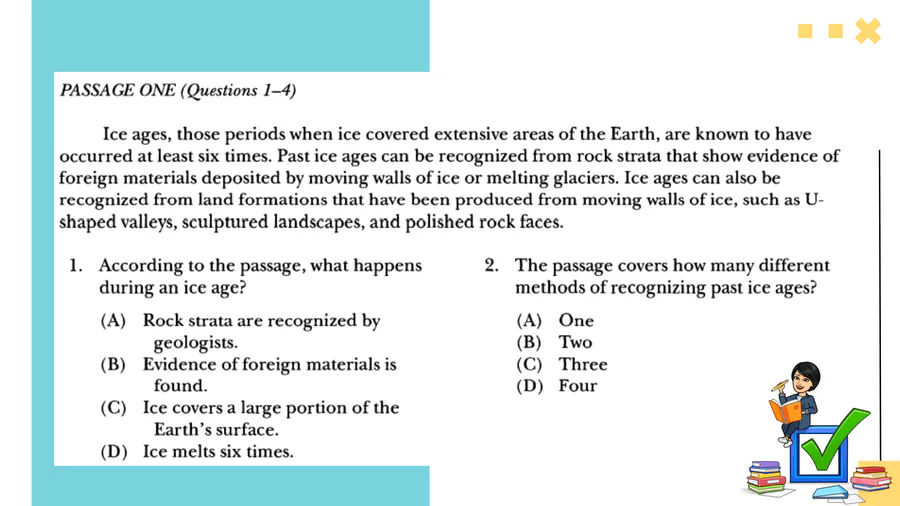
Ice ages, those periods when ice covered extensive areas of the Earth, are known to have occurred at least six times. Past ice ages can be recognized from rock strata that show evidence of foreign materials deposited by moving walls of ice or melting glaciers. Ice ages can also be recognized from land formations that have been produced from moving walls of ice, such as U-shaped valleys, sculptured landscapes, and polished rock faces.
According to the passage, what happens during an ice age?
Rock strata are recognized by geologists
Ice covers a large portion of the Earth's surface.
Evidence of foreign materials is found.
Ice melts six times.
6
SLIDESMANIA.COM
Practice
7
Multiple Choice
Ice ages, those periods when ice covered extensive areas of the Earth, are known to have occurred at least six times. Past ice ages can be recognized from rock strata that show evidence of foreign materials deposited by moving walls of ice or melting glaciers. Ice ages can also be recognized from land formations that have been produced from moving walls of ice, such as U-shaped valleys, sculptured landscapes, and polished rock faces.
The passage covers how many different methods of recognizing past ice ages?
one
two
three
four
8
SLIDESMANIA.COM
Practice
9
Multiple Choice
The human heart is divided into four chambers, each of which serves its own function in the cycle of pumping blood. The atria are the thin-walled upper chambers that gather blood as it flows from the veins between heartbeats. The ventricles are the thick-walled lower chambers that receive blood from the atria and push it into the arteries with each contraction of the heart. The left atrium and ventricle work separately from those on the right. The role of the chambers on the right side of the heart is to receive oxygen-depleted blood from the body tissues and send it on to the lungs; the chambers on the left side of the heart then receive the oxygen-enriched blood from the lungs and send it back out to the body tissues.
The passage indicates that the ventricles...
have relatively thin walls
are above the atria
send blood to the atria
force blood into the arteries
10

SLIDESMANIA.COM
Did you know?
11
Multiple Choice
The human heart is divided into four chambers, each of which serves its own function in the cycle of pumping blood. The atria are the thin-walled upper chambers that gather blood as it flows from the veins between heartbeats. The ventricles are the thick-walled lower chambers that receive blood from the atria and push it into the arteries with each contraction of the heart. The left atrium and ventricle work separately from those on the right. The role of the chambers on the right side of the heart is to receive oxygen-depleted blood from the body tissues and send it on to the lungs; the chambers on the left side of the heart then receive the oxygen-enriched blood from the lungs and send it back out to the body tissues.
According to the passage, when is blood pushed into the arteries from the ventricles?
As the heart beats
Before each contraction of the heart
Between heartbeats
Before it is received by the atria
12



SLIDESMANIA.COM
UNSTATED DETAIL QUESTIONS
13
Multiple Choice
Blood pressure measurement has two components: systolic and diastolic. Systolic pressure is taken when the heart is contracting to pump blood; diastolic pressure is taken when the heart is resting between beats. In the usual blood pressure reading, the systolic measurement is given first and is the higher of the two.
Normal blood pressure is a systolic measurement of 140, and when the systolic pressure is 160 or higher, then hypertension exists. Systolic pressure between 140 and 160 indicates borderline hypertension.
Which the following is NOT true about systolic blood pressure?
It is taken during the contraction of the heart.
A normal systolic measurement is 140.
It is usually given first in a blood pressure reading.
Hypertension exists when the systolic pressure is below 140.
14


SLIDESMANIA.COM
UNSTATED DETAIL QUESTIONS
Blood pressure measurement has two components: systolic and diastolic.
Systolic pressure is taken when the heart is contracting to pump blood;
diastolic pressure is taken when the heart is resting between beats. In the
usual blood pressure reading, the systolic measurement is given first and is
the higher of the two.
Normal blood pressure is a systolic measurement of 140, and when the
systolic pressure is 160 or higher, then hypertension exists. Systolic
pressure between 140 and 160 indicates borderline hypertension.
1. Which the following is NOT true about systolic blood pressure?
(A) It is taken during the contraction of the heart.
(B) It is usually given first in a blood pressure reading.
(C) A normal systolic measurement is 140.
(D) Hypertension exists when the systolic pressure is below 140.dc dd
15
Multiple Choice
Blood plasma is a clear, almost colorless liquid. It consists of blood from which the red and white blood cells have been removed. It is often used in transfusions because a patient generally needs the plasma portion of the blood more than the other components.
Plasma differs in several important ways from whole blood. First of all, plasma can be mixed for all donors and does not have to be from the right blood group, as whole blood does. In addition, plasma can be dried and stored, while whole blood cannot.
AlI of the following are true about blood plasma EXCEPT...
it is a deeply colored liquid
patients are often transfused with it
blood cells have been taken out of it
it is generally more important to the patient than other parts of whole blood
16


SLIDESMANIA.COM
Blood plasma is clear, almost colorless liquid. It consists of blood from which the read and
white cells have been removed. It is often used in transfusions because a patient generally
needs the plasma portion of the blood more than the other components.
Plasma differs in several important ways from whole blood. First of all, plasma can be
mixed for all donors and does not have to be from the right blood group, as whole blood
does. In addition, plasma can be dried and stored, while whole blood cannot.
1 All of the following are true about blood plasma EXCEPT that ….
A. it is a deeply colored liquid
B. blood cells have been taken out of it
C. patents are often transfused with it
D. it is generally more important to the patient than other parts of whole blood
2 Which of the following is NOT stated about whole blood?
A. it is different from plasma
B. it cannot be dried
C. it is impossible to keep it in storage for a long time
D. it is a clear, colorless liquid
17
Multiple Choice
Blood plasma is a clear, almost colorless liquid. It consists of blood from which the red and white blood cells have been removed. It is often used in transfusions because a patient generally needs the plasma portion of the blood more than the other components.
Plasma differs in several important ways from whole blood. First of all, plasma can be mixed for all donors and does not have to be from the right blood group, as whole blood does. In addition, plasma can be dried and stored, while whole blood cannot.
Which of the following is NOT stated about whole blood?
It is different from plasma.
It is impossible to keep it in storage for a long time.
It cannot be dried.
It is a clear, colorless liquid.
18


SLIDESMANIA.COM
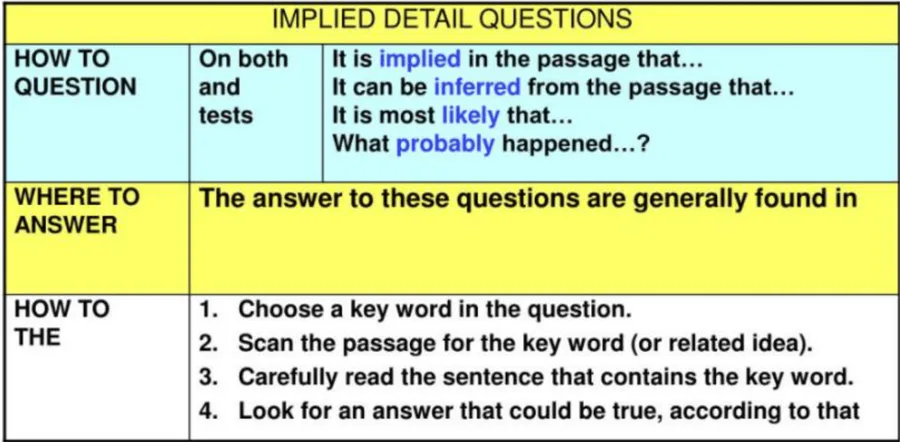
INFERED QUESTIONS
19


SLIDESMANIA.COM
The body that impacted Earth at the end of the Cretaceous period was a meteorite with a
mass of more than a trillion tons and a diameter of at least 10 kilometers. Scientists first
identified this impact in 1980 from the worldwide layer of sediment deposited from the dust
cloud that enveloped the planet after the impact. This sediment layer is enriched in the rare
metal iridium and other elements that are relatively abundant in a meteorite but very rare in
the crust of Earth. Even diluted by the terrestrial material excavated from the crater, this
component of meteorites is easily identified. By 1990 geologists had located the impact
site itself in the Yucatán region of Mexico. The crater, now deeply buried in sediment, was
originally about 200 kilometers in diameter.
Question: Which of the following can be inferred from the paragraph about the location of
the meteorite impact in Mexico?
A. The location of the impact site in Mexico was kept secret by geologists from 1980 to
1990.
B. It was a well-known fact that the impact had occurred in the Yucatán region.
C. Geologists knew that there had been an impact before they knew where it had occurred.
D. The Yucatán region was chosen by geologists as the most probable impact site
because of its climate.
SLIDESMANIA.COM
Reading TOEFL
Windi Asariastika
Show answer
Auto Play
Slide 1 / 19
SLIDE
Similar Resources on Wayground

14 questions
PROCEDURE TEXT : MANUAL
Presentation
•
12th Grade
14 questions
Eng. 11: How It Feels...Playlist
Presentation
•
11th Grade
13 questions
Gerunds and Gerund Phrases
Presentation
•
10th Grade
15 questions
Comparative adjectives
Presentation
•
10th Grade
14 questions
CV writing practice
Presentation
•
11th Grade
13 questions
The Power of Words: Exploring Different Text Types
Presentation
•
10th Grade
15 questions
Summary completion: IELTS reading practice
Presentation
•
11th Grade
14 questions
Has/ have (Simple Present Tense)
Presentation
•
10th Grade
Popular Resources on Wayground
20 questions
"What is the question asking??" Grades 3-5

Quiz
•
1st - 5th Grade
20 questions
“What is the question asking??” Grades 6-8
Quiz
•
6th - 8th Grade
10 questions
Fire Safety Quiz
Quiz
•
12th Grade
20 questions
Equivalent Fractions
Quiz
•
3rd Grade
34 questions
STAAR Review 6th - 8th grade Reading Part 1
Quiz
•
6th - 8th Grade
20 questions
“What is the question asking??” English I-II
Quiz
•
9th - 12th Grade
20 questions
Main Idea and Details
Quiz
•
5th Grade
47 questions
8th Grade Reading STAAR Ultimate Review!
Quiz
•
8th Grade
Discover more resources for English
20 questions
“What is the question asking??” English I-II
Quiz
•
9th - 12th Grade
10 questions
Fire Prevention
Quiz
•
9th - 12th Grade
20 questions
Grammar
Quiz
•
9th - 12th Grade
10 questions
Credible Sources
Presentation
•
8th - 12th Grade
20 questions
Text Structures
Quiz
•
9th - 12th Grade
15 questions
Main Idea and Supporting Details.
Quiz
•
4th - 11th Grade
20 questions
English 2 STAAR Grammar Review
Quiz
•
9th - 11th Grade
24 questions
English I/II STAAR Review
Presentation
•
9th - 12th Grade