Search Header Logo
Repaso de ondas

Repaso de ondas

Assessment

Presentation

Physics

6th - 8th Grade

Medium

NGSS
HS-PS4-1, MS-PS4-1, MS-PS4-2

+3

Standards-aligned

Created by

Saimara Cuevas

Used 5+ times

FREE Resource

21 Slides • 20 Questions

1

media

Wave Properties

Propiedades de las ondas

2

media

Qué es una onda?

Una perturbación que viaja

a través de un medio, como

agua o aire, transfiriendo

energía más NO materia.

3

media

What is a Wave?

A disturbance or back and

forth motion that travels

through something like

water or air, carrying energy

without transporting objects

4

Multiple Choice

Qué es una onda?

1

Una perturbación que transfiere energía

2

Un movimiento circular

3

Una perturbación que transfiere materia

5

media

Partes de una onda

Cresta

Posición de

reposo

Valle

Amplitud

Longitud de

onda

6

media

Parts of a Wave

Crest

Rest

Position

Trough

Amplitude

Wavelength

7

media

Amplitude/Amplitud

The height or size of a wave.

La altura o tamaño de la

onda.

Wavelength/Longitud de onda

The distance from one

wave to another.

La distancia de una onda a

otra.

8

media

Crest/ Cresta

The highest point of a

wave.e.

El punto más alto de una

onda.

Trough/ Valle

The lowest point of a wave.

El punto más bajo de una

onda.

9

media

Rest position/Posición de reposo

Posición de

reposo

Where the material was before

started the wave.

Donde el material (hilo, soga o agua)

se encontraba antes de que

comenzara la onda.

10

Multiple Choice

Question image

Which image represents a longitudinal wave?

1

A

2

B

11

Multiple Choice

Question image

The displacement marked in the diagram by a red arrow is known as the ____ of the wave.

1

time

2

speed

3

frequency

4

amplitude

12

Multiple Choice

Question image

A wavelength is the distance between which 2 points?

1

B and G

2

A and C

3

C and F

4

A and H

13

Multiple Choice

What is transferred by a wave?

1

energy

2

matter

3

particles

4

mass

14

Multiple Choice

Question image
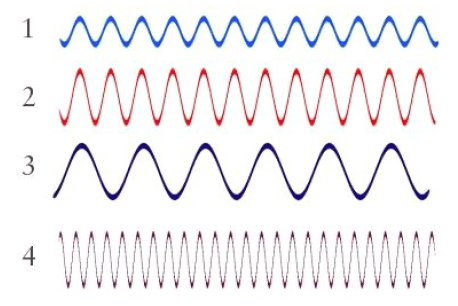
Which wave in the diagram has the greatest wavelength?
1
1
2
2
3
3
4
4

15

Multiple Choice

Question image
Which vocabulary term is used to identify the distance between points C & G?
1
Amplitude
2
Crest
3
Frequency
4
Wavelength

16

Multiple Choice

Question image

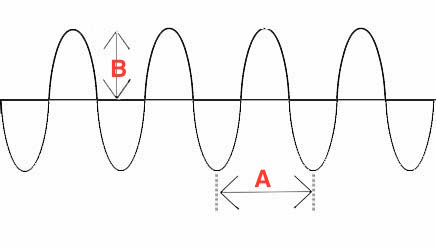
What property of this wave is represented by the letter "A"

1

amplitude

2

crest

3

trough

4

wavelength

17

Multiple Choice

Question image
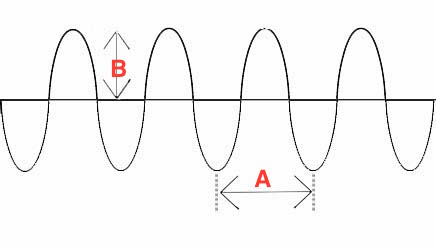
What property of the wave is represented by the letter "B"?
1
amplitude
2
crest
3
trough
4
wavelength

18

Multiple Choice

Question image
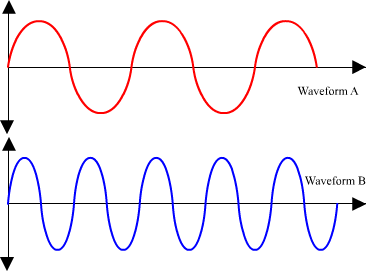
These waves have the same
1
amplitude
2
frequency
3
period 
4
wavelength

19

media
media

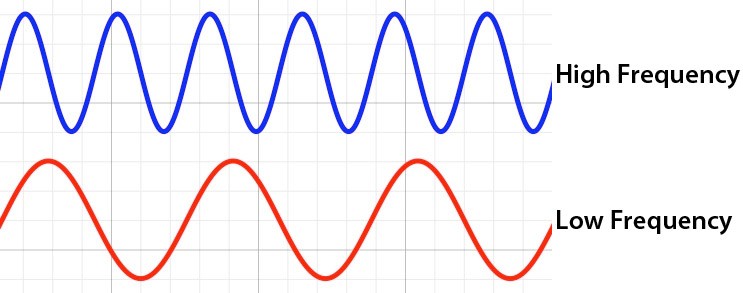
Frecuencia

Número de ondas que

ocurren en una cantidad
de tiempo. Se mide en

hertz (Hz).

Música de alta
frecuencia tiene

muchos cambios y se

escucha rápido y

energética.

Música de baja frecuencia tiene cambios lentos y se siente calmada y

relajante.

20

media
media

Wave Frequency

Number of complete
cycles or waves that

occur in a given amount

of time, measured in

hertz (Hz).

High-frequency music

has lots of quick

changes in the sound

waves, and it feels
fast and energetic.

Low-frequency music has slower changes in the sound waves, and it feels

calm and soothing.

21

Multiple Choice

Question image
Frequency is measured in
1
Newtons
2
Joules
3
Hertz
4
Decibels

22

Multiple Choice

Question image
Sound travels best through
1
solids
2
liquids
3
gases
4
colloids

23

media

Wave Velocity

Distance

Time

How fast a wave moves from one place to
another, measured in meters per second

(m/s) or kilometers per hour (km/h)

If a wave travels 10 meters in

2 seconds, its speed would

be 5 meters per second.

Speed=
10m

2s

5s=

24

Multiple Choice

Which is the correct equation for calculating the speed of a wave?
1
T = 1/f
2
Speed= Wavelength x Period
3
Speed = Wavelength/Frequency
4
Speed= Wavelength x Frequency

25

media

Velocidad de onda

Distancia
Tiempo

Cuán rápido una onda se mueve de un

lugar a otro. Se mide en metros por
segundo (m/s) o kilometros por hora

(km/h).

Si una onda viaja 10 metros
en 2 segundos, su velocidad

será 5 m/s.

Velocidad=
10m

2s

5s=

26

media
media

Cuanto más elevada y rápida sea la frecuencia, más corto será

el periodo de la onda.

Periodo

Es la cantidad de tiempo
que cuesta finalizar una

revolución completa de un
ciclo de onda.. El período
se mide en segundos (s).

27

media
media

The faster and high the frequency is, the period will be shorter.

Period

The period is the time it takes

for one complete up-and-
down motion of the wave.
The period is measured in

seconds (s).

28

Multiple Choice

Question image

Period of a wave refers to...

1

how long it takes for the event to repeat.

2

how strong a wave is.

3

how long a wave is.

4

how much energy a wave has.

29

media

¿Qué son las Ondas Mecánicas?

Las ondas mecánicas necesitan un medio material para moverse.

¿Pueden pensar en ejemplos de medios materiales? (Como el agua o el aire)

Las partículas del medio vibran para transmitir la energía de la onda.

These are waves that require a material medium to propagate.

The particles in the medium vibrate to transfer the energy from the
wave.

What are mechanical waves?

30

media
media
media

Ejemplos de Ondas Mecánicas

Olas en el agua: creadas por el viento o movimientos en el
agua.

Sonido: viaja a través del aire cuando hablamos o escuchamos
música.

Ondas sísmicas: se generan durante un terremoto y se mueven
a través de la Tierra.

31

media

Examples of mechanical waves

Water waves: created by the wind or movements in water.

Sound: travel through the air when we talk or listen music.

Seismic: it generates during a earthquake and moves through
the Earth.

32

Multiple Choice

Ondas mecánicas (como sonido) no pueden viajar a través de...

1

metal

2

arboles

3

espacio vacío

4

puertas

33

Multiple Select

son aquellas ondas que se propagan en la misma dirección en la cual vibran las partículas

1

Mecanicas

2

Transversales

3

Longitudinales

4

Electromagneticas

34

Multiple Select

Segun su direccion las ondas se clasifican en

1

Mecanicas y electromagnéticas

2

Longitudinales y transversales

3

Sonoras y luminicas

4

Gravitatorias y mecanicas

35

media

¿Qué son las Ondas Electromagnéticas?

Las ondas electromagnéticas son capaces de viajar a través del vacío.

No necesitan un medio material.

Están formadas por campos eléctricos y magnéticos que oscilan
perpendicularmente.

What are electromagnetic waves?

These are waves that can propagate through the vacuum of space.

It does not need for a material medium.

They are form from electrical and magnetic fields that travel perpendicular.

36

media
media

Ejemplos de Ondas Electromagnéticas

Luz visible: lo que nuestros ojos pueden detectar.

Rayos X: utilizados en medicina para ver dentro del cuerpo.

Ondas de radio: para transmitir señales de radio y televisión.

¿Se les ocurre algún otro ejemplo de uso cotidiano?

37

media

Examples of electromagnetic waves

Visible light: what our eyes can detect or see.

X rays: medical use to see through us.

Radio waves: to transmit radio or TV waves.

38

media
media

Comparación de Ondas Mecánicas y Electromagnéticas

39

Multiple Choice

Question image

Que es un ejemplo de una onda longitudinal?

1

rayos x

2

microondas

3

ondas de sonido

4

onda de agua

40

Multiple Choice

Question image

Las ondas sonoras en el aire es un ejemplo de ondas

1

electromagneticas

2

longitudinales

3

transversales

4

mecánicas

41

Multiple Choice

Question image

La luz de los rayos X son una forma de ondas.........................

1

Transversales

2

Electromagneticas

3

longitudinales

4

mecanicas

media

Wave Properties

Propiedades de las ondas

Show answer

Auto Play

Slide 1 / 41

SLIDE