Search Header Logo
Y4 Unit 6 Part 1 : Be a Musician

Y4 Unit 6 Part 1 : Be a Musician

Assessment

Presentation

Computers

4th Grade

Practice Problem

Easy

Created by

Ms Valerie

Used 6+ times

FREE Resource

27 Slides • 13 Questions

1

media

2

media

Unit 6:
Be a Musician

In this unit, you will create music with repetition using Scratch.
You will learn:

  • to predict the outcome of algorithms that contain repetition

  • to compare and contrast algorithms designed for the same task

  • to develop programs with iteration.

3

media

​BRAIN
WARM UP

4

​The aim of this exercise is
to understand patterns in a sequence, in preparation for exploring loops in algorithms and code.
This exercise is not to introduce note values.

5

media

​whole note

​half note

​quarter note

​eighth note

6

Draw

Look at the pattern of the musical notes below and fill in the blanks to complete the series.

7

Multiple Select

Select the type of repetition we learnt in Term 1.

1

Forever

2

Repeat

3

Repeat Until

8

  • ​Forever Loop (Unit 1)

  • Repeat Loop (Unit 4)

​In Term 1, you learnt about :

9

Multiple Choice

Which algorithm uses the forever loop?

1
2

10

Multiple Choice

Which algorithm uses the repeat loop?

1
2

11

From Algorithm to Code
Predicting Outcomes

12

  • Repetition in Scratch uses either the forever loop or the repeat loop.

media
media

13

Open Ended

Question image

Look at the steps for Algorithm A.
Predict the outcome of this algorithm.

14
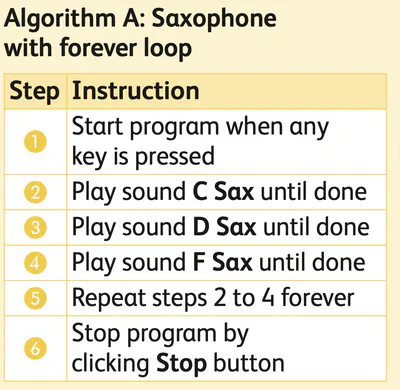
  • Algorithm A with forever loop

    • What sprite do we use?

    • How to start the program? What do we pressed?

    • How does the program end?

media

15

Open Ended

Question image

Look at the steps for Algorithm B.
Predict the outcome of this algorithm.

16

  • Algorithm B with repeat loop

    • What sprite do we use?

    • How to start the program? What do we pressed?

    • How does the program end?

media

17

In a forever loop

  • instructions are repeated over and over without stopping

In a repeat loop

  • instructions are repeated a set number of times

18

Practice

media

19

media
  • ​In Scratch, each sprite can play different sounds.

  • The minus sign (-) means decrease

20

Multiple Choice

Question image

Which algorithm uses the forever loop?

1

Algorithm C

2

Algorithm D

21

Multiple Choice

Question image

Which algorithm uses the repeat loop?

1

Algorithm C

2

Algorithm D

22

Open Ended

Question image

Which musical instrument is used in each algorithm?
Algorithm C - ?
Algorithm D - ?

23

Open Ended

Question image

How many times is the High Tom sound played in Algorithm C?

24

​The High Tom sound plays forever, until the program is stopped.
There is no set number of times that the High Tom (or Low Tom) is played.

ANSWER EXPLANATION

25

Open Ended

Question image

What is the lowest volume in Algorithm D?

26

The lowest volume in Algorithm D is 20.

  • The volume decreases by 10 in each loop and there are 8 loops in total.

  • The starting volume was 100,

    • so 100 - (10x8) = 20

ANSWER EXPLANATION

media

27

media

28

Comparing
Algorithms

29

media
media
media

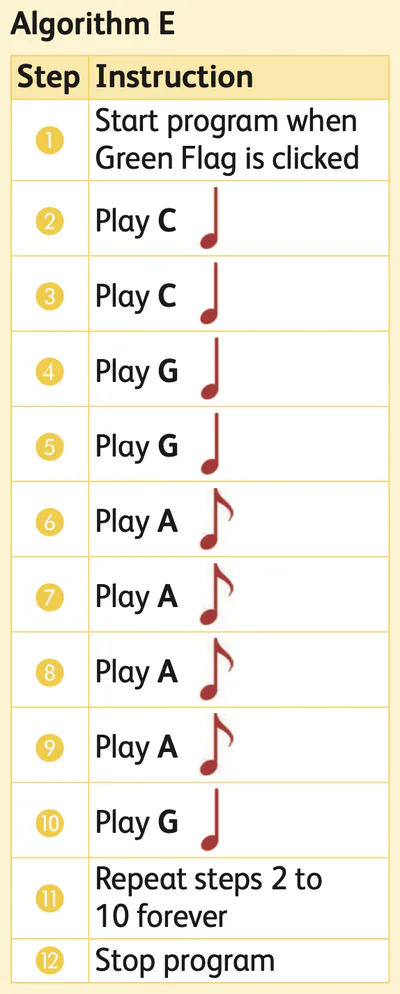
We want to repeat the song until the space key is pressed. Look at the two Algorithms E and F.

  • Which algorithm is better?

  • Why?

30

  • Algorithm F has a total of ten steps and repeats the song until the space key is pressed.

  • Algorithm E has a total of twelve steps and plays the song forever.

ANSWER EXPLANATION

31

Practice

media

32

media
media

33

media
media

34

media
media
media

​ANSWER

35

Open Ended

Question image

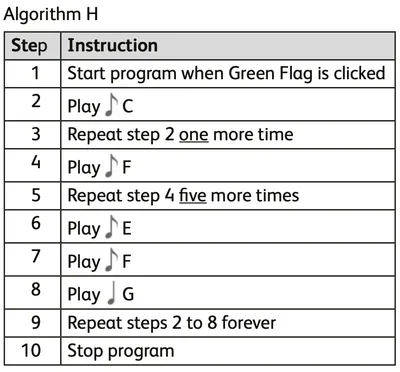
How many steps are there in each algorithm?

Algorithm G has _ steps and Algorithm H has _ steps.

36

Multiple Choice

Question image

Which algorithm is best suited to play the song forever?

1

Algorithm G

2

Algorithm H

37

  • Algorithm G will use more blocks of code to create the program.

  • Algorithm H will save time in writing and creating the program.

ANSWER EXPLANATION

38

Worksheet

media

39

media
media

40

Next Week
Using Iteration

media

Show answer

Auto Play

Slide 1 / 40

SLIDE