Search Header Logo
Lesson #31

Lesson #31

Assessment

Presentation

Physics

12th Grade

Medium

NGSS
HS-PS4-1, HS-PS4-3, HS-PS4-4

+2

Standards-aligned

Created by

Kevin Correa

Used 1+ times

FREE Resource

45 Slides • 37 Questions

1

Lesson #31 (Last lesson)
Make sure to screenshot your score and submit it in canvas

2

​Doppler Effect

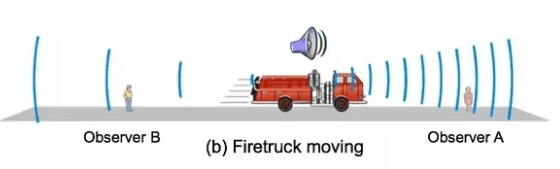
The apparent change in frequency due to the relative motion of the source (or receiver) is called the Doppler effect.

​As a result of the change in frequency, the pitch of the sound produced is impacted.

3

media

4

media

​Frequency is same at A and B

5

media

6

media

Shorter wavelength=

higher frequency

Longer wavelength=

​Lower frequency

7

media

8

media

9

media

10

Multiple Choice

The pitch of a sound wave relates to the wave's _________________.

1

Amplitude

2

Frequency

3

Wavelength

4

Period

11

Multiple Choice

An ambulance is driving towards you as you stand on the sidewalk. What happens to the pitch of the siren as it comes towards you?

1

It increases

2

It decreases

12

Multiple Choice

You are standing on the side of the road when a police car races past you with its siren on. After the police car passes you, what happens to the pitch of the siren?

1

It increases

2

It decreases

3

It turns red

13

Multiple Choice

Question image

Look at the picture. Who is experiencing a higher pitched sound?

1

Observer A

2

Observer B

3

There's no difference

14

Multiple Choice

Question image
Long sound waves are...
1
high pitched
2
low pitched
3
medium pitched

15

Multiple Choice

Question image
When the car moves AWAY from you, its horn seems...
1
Low pitched
2
High pitched
3
Normal

16

17

Electromagnetic spectrum

media

18

Electromagnetic Spectrum Review

media

19

media

EM Waves can travel in a vacuum! Mechanical waves (sound waves) CANNOT!!!

20

Multiple Choice

Question image

All waves carry...

1

Energy

2

Matter

3

Light

4

Particles

21

Multiple Choice

How are electromagnetic waves different from other waves?

1

They have very short wavelengths

2

They can travel through empty space

3

They transmit energy instead of matter

4

They can change direction by reflection

22

Multiple Choice

Question image

The type of wave that can travel through both matter AND empty space:

1

Mechanical Waves

2

Electromagnetic Waves

23

media

24

media

25

media

26

media

27

Multiple Choice

Question image

Which of the following electromagnetic waves has the lowest energy?

1

Gamma Ray

2

Visible Light

3

Infrared

4

Microwave

28

Multiple Choice

Question image

As the frequency of an electromagnetic wave increases, the amount of energy in that wave...

1

Increases

2

Stays the same

3

Decreases

29

media

30

Multiple Choice

Light is a form of

1

Energy

2

Reflection

3

Radiation

31

Multiple Choice

Which has the longest wavelength and, therefore, the LOWEST frequency/energy

1

Gamma Rays

2

Visible Light Waves

3

Radio Waves

4

Infrared Waves

32

media

33

media

34

media

35

Multiple Choice

Which section of the spectrum is the ONLY one we can see?

1

X-Rays

2

Gamma Rays

3

Visible Light

4

Ultraviolet Rays

36

Multiple Choice

Which of the following electromagnetic waves is given off as heat?

1

Radio Waves

2

Visible Light

3

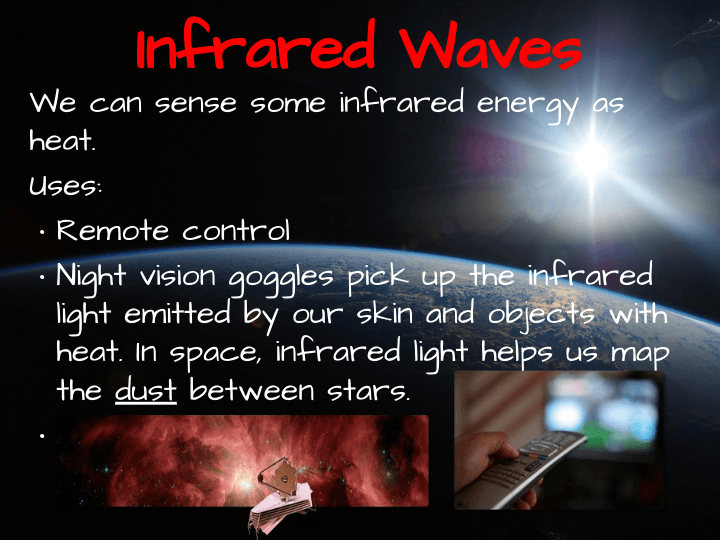
Infrared Rays

4

Gamma Rays

37

Multiple Choice

Select the correct order of waves on the EMS from the longest wavelength to the shortest wavelength

1

Radio, Microwave, Infrared, Visible Light, Ultra Violet, X-Ray, Gamma.

2

Visible, Microwave, Infrared, Ultraviolet, X-Ray, Gamma, Radio.

3

Gamma, X-Ray, Ultraviolet, Visible, Infrared, Microwave, Radio.

4

Microwave, Radio, Visible, Infrared, Ultraviolet, X-Ray, Gamma.

38

Mirrors and Lenses

media

39

There are 2 ways in which a surface can reflect light: Regular Reflection and Diffuse Reflection.

  • Regular Reflection: occurs when parallel rays of light hit a smooth surface. All rays reflect at the same angle and produce a clear image.

  • Diffuse Reflection: occurs when parallel rays of light hit an uneven surface and reflect at diferent angles producing an unclear image.

40

  • Top Image: Regular Reflection

  • Bottom Image: Diffuse Reflection

media

41

Multiple Choice

Question image

What type of reflection will this image produce?

1

Regular Reflection

2

Diffuse Reflection

42

What is an image?

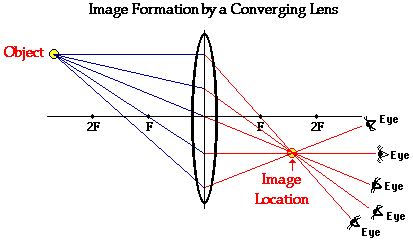
  • An Image is a copy of the object formed by reflected or refracted light rays.

  • There are two types of Images: Virtual and Real

media

43

Virtual Images:

  • Virtual images are right side up

  • Virtual images have the left and right side reversed.

  • Virtual images form where light seems to come from (like behind the mirror)

  • Virtual images cannot be projected onto a screen

media

44

Real Images

  • Real images are upside down

  • Real images form at the focal point where light rays meet

  • Real images can be projected onto a screen

media

45

Multiple Choice

What type of image is upside down?

1

real

2

virtual

46

Multiple Choice

What type of image can be projected onto a screen?

1

real

2

virtual

47

Multiple Choice

Which type of image is right side up but left and right are reversed?

1

real

2

virtual

48

Types of Mirrors

There are three types of mirrors that we will discuss: Plane, Concave, and Convex.

media

49

Plane Mirrors

Flat mirrors like the one you have in your bathroom. Creates an image that is:

Virtual and Same Size as the object

media

50

Concave Mirrors

  • Curved (like the inside of a spoon)

  • Real or Virtual Images

  • (Virtual Image when object is between the focal point and the mirror)

  • (Real Image when object is beyond the focal point)

  • Size can be larger, smaller, or same (the closer to the focal point the larger it will appear)

media

51

52

Convex Mirrors

  • virtual image smaller than the object

  • advantage is that it allows you to see a larger area but disadvantage is the image is reduced in size.

  • Used in driver side mirrors and on ceilings in stores for security.

media

53

54

Overview

  • There are two types of reflections: Regular and Diffuse

  • There are three types of mirrors (Plane, Concave, and Convex)

  • These mirrors can produce two types of images: Real or Virtual

  • Virtual Images are right side up

  • Real Images are upside down

media

55

Multiple Choice

Now I get it! There are two types of reflections: __________ and ____________

1

Diffuse and Regular

2

Real and Virtual

56

Multiple Choice

An ___________ is a copy of an object formed by the reflected or refracted rays of light.

1

Image

2

Convex

3

concave

4

plane

57

Multiple Choice

A ___________ mirror can produce both real and virtual images.

1

plane

2

concave

3

convex

58

Multiple Choice

What kind of image does a convex mirror produce?

1

real but smaller

2

virtual but smaller

59

Multiple Choice

What kind of image does a plane mirror produce?

1

real and same size

2

virtual and same size

60

media
media
media
media

What is a lens?

A lens is a curved piece of glass or transparent object that can bend light.

Light can be refracted using a lens.

61

62

media
media
media

TWO TYPES OF LENSES

CONVEX

Focuses
light
inwards

CONCAVE

Spreads light outwards

63

64

media

65

media

66

Multiple Choice

Question image

Is a convex lens thicker or thinner in the middle?

1

Thicker

2

Thinner

67

Multiple Choice

A diverging lens is also known as a ____lens.

1

refracted

2

diffracted

3

convex

4

concave

68

Multiple Choice

What does the word "diverging" mean?

1

to spread apart

2

to come together

3

parallel

4

perpendicular

69

Multiple Choice

A converging lens is also known as a ____ lens.

1

convex

2

concave

3

double

4

refracted

70

Multiple Choice

What does the word "converging" mean?

1

to separate

2

to come together

3

parallel

4

perpendicular

71

media

72

media

73

Multiple Choice

Question image

This image is.....

1

inverted and smaller

2

inverted and larger

3

not inverted and smaller

4

not inverted and larger

74

Multiple Choice

When an object is placed between the focal point and the convex lens, the image produced is ___.

1

real, reduced, and inverted

2

real, enlarged, and inverted

3

virtual, enlarged, and upright

4

virtual, reduced, and upright

75

media

76

media

77

Multiple Choice

An object is placed 20 cm from a convex lens of focal length 15 cm. What is the image distance and the nature of the image?

1

60 cm, real image

2

30 cm, real image

3

Image not formed

4

15 cm, virtual image

78

Multiple Choice

An object is located 35.0 cm from a converging lens. The lens forms a real image at a distance of 15.0 cm. What is the focal length?

1

0.0953 cm

2

10.5 cm

3

26.2 cm

4

0.0678 cm

79

The Human Eye

  • Retina: thin layer of cells that line the back of the eye

  • Lens: convex shape, bends light to form an image on the retina

  • pupil: the muscle that contracts when exposed to sunlight

  • Iris: the color part of the eye

  • Cornea: the protective outer layer

media

80

Dropdown

A ​
helps to focus light rays to form images.​

81

Multiple Choice

Which mirror can form an enlarged image?

1

Plane

2

Convex

3

Concave

82

Multiple Choice

The image formed by a plane mirror is __________.

1

real and upright

2

virtual and upright

3

real and reversed

4

virtual and inverted

Lesson #31 (Last lesson)
Make sure to screenshot your score and submit it in canvas

Show answer

Auto Play

Slide 1 / 82

SLIDE