

Final Exam Review

Presentation
•
History
•
10th Grade
•
Medium

Sarah Gray
Used 10+ times
FREE Resource
0 Slides • 51 Questions
1
Multiple Choice
According to the scientific method, the world is best understood through-
asking random people on the internet
direct observation
2
Multiple Choice
The U.S constitution includes what idea originating from Baron Montesquieu?
Freedom of Speech
3
Multiple Choice
What most contributed to the start of the scientific revolution in 16th century Europe?
Publication of new theories related to astronomy
4
Multiple Choice
The philosophers Hobbes, Locke, and Rousseau all-
Inspired philosophy behind political revolutions
5
Multiple Choice
The ideas behind the development of democratic-republican form of government and the Bill of Rights in North American can BEST be attributed to –
Jean Jacques Rousseau
John Locke
Baron de Montesquieu
6
Multiple Choice
What nation had complete control of India at one time?
England
7
Multiple Choice
Why did Europeans begin to explore and expand in the 1500’s?
Gain riches, find adventure, and spread religion
8
Multiple Choice
Why were the Portuguese the first to explore other lands?
They had superior ships
They had superior military strength
They had the best economic prosperity
They had a geographical advantage
9
Multiple Choice
How did Spanish conquistadors' weaponry compare to the Aztecs and Incas?
Spain had more advance weaponry. It allowed relatively fewer men to control large populations.
10
Multiple Choice
African people were captured and forcibly sent to the Americas as part of the –
Triangular trade route
11
Multiple Choice
What led to the beginning of Napoleon's downfall in 1812?
12
Multiple Choice
Jose de San Martin and Simon Bolivar led South American independence movements against what country?
13
Multiple Choice
What is always true of a limited monarchy?
The monarch must obey the laws of government
14
Multiple Choice
The French Revolution was most influenced by which principle from the Declaration of Independence?
brotherhood of citizens
freedom of speech
separation of church and state
certain basic human rights
15
Multiple Choice
The French and American revolutions had what important effect on Latin America?
16
Multiple Choice
What is the difference between the American Revolution and French Revolution?
The American Revolution was a colonial independence movement, while the French Revolution was a broader social and economic reorganization.
17
Multiple Choice
During the French Revolution, the social and political disorder led to –
Establishment of a constitutional monarchy by King Louis
Napoleon gaining power and spreading conflict throughout Europe.
18
Multiple Choice
Which revolution ended with the end of the Romanov Dynasty?
19
Multiple Choice
Why did the British government want to control Egypt?
20
Multiple Choice
In the Communist Manifesto, the proletariat are what social class?
21
Multiple Choice
•Adam Smith: _______:: Charles Fourier:______________.
22
Multiple Choice
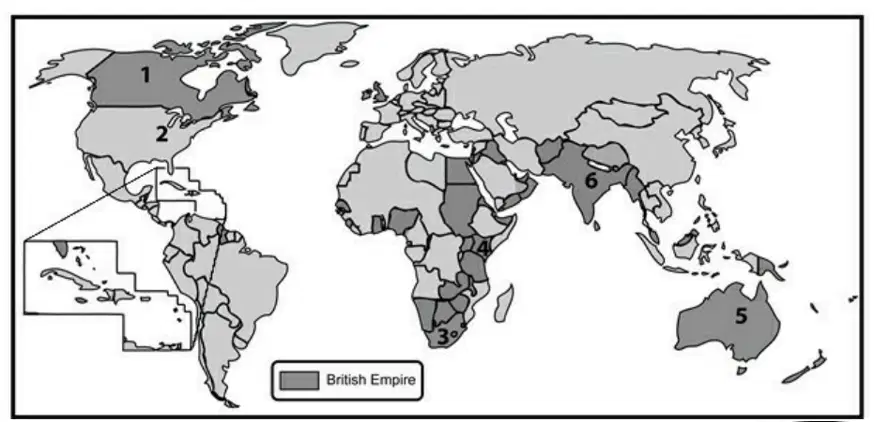
What conclusion can you draw from this map?
The British Empire extended into all of the inhabited continents.
23
Multiple Choice
How did the rivers in Britain contribute to the Industrial Revolution starting there?
The rivers in Britain provided waterpower for early industrial machinery and transportation routes for goods and resources.
24
Multiple Choice
How did economic freedoms during the Industrial Revolution contribute to a better quality of life?
25
Multiple Choice
What did working-class women in Europe in the 19th century do to change their status?
26
Multiple Choice
Why did the US propose the Open-Door policy?
27
Multiple Choice
In WWI what was the strip of territory between trenches that separated the troops from each other called?
28
Multiple Choice
How would you classify a government that aims to control the political, economic, social, intellectual, and cultural lives of its citizens?
29
Multiple Choice
What led President Truman to drop the atomic bombs on Japan?
To save the lives of American soldiers
30
Multiple Choice
How did President Wilson’s “Fourteen Points” speech influence the peace after the First World War?
31
Multiple Choice
Why is the holocaust a genocide?
32
Multiple Choice
What did NOT contribute to the global depression in the 1930s?
Increased demand for automobiles
33
Multiple Choice
A Period of low economic activity and rising unemployment is called-
poverty
34
Multiple Choice
What did the German Gov do during WWI that contributed to the communist revolution in Russia?
35
Multiple Choice
The alliance system contributed to the outbreak of conflict in Europe because-
36
Multiple Choice
What event led to the start of WWI?
37
Multiple Choice
What event led to the start of WWII?
38
Multiple Choice
What system of government is described as follows: led by dictator, forcibly suppresses opposition, strictly regulates all industry, aggressive nationalism.
39
Multiple Choice
What was the goal of Stalin’s 5 Year Plans?
40
Multiple Choice
How did Gandhi protest British Laws?
refusing to obey any British laws
41
Multiple Choice
What was the Cold War based on?
Lack of economic cooperation
Emerging military alliances
Limited cultural exchange
Distrust between US and USSR
42
Multiple Choice
What happened in the year after the UN proposed a division of the Palestine Mandate?
Proclamation of the state of Israel
43
Multiple Choice
Where is the terrorist organization Al-Qaeda based in?
Europe
Afghanistan
China
Canada
44
Multiple Choice
North and South Vietnam were reunited by-
Communist North Vietnamese forces.
45
Multiple Choice
What was the Purpose of the North American Free Trade Agreement (NAFTA)?
46
Multiple Choice
“Developing countries” are characterized by-
47
Multiple Choice
Where did the Soviets (Russians) place missiles aimed at the US?
48
Multiple Choice
•Gandhi, Mandela, and Romero all-
resisted political oppression
49
Multiple Choice
Why did the communist economy of the Soviet Union eventually collapse at the end of the 20th century?
50
Multiple Choice
How did decolonization and Independence for many African Nations after WWII affect their government and society?
Many of the newly independent nations have struggled with ethnic conflict and corrupt leadership.
African Nations were forced to become more dependent on colonial powers
Resulted in the dissolution of African Nations after WWII
51
Multiple Choice
How did communist policies differ between China and the Soviet Union?
According to the scientific method, the world is best understood through-
asking random people on the internet
direct observation
Show answer
Auto Play
Slide 1 / 51
MULTIPLE CHOICE
Similar Resources on Wayground

46 questions
Parallel Lines & Transversals
Presentation
•
10th Grade
44 questions
World War I Begins
Presentation
•
9th - 10th Grade
42 questions
Circle Vocabulary Part 2
Presentation
•
10th Grade
43 questions
History of Renaissance
Presentation
•
10th Grade
44 questions
M.4 Past Perfect Continuous
Presentation
•
10th Grade
47 questions
Four Freedom Speech
Presentation
•
10th Grade
45 questions
Proklamasi Kemerdekaan dan Pembentukan Perangkat Kenegaraan
Presentation
•
11th Grade
46 questions
D11: Rome, Roman Republic, & Roman Empire
Presentation
•
10th Grade
Popular Resources on Wayground
11 questions
Hallway & Bathroom Expectations

Quiz
•
6th - 8th Grade
10 questions
HCS SCI 03 Summer School Assessment 2
Quiz
•
3rd Grade
11 questions
Home Scope
Quiz
•
7th - 8th Grade
12 questions
2026 TAP Technology in the Classroom
Presentation
•
Professional Development
15 questions
HCS SCI 05 Summer School Assessment 2 Review
Quiz
•
5th Grade
15 questions
HCS SCI 04 Summer School Review 2
Quiz
•
4th Grade
59 questions
Geometry Unit 3 Review
Quiz
•
9th - 12th Grade
14 questions
FAST ELA READING SMAPLE TEST MATERIALS

Passage
•
3rd Grade