

WATER

Presentation
•
Science
•
8th - 12th Grade
•
Practice Problem
•
Hard

Andrews AABESAGR
Used 1+ times
FREE Resource
35 Slides • 0 Questions
1


Sources of Water
Group 4
2


What Is Water?
Water is a substance composed of the
elements hydrogen and oxygen. It is a
colourless, odourless and tasteless liquid
which is essential for life on Earth.
3



Atmospheric water
Sources Of Water
Surface Water
Ground Water
Fresh Water
01
02
03
04
4


Surface Water
Surface water are most gotten from rivers,lakes and
wetlands.
01
5


●
Rivers: Flowing bodies of water that originate from
sources like lakes, glaciers, and springs.
●
Lakes: Large bodies of standing water, either freshwater
or saltwater, found in depressions on the Earth's surface.
●
Wetlands: Areas of land that are saturated with water,
either permanently or seasonally, and support unique
ecosystems.
6



Ground Water
Ground water is mostly gotten from aquifers,
springs, wells and underground streams
02
7


●
Aquifers: Underground layers of water-bearing
permeable rock, sand, or gravel.
●
Springs: Natural sources of water that flow from the
ground, often from an aquifer.
●
Wells: Artificial structures drilled into the ground to
access groundwater for human use.
8


Fresh Water
Fresh water are water sources that are not salty.
Only 3% of Earth’s water is fresh and only 0.3% is
used by humans.
03
9



Atmospheric Water
Atmospheric water is mostly gotten from clouds,
precipitation and humidity.
04
10


●
Clouds: Water vapor that condenses in the atmosphere,
forming visible masses of water droplets or ice crystals.
●
Precipitation:Water that falls from the sky in the form of
rain, snow, sleet, or hail, replenishing surface and
groundwater.
●
Humidity: The amount of water vapor present in the air,
which plays a role in the water cycle and weather
patterns.
11



Diagram on Distribution of
Water
12



Our Group Members
● Toby
● Jade
● Dorcas
● Isaac
13


CREDITS: This presentation template was created by Slidesgo,
including icons by Flaticon, infographics & images by Freepik
Do you have any questions?
Thanks!
14

Group 2
Hard Water and Soft Water
15

01.
02.
GROUP MEMBERS
GEORGE NII
YARBOYE ANNAN
03.
04.
OHEMAA AKOSUA
KORANTEMAA
OWUSU
EMMANUEL
BABATUNDE
ADEKANLA
KWADWO ADU-KUSI
16

DEFINITION of
Hard and Soft
Water
Hard water is defined as water which does not
readily lather with soap. Example: Sea water
Soft water is defined as water which forms lather
readily with soap. Example: Rain water and distilled
water.
17

What is Hardness of Water?
Hardness of water is defined as the inability of water
to form lather easily with soap.
Causes of water hardness
1.Presence of Calcium salts
2. Presence of magnesium salts
3. Presence of Iron(III) salts
18

EXPERIMENT
An experiment to compare formation of lather with soap using hard
and soft water
Procedure
● Collect about 150 cm3 of water from various sources such as
river, borehole, tap water, rain, sea, and well.
● Measure about 25 cm3 of each sample of water into conical
flasks.
● Pour soap solution into a burette or graduated cylinder.
● Carefully, titrate or pour the soap solution bit by bit from the
graduated cylinder or burette into each sample of water in the
flask while swirling gently.
● Record the volume of soap solution added to give a permanent
lather.
● Record any scum formed until the mixture forms a permanent
lather.
● List and explain which water is hard and which is soft
19

Disadvantages of Hard water
1.It wastes soap since it does not lather easily with soap.
2.It forms scale or deposits in pipes, biolers, and kettles.
3.It causes graying in white clothes.
20

Disadvantages of Soft Water
1.It does not have a pleasant taste
2.It is believed to increase the chances of heart diseases.
3.The abscence of calcium ions causes weak bones and teeth.
21

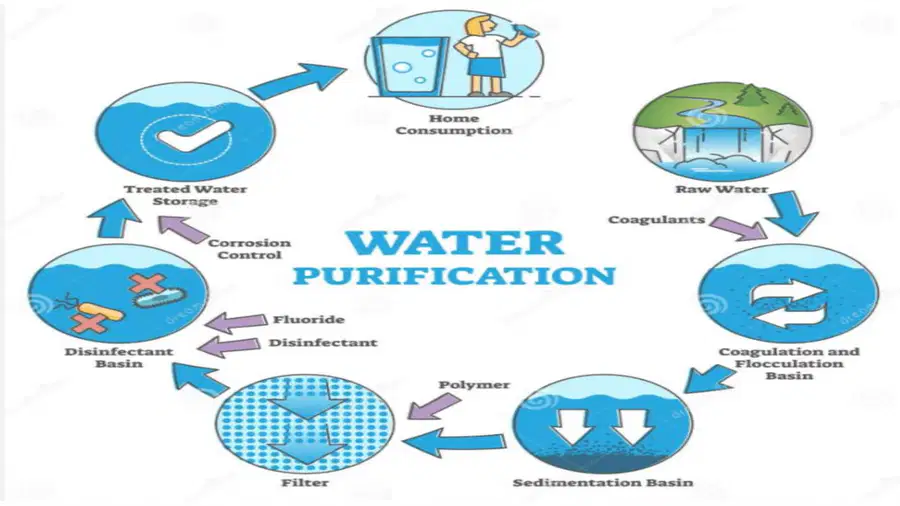
PURIFICATION
OF WATER FOR
PUBLIC
CONSUMPTION
22

Group Members
Yasin Alhassan
Abigail Aseda
Osei-Adjei
Kelsie Manzah
Buah
Awenley Davina
Ayarick
23

Contents of this template
● What is impure water?
● Sources of water contamination
● What is water purification?
● Key stages in the purification of water for public
consumption
24

What is impure water?
● Impure water is water
that is not suitable for
human consumption due
to impurities.
25

26

What is water purification?
They are the methods carried out in order to make water
suitable for human use or consumption.
Drinkable water is known as potable water.
27

Key Stages in the
purification of water for
consumption
28

Stage 1
The first step in purifying surface water
is by passing it through strainers to
remove large debris such as sticks,
leaves, trash and other large particles
which may interfere with subsequent
purification steps.
29

Stage 2
Water is pumped into large settling or
sedimentation tanks and then exposed to
sunlight. Here much of the suspended
particles settle down and therefore
removed. Also because of exposure to
sunlight, water is bleached to remove
undesirable colour.
30

Stage 3
Water is then passed through filter beds
made up of sand, fine gravels and
coarse gravels to remove both organic
and inorganic debris or large
suspended particles.
31

Stage 4
After filtration through sand and gravel beds, fine
suspended particles are removed by the addition of potash
alum in a tank(often called rapid mix tank or flash mixer)
which makes these particles coagulate and settle easily.
In most treatment plants, the mixture remains in the tank for
10 to 30 seconds to ensure full mixing. The amount of
coagulant that is added to the water varies widely due to
the different source water quality.
32

Stage 5
This stage is referred to as the chlorination or
disinfection stage.Here,water is disinfected by
passing chlorine gas through the water which kills the
microbes,harmful bacteria and other germs.
33

Stage 6
Because of passage of chlorine gas through
the water it becomes a little bit acidic. A
calculated amount of calcium hydroxide is
then added to control the pH.
34
35

Sources of Water
Group 4
Show answer
Auto Play
Slide 1 / 35
SLIDE
Similar Resources on Wayground

29 questions
Heat Energy
Presentation
•
8th - 11th Grade
29 questions
Convention & Compromise
Presentation
•
8th - 12th Grade
29 questions
Halloween Fun
Presentation
•
8th - 12th Grade
25 questions
Magnetism
Presentation
•
8th - 12th Grade
23 questions
Earthquakes
Presentation
•
8th - 12th Grade
25 questions
Crime Scene Investigation and Evidence Collection Part 2
Presentation
•
9th - 12th Grade
25 questions
newton's laws
Presentation
•
9th - 12th Grade
Popular Resources on Wayground
11 questions
Hallway & Bathroom Expectations

Quiz
•
6th - 8th Grade
10 questions
HCS SCI 03 Summer School Assessment 2
Quiz
•
3rd Grade
11 questions
Home Scope
Quiz
•
7th - 8th Grade
12 questions
2026 TAP Technology in the Classroom
Presentation
•
Professional Development
15 questions
HCS SCI 05 Summer School Assessment 2 Review
Quiz
•
5th Grade
15 questions
HCS SCI 04 Summer School Review 2
Quiz
•
4th Grade
59 questions
Geometry Unit 3 Review
Quiz
•
9th - 12th Grade
14 questions
FAST ELA READING SMAPLE TEST MATERIALS

Passage
•
3rd Grade