

6.17

Presentation
•
Mathematics
•
4th Grade
•
Practice Problem
•
Hard

Makayla Lewis
Used 1+ times
FREE Resource
29 Slides • 0 Questions
1


Teacher Facing
Day 1
Second Grade Mathematics
2










2
MRS Icons
3
3
Timer Options (Silent)
4







4
Timer Options (Soft Music)
5



5
Timer Options (Fun Music)
6

6
Daily Lesson include:
●Fluency
●Application Problems
●Concept Development and Student Guide Activity Problem Set
●Student Debrief and Demonstration of Learning
Alignment to Research
Alignment to Research
BALANCE CONCEPTUAL
& PROCEDURAL
Pursue rigor by balancing conceptual understanding, procedural skill and fluency. Apply this
balanced understanding to mathematical applications as required by the standards in the TEKS.
DEPTH OF KEY
CONCEPTS
Focus on math content that aligns to and meets the rigor of the TEKS for each grade level,
while concentrating time and effort on going deep on the mostimportant topics for the grade
level.
COHERENCE OF KEY
CONCEPTS
Connect concepts within and across grades along a strategic progression of learning so that
new understandings are built on previous foundations. Mathematics tells a continuous,
connected story.
PRODUCTIVE STRUGGLE
Students engage in productive problem solving, engaging in multiple opportunities for practice,
discussion, representations, and writing that requires them to explain and revise their thinking.
ASSESSMENTS
Leverage HQIM embedded assessments to drive instruction.
7


7
Eureka Math TEKS Edition lessons follow a structured approach that includes fluency activities,
conceptual understanding, procedural skills, and problem solving. The material is presented in a
deliberate progression from concrete to representational to abstract, allowing students to develop a
deeper understanding.
Concrete
Representational
Abstract
Students manipulate
hands-on, concrete
materials
Students draw and
utilize diagrams to
represent the concrete
manipulatives or to
create a visual
representation of the
concept
Students use numbers
and symbols that
connect to the
underlying math concept
and algorithm.
2 x 4=8
Concrete-Representational-Abstract
8


8
Great Minds PBC. Except where otherwise noted, this content is published
under a limited public license with the Texas Education Agency. Use limited
to noncommercial educational purposes. Where indicated, teachers may
copy pages for use by students in their classrooms. For more information,
visit https://gm.greatminds.org/texas.
9

9
Grade 2
Module 4
Topic F
Lesson 30
TEKS: 2.4B add up to four two-digit numbers and subtract two-digit numbers using mental strategies and algorithms
based on knowledge of place value and properties of operations.
LO: SWBAT solve addition number sentences using algorithms based on knowledge of place value and properties of
operations.
DOL: Given problems, I will solve addition number sentences using a variety of strategies based on knowledge of place
value and properties of operations correctly on 3 out 4 questions.
Vocabulary
1 minute
Fluency
5 minutes
Application Problem
5 minutes
Concept Development
20 minutes
Student Guide Activity Problem Set
10 minutes
Student Debrief
4 minutes
Demonstration of Learning
10 minutes
Total
55 minutes
Lesson Outline
10


Second Grade Mathematics
Day 1
11

LO: SWBAT solve addition number sentences using algorithms based on
knowledge of place value and properties of operations.
DOL: Given problems, I will solve addition number sentences using algorithms
based on knowledge of place value and properties of operations correctly on 3
out 4 questions.
K.6(A) identify two‐dimensional shapes, including circles, triangles, rectangles, and squares as special rectangles
TEKS: 2.4B add up to four two-digit numbers and subtract two-digit numbers using mental strategies and
algorithms based on knowledge of place value and properties of operations.
Module 4 | Topic F | Lesson 30
12

12
Lesson Vocabulary
New Groups Below
Totals Below
Algorithm
Newly composed units on
the line below the
appropriate place in the
addition problem.
Newly composed total on the
line below to show the total
of the addition problem
A step-by-step procedure to
solve a
particular type of problem
3 1
- 1 8
1 3
2 11
3 5
+12
7
4 0
4 7
3 5
+1 2
4 7
13

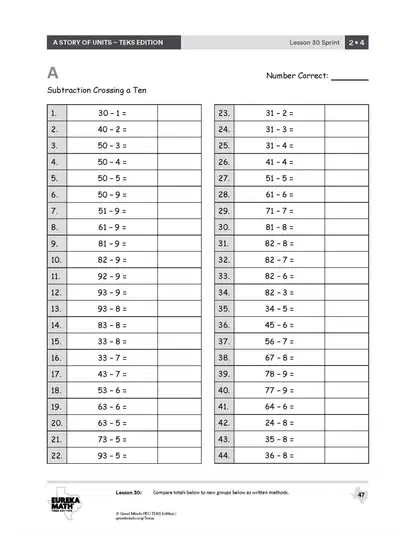
13
Check answers
for Sprint A
Check answers
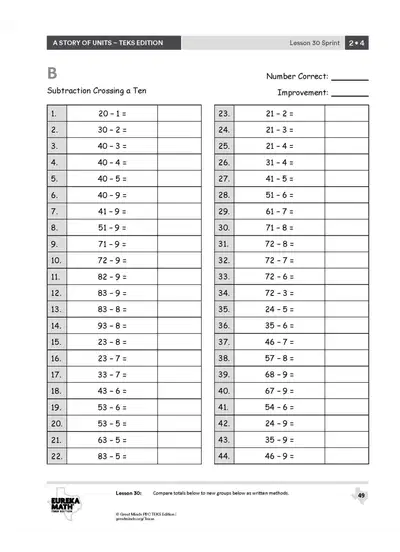
for Sprint B
14


14
READ: Eli spent 87 cents for a notebook and 38 cents for a pen.
How much money did he spend in all?
Image by Clker-Free-Vector-Images from Pixabay
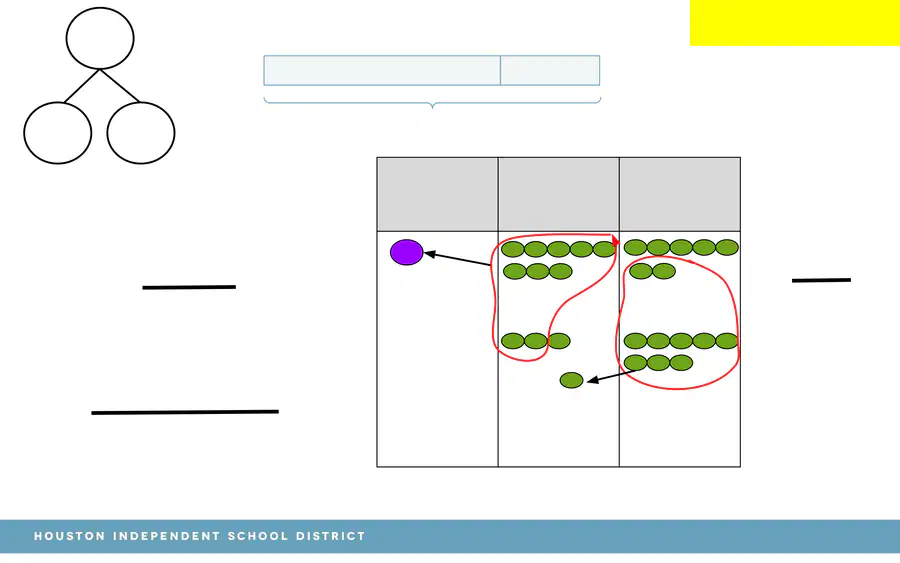
DRAW/Represent:
WRITE/Solve:
Teacher Note:
Second semester the verbiage
for application problems and
problem solving will change.
Getting students prepared for
what they will hear starting in
3rd grade. Slowly transition into
not labeling the problems but
allowing students to mentally
solve each problem with these 3
steps. Read, Represent, Solve!
READ → Read
DRAW →Represent
WRITE → Solve
I knew I was suppose to ____________ because the word______ tells me to
15
15
Teacher Exemplar
87 cents
38 cents
???
Notebook
Pencil
?
87
38
87
+ 38
15
110
+
125
Eli spent 125 cents, or $1.25, in all.
87
+ 38
125
H
T
O
1
5
2
16


16
I noticed I had to regroup when I ___________________
17

17
Teacher Exemplar
Problem 1:
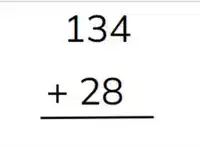
134
134
134
+ 28
+ 28
+ 28
162
12
100
50
50
100
12
162
162
1
BE CAREFUL !!
If you show students to
add from left to right, just
remember this may
become a misconception
for students when solving
as it will be incorrect in
certain situations and
adding from left to right will
not work.
18


18
I noticed I had to regroup when I ___________________
19
19
Teacher Exemplar
Problem 2:
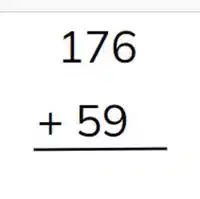
176
176
176
+ 59
+ 59
+ 59
235
15
100
120
120
100
15
235
235
11
BE CAREFUL !!
If you show students to
add from left to right, just
remember this may
become a misconception
for students when solving
as it will be incorrect in
certain situations and
adding from left to right will
not work.
20

20
179
+ 18
56
+ 82
105
+ 89
21

21
Teacher Exemplar
105
+ 89
194
149
+ 39
188
118
+ 82
200
105
+ 89
194
14
80
100
149
+ 39
188
18
70
100
10
90
100
1
118
+ 82
200
22


22
23


23
24
24
25
25
26
26
27

27
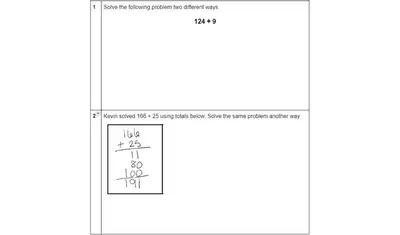
Teacher Exemplar
133
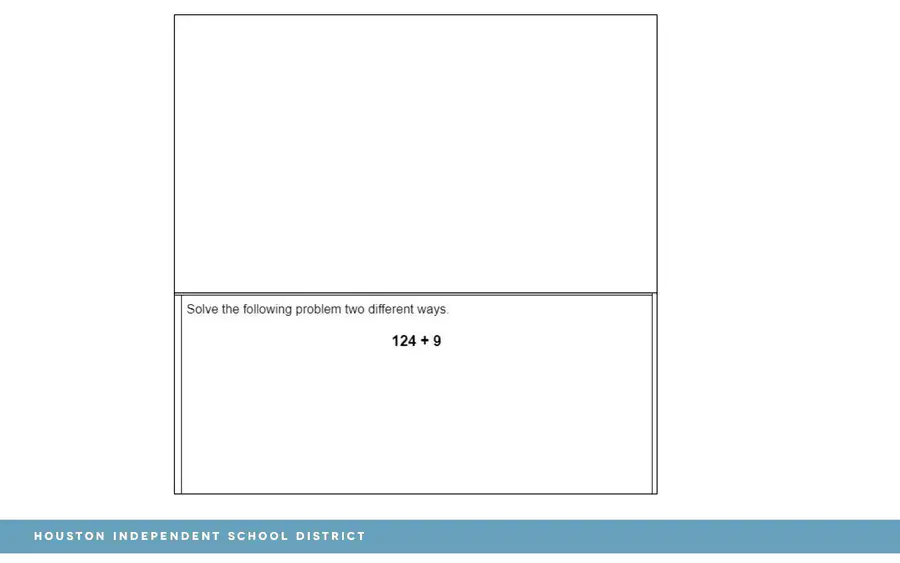
124
+ 9
13
20
100
124
+ 9
133
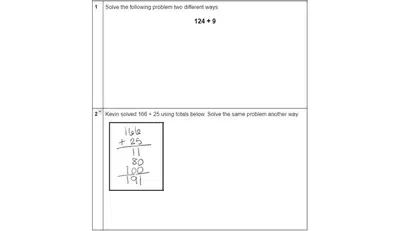
191
166
+ 25
166
+ 25
100 + 60 + 6
20 + 5
100 + 80 + 11
100 + 90 + 1
191
191
166
25
1
1
9
Students work may vary.
Students work
may vary.
28


28
Teacher Exemplar
7
60
100
142
+ 25
167
100 + 40 + 2
20 + 5
100 + 60 + 7
167
142
+ 25
Students work may vary.
142
+ 25
167
29

29
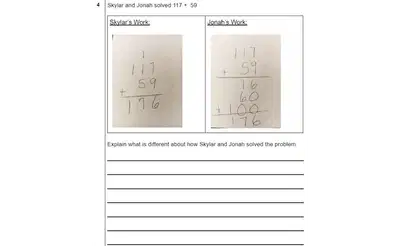
Teacher Exemplar
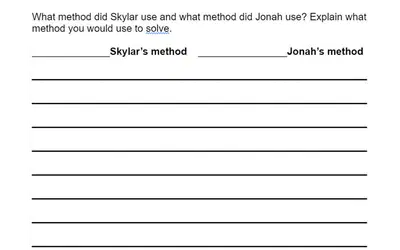
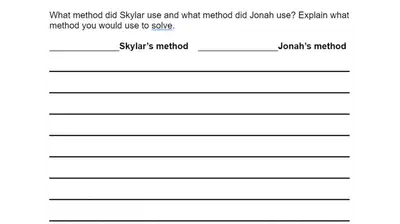
Students explanations may vary.
Total Below
New Groups Below
Teacher Facing
Day 1
Second Grade Mathematics
Show answer
Auto Play
Slide 1 / 29
SLIDE
Similar Resources on Wayground

22 questions
Relating Fractions and Decimals
Presentation
•
4th Grade
22 questions
Equivalent Fractions
Presentation
•
4th Grade
21 questions
Adding and Subtracting Fractions
Presentation
•
4th - 5th Grade
20 questions
Changing Percents to Decimals
Presentation
•
KG
20 questions
Whole Number Operations
Presentation
•
4th Grade
19 questions
19.4 Compare Customary Units of Liquid Measurement
Presentation
•
4th Grade
20 questions
Fraction-Of Whole Numbers
Presentation
•
4th - 5th Grade
21 questions
Fractions with Denominators of 10s and 100s
Presentation
•
4th Grade
Popular Resources on Wayground
19 questions
Naming Polygons

Quiz
•
3rd Grade
10 questions
Prime Factorization
Quiz
•
6th Grade
20 questions
Math Review
Quiz
•
3rd Grade
15 questions
Fast food
Quiz
•
7th Grade
20 questions
Main Idea and Details
Quiz
•
5th Grade
20 questions
Context Clues
Quiz
•
6th Grade
20 questions
Inferences
Quiz
•
4th Grade
19 questions
Classifying Quadrilaterals
Quiz
•
3rd Grade
Discover more resources for Mathematics
20 questions
Classifying Quadrilaterals
Quiz
•
3rd - 4th Grade
35 questions
4th Grade Math SOL Review
Quiz
•
4th Grade
16 questions
multiplication facts
Quiz
•
4th Grade
30 questions
Multiplication Facts 1-12
Quiz
•
2nd - 5th Grade
25 questions
4th Grade End of Year Math Review
Quiz
•
4th Grade
14 questions
Fractions to Decimals & Decimals to Fractions
Quiz
•
4th Grade
77 questions
Mixed Multiplication and Division Facts
Quiz
•
4th Grade
20 questions
Geometry Review
Quiz
•
4th Grade