

24-25 G5 Reading News Online - S2

Presentation
•
Other
•
5th Grade
•
Practice Problem
•
Hard

Mohit Shah
Used 8+ times
FREE Resource
13 Slides • 0 Questions
1


commonsense.org/education
Shareable with attribution for noncommercial use. Remixing is permitted.
headline
The headline is the title of a news article. It's
usually printed in big, bold letters near the top
of the article.
The headline tells readers what the article is
about before they start reading.
OBSERVE + ANALYZE IMAGE
They sometimes exaggerate or say something different from the article to get you to click on them.
2


commonsense.org/education
Shareable with attribution for noncommercial use. Remixing is permitted.
byline
The byline is the name of the article's author.
It tells readers the name of the person
(or people) who wrote the article.
OBSERVE + ANALYZE IMAGE
If there's no byline or date, the article might not be trustworthy.
3


commonsense.org/education
Shareable with attribution for noncommercial use. Remixing is permitted.
URL
The URL is the unique, one-of-a-kind address
of an article on the web.
It helps you know exactly which webpage
you're looking at. It might also help you share
the article with someone else.
OBSERVE + ANALYZE IMAGE
Always double-check to make sure you're actually on the page you're looking for.
4


commonsense.org/education
Shareable with attribution for noncommercial use. Remixing is permitted.
section title
The section title is the category or section of an
article on a news website.
It tells you what type of article you're reading
and how the article is categorized by the website.
OBSERVE + ANALYZE IMAGE
If you want the facts, just be sure you're not on an opinion article.
5



commonsense.org/education
Shareable with attribution for noncommercial use. Remixing is permitted.
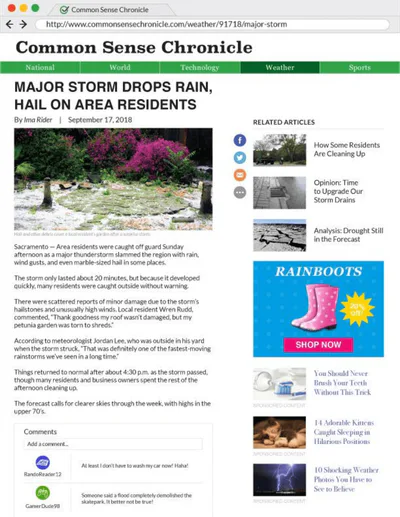
image
The main image is a photograph (or video) that's
usually near the top of an article, under the
headline.
The image or video helps introduce the article and
sometimes shows details that words can't.
OBSERVE + ANALYZE IMAGE
It might be too crazy to be true, or misleading, or might be advertisements.
6


commonsense.org/education
Shareable with attribution for noncommercial use. Remixing is permitted.
date
The date is the exact day (and sometimes time)
when the article was published or last updated.
It tells you how recently the article was published
and how current the information is.
OBSERVE + ANALYZE IMAGE
If there's no byline or date, the article might not be trustworthy.
7


commonsense.org/education
Shareable with attribution for noncommercial use. Remixing is permitted.
Related articles are links to more articles from
the same website. They may be similar to the one
you're reading.
They help show readers more articles that might
be interesting or important.
related articles
OBSERVE + ANALYZE IMAGE
They could be opinion pieces or other things that aren't news articles.
8


commonsense.org/education
Shareable with attribution for noncommercial use. Remixing is permitted.
Advertisements (or ads) are links to other
websites that are usually selling something.
They help the news website make money by
selling space on their article pages.
advertisements
OBSERVE + ANALYZE IMAGE
Advertisements can be disguised to look like news articles. Don't let them fool you.
9


commonsense.org/education
Shareable with attribution for noncommercial use. Remixing is permitted.
sponsored content
Sponsored content is a link to another website.
This content is usually not news (even though it
might be disguised to look like news).
It helps the news website make money by selling
space on their article pages.
OBSERVE + ANALYZE IMAGE
It can include shocking headlines or wild images to get you to click on them.
10



commonsense.org/education
Shareable with attribution for noncommercial use. Remixing is permitted.
comments
Comments are thoughts and opinions about the
article that any reader can post.
They give readers a public place to post reactions,
thoughts, and questions. The comments section is
also a place to have a discussion or debate about
the article.
OBSERVE + ANALYZE IMAGE
Comments are open for anyone to post, even if what they have to say is mean or completely untrue.
11

Name the components in the following links.
12
What is sudden stratospheric warming? Inside the ultra-rare weather hitting the UK | The Independent
You can open this webpage in a new tab.
13
Check out this News Article and name its components.
commonsense.org/education
Shareable with attribution for noncommercial use. Remixing is permitted.
headline
The headline is the title of a news article. It's
usually printed in big, bold letters near the top
of the article.
The headline tells readers what the article is
about before they start reading.
OBSERVE + ANALYZE IMAGE
They sometimes exaggerate or say something different from the article to get you to click on them.
Show answer
Auto Play
Slide 1 / 13
SLIDE
Similar Resources on Wayground

9 questions
Boston Massacre Paired Passages
Presentation
•
5th Grade
12 questions
Authors purpose
Presentation
•
6th Grade
12 questions
Firsthand and Secondhand Accounts
Presentation
•
4th Grade
11 questions
Phyto-Power
Presentation
•
5th Grade
6 questions
Broken-Crayon Solution
Presentation
•
4th Grade
12 questions
Who is Santa?
Presentation
•
5th Grade
11 questions
Summarizing
Presentation
•
5th Grade
9 questions
Well-Being Studies Weekly Week 3 Article 4
Presentation
•
6th Grade
Popular Resources on Wayground
11 questions
Hallway & Bathroom Expectations

Quiz
•
6th - 8th Grade
10 questions
HCS SCI 03 Summer School Assessment 2
Quiz
•
3rd Grade
11 questions
Home Scope
Quiz
•
7th - 8th Grade
12 questions
2026 TAP Technology in the Classroom
Presentation
•
Professional Development
15 questions
HCS SCI 05 Summer School Assessment 2 Review
Quiz
•
5th Grade
15 questions
HCS SCI 04 Summer School Review 2
Quiz
•
4th Grade
59 questions
Geometry Unit 3 Review
Quiz
•
9th - 12th Grade
14 questions
FAST ELA READING SMAPLE TEST MATERIALS

Passage
•
3rd Grade