
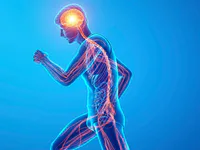
Nervous System

Presentation
•
Science
•
5th Grade
•
Practice Problem
•
Easy
+9
Standards-aligned

Beatriz Cortes
Used 4+ times
FREE Resource
8 Slides • 12 Questions
1
Your nervous system is in charge of the movement and storage of all the information in your body. Your brain sends and receives messages about what is happening in and around your body through the central nervous system. The brain is made of millions of neuron cells; these are the smallest part of the nervous system where the information is stored and moved from one neuron to another.
The nervous system controls all

2
Multiple Choice
What is the primary function of the nervous system?
To circulate blood throughout the body
To move and store information
To provide nutrients to cells
3
Multiple Choice
What are neurons?
The largest part of the nervous system
Cells that transport oxygen
The smallest part of the nervous system where information is stored
4
The nervous system is divided in two main parts: the central nervous system and the peripheral nervous system.

5
The central nervous system is made up of your spinal cord and your brain and carries messages between your brain and the rest of your body.
Your spinal cord is a network of nerve cells connected to one another from the brain to the lower back. It is between 43 and 45 cm long and is covered by a bone tissue called backbone.

6
Multiple Choice
What are the two main parts of the nervous system?
Central nervous system and respiratory system
Central nervous system and peripheral nervous system
Peripheral nervous system and digestive system
7
Multiple Choice
What is the spinal cord covered by?
Muscle tissue
Skin
Bone tissue called backbone
8
Your brain is the director of your body which controls everything you do, even when you are asleep. The brain sends and receives information through neurons. Neurons are cells specialized in transmitting messages through the nervous system to and from the brain; they also store the information. Your brain has three main parts:

9
The cerebrum is the biggest and heaviest part of your brain. It is divided into several parts that are responsible for different functions. Some parts receive and process information about sight, touch, hearing, smelling and taste; other areas control movement, speech, learning, intelligence, personality and your memory.
The cerebellum is a lot smaller and lighter than the cerebrum. However, it is a very important part of your brain because it controls and coordinates the movements of your muscles to give you balance. Thanks to your cerebellum, you can stand straight, walk and play sports.
The brain stem is small but mighty. If the brain is the director of your body, the brain stem is the brain’s personal assistant. It controls your heart beating and your lungs breathing without you having to tell them to do so. Without your brain stem, you could not survive.


10
Multiple Choice
What does the cerebrum control?
Digestion and respiration
Movement, speech, and memory
Circulation and excretion
11
Multiple Choice
What is the main function of the cerebellum?
Control digestion
Coordinate muscle movements for balance
Process visual information
12
Multiple Choice
What does the brain stem control?
Voluntary muscle movements
Heartbeat and breathing
Digestive processes
13
The peripheral nervous system carries messages between the central nervous system and the rest of your body. It sends information to the brain and carries out orders from the brain. It is divided into two main parts: the somatic system and the autonomic system.
Communication is all over your body

14
The Somatic System
How can you be connected to the world around you? This is possible thanks to your sense organs! The somatic system sends all the information collected by your sense organs to the central nervous system.
The Autonomic System
Imagine you had to keep telling your body to breathe in and out, even while you were sleeping. How hard would that be? The autonomic system directs all the involuntary activities like breathing, digesting food and pumping blood to your heart; it continues to work without you having to think about the actions. This system is in charge of sending those orders continuously to your body.

15
Information Flow
Your nervous system is made up of thousands and thousands of neurons. Each neuron is made up of dendrites, a cell body, an axon, a nucleus and a synaptic terminal. The dendrites bring information to the cell body and the axon takes the information away from the cell body to the synaptic terminal. The synaptic terminal is at one end of the neuron and it is made up of many tiny branches that connect the neuron to many other neurons. It is also made up of many tiny sacs that hold the neurotransmitters. The neurotransmitter is a type of chemical substances; its job is to transmit messages from one neuron to the other. Each neuron has its own neurotransmitter.

16
Multiple Choice
What does the peripheral nervous system do?
It controls voluntary movements only
It stores information
It carries messages between the central nervous system and the rest of the body
17
Multiple Choice
What is the function of the somatic system?
To send information from sense organs to the central nervous system
To control involuntary actions like breathing
To regulate heart rate
18
Multiple Choice
Which system is responsible for involuntary activities?
Somatic system
Autonomic system
Peripheral nervous system
19
Multiple Choice
What is the role of dendrites in a neuron?
They transmit messages from one neuron to another
They bring information to the cell body
They hold neurotransmitters
20
Multiple Choice
What are neurotransmitters?
Chemical substances that transmit messages between neurons
Electrical signals in the brain
Parts of the spinal cord
Your nervous system is in charge of the movement and storage of all the information in your body. Your brain sends and receives messages about what is happening in and around your body through the central nervous system. The brain is made of millions of neuron cells; these are the smallest part of the nervous system where the information is stored and moved from one neuron to another.
The nervous system controls all
Show answer
Auto Play
Slide 1 / 20
SLIDE
Similar Resources on Wayground

13 questions
Food Chains and Food Webs Lesson
Presentation
•
5th Grade
15 questions
Respiratory System Lesson
Presentation
•
5th - 6th Grade
18 questions
Electric Circuits
Presentation
•
5th Grade
16 questions
The Sun!
Presentation
•
5th Grade
14 questions
Circuits and Electricity
Presentation
•
5th Grade
16 questions
Inherited Traits
Presentation
•
5th Grade
13 questions
Newton's First Law
Presentation
•
5th Grade
17 questions
Physical Science: Forces and Motion
Presentation
•
5th Grade
Popular Resources on Wayground
25 questions
The Ultimate College Knowledge Quiz

Quiz
•
8th Grade
20 questions
Math Review
Quiz
•
3rd Grade
15 questions
Fast food
Quiz
•
7th Grade
20 questions
Math Review
Quiz
•
6th Grade
20 questions
Context Clues
Quiz
•
6th Grade
20 questions
Inferences
Quiz
•
4th Grade
19 questions
Classifying Quadrilaterals
Quiz
•
3rd Grade
20 questions
Figurative Language Review
Quiz
•
6th Grade
Discover more resources for Science
45 questions
Science SOL Review 1
Quiz
•
5th Grade
25 questions
5th Grade NC Science EOG Review Part 1
Quiz
•
5th Grade
20 questions
5th grade science EOG practice
Quiz
•
5th Grade
20 questions
5th grade science EOG review #3
Quiz
•
5th Grade
18 questions
Science EOG Review
Quiz
•
5th Grade
20 questions
NC Science EOG Prep (5th Grade)
Quiz
•
5th Grade
20 questions
5th grade science EOG review #4
Quiz
•
5th Grade
20 questions
5th Grade Science
Quiz
•
5th Grade