Search Header Logo
Unit 1.1 Ecosystem Stability

Unit 1.1 Ecosystem Stability

Assessment

Presentation

Other, Biology, Science

9th - 12th Grade

Practice Problem

Medium

Created by

Samah Al-hamadi

Used 6+ times

FREE Resource

14 Slides • 46 Questions

1

media

2

media

3

4

Open Ended

Question image

How did the wolves influence the ecosystem?

5

Multiple Choice

What would most likely happen if an ecosystem no longer received sunlight?
1
The number of herbivores would increase
2
The number of plants would increase
3
all organisms would adapt
4
All living organisms would eventually die

6

Multiple Choice

Question image
The place where an organism lives is called...
1
Biome
2
Habitat
3
Abiotic
4
Biotic

7

Multiple Choice

What is ecology?

1

the study of animals

2

astronaut school

3

a deadly bacteria

4

the study of ecosystems

8

Multiple Choice

What is an ecosystem?

1

all the living and nonliving factors in an area

2

a system of pipes and drains in a field

3

all the living organisms in an environment

4

an organization system used by scientists

9

Multiple Choice

What is competition?

1

an interaction between two species where both benefit

2

an interaction that occurs when two species compete for the same resource

3

when one animal eats another

4

a soccer game

10

Multiple Choice

Give some examples of limiting factors

1

a balance in the ecosystem

2

food, water, predators, space, disease, etc.

3

desert, wetland, alpine, forest

4

plants, animals, fungus

11

Multiple Choice

Which of the following is a true statement?

1

Pinecones are abiotic because they grow on a tree.

2

Dead pine needles are considered abiotic because they are no longer alive.

3

Water is biotic because it is not living.

4

Soil is abiotic because it is not living.

12

Multiple Choice

Question image

What is this?

1

Food Web

2

Food Chain

13

Match

Match the following

Biotic

Abiotic

Ecosystem

living things

Nonliving things

 the relationship between living and nonliving parts of the environment

14

Multiple Choice

A change in a characteristic of a living thing that allows it to survive in its environment is called _____________.

1

an adaptation

2

an ecosystem

3

migration

15

media

16

Multiple Choice

Question image
What is an ecosystem?
1
A system of living and non-living things working together
2
The flow of energy and matter
3
Everything in the environment
4
Photosynthesis

17

media

18

Multiple Choice

Question image
plants, rocks, air, sunlight, water, 
1
ecosystem 
2
population 
3
community 

19

Multiple Choice

Question image
all the snakes in the area 
1
organism 
2
ecosystem 
3
population 

20

Multiple Choice

snakes, mice, small birds, crickets, hawks, cactus, tumbleweed
1
organism
2
community
3
population 

21

Multiple Choice

Question image
A snake 
1
ecosystem 
2
organism 
3
population 

22

media

23

Categorize

Options (15)

Sun

Wind

Rocks

Water

Soil

Mountains

Desert

Ice

Plants

Animals

Fungi

Bacteria

Algae

Protozoa

Insects

Question image

Organize these options into the right categories

Abiotic
Biotic

24

Dropdown

The nonliving part of the ecosystem such as oxygen, water,soil are ​
factors, while the living parts of the organisms such as plants, animals, and animal feces are ​
factors.

25

media

26

Labelling

Label each group with their mode of nutrition:

Drag labels to their correct position on the image

Heterotrophs

Autotrophs

27

Multiple Choice

Plants need _____ to make food.

1

light

2

protection

3

to stay warm

28

media

29

Multiple Choice

Biodiversity refers to…

1

the variety of species in an ecosystem

2

extinct species

3

the rate of species decline

4

nonrenewable resources

30

Multiple Choice

Which answer is true regarding biodiversity?

1

As long as there are enough producers, an ecosystem is considered to have a good amount of biodiversity.

2

The rain forest has an unhealthy ecosystem because its biodiversity is too great.

3

An ecosystem is healthier when the biodiversity is great.

4

Biodiversity is positively affected when non-native species are introduced into an environment

31

Reorder

Question image

Order the following ecosystems from most stable to least stable.

1
2
3
4

32

media

33

Multiple Select

Question image

Which 2 answers are true about stable ecosystems?

1

Healthy ecosystems have a stable balance between producer and consumer populations.

2

Stable ecosystems have more consumers than they can support.

3

Healthy ecosystems have high biodiversity.

4

Stable ecosystems have too many producers.

34

Multiple Choice

Which ecosystem below describes a stable ecosystem?

1

An invasive species decreased the amount of biodiversity by half

2

This ecosystem’s deer have increased due the loss of a predator population, now the producer population has decreased by ¼.

3

This ecosystem suffered a tornado, but due to great biodiversity, it was able to be restored.

4

This ecosystem is impacted by overfishing, causing 3 fish species to become extinct.

35

Multiple Choice

An organisms ability to withstand change is called its?

1

Limit

2

Tolerance

3

Niche

4

Habitat Range

36

media

37

Multiple Choice

On a safari at night, a lion hunts and feeds on an antelope. In this relationship, the lion is the ____________________ and the antelope is the _________________.

1

Parasite/host

2

Predator/prey

3

Prey/Predator

38

media

39

Multiple Select

Check all the natural disasters that can worsen with climate change.

1

Floods

2

Hurricanes

3

Tornados

4

Heat waves

40

Multiple Choice

What is causing climate change NOW?

1

Human activity

2

Orbital variation

3

Earth's proximity to the Sun

41

media

42

Multiple Select

What are some activities YOU can do to help the climate change problem?

1

Recycle and reuse

2

Eat less meat

3

Eat locally grown produce and meat

4

Turn off electronics when not in use

43

media

44

Multiple Choice

Examples of how humans negatively affect local ecosystems are
1
Building dams, deforestation (cutting down trees), adding point sources to nearby streams to allow for run-off, building roads and structures, and salting roads.
2
Creating laws to prohibit fishing from local streams.
3
Planting trees and other plants to attract native species.
4
Removing non-native species from the environment.

45

media

📍 Unit at a Glance: Following Questions are about topics we will cover for the rest of the unit.

46

Multiple Choice

Question image
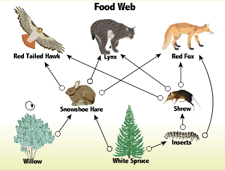
What may happen if the snowshoe hare was removed from the food web pictured?
1
The insects in the habitat would increase.
2
The shrew population would decrease due to being only hawk food source.
3
The willow tree population would decrease.
4
Foxes would dies due to no food source. 

47

Multiple Choice

Question image

How would the biodiversity of this ecosystem be affected if the lantern fish disappeared?

1

The ocean sunfish population would increase.

2

The large shark population would die out.

3

The squid would die out.

4

There would be no change.

48

Multiple Choice

Question image

How might deforestation impact this ecosystem?

1

Birds will increase

2

Squirrels will increase

3

Insects and birds will decrease

4

Insects and birds will increase

49

Multiple Choice

A group of people in your town decide they will each use a portion of their yard to plant a variety of native plants. Fifty families replace a part of their yard with native plants.  

Which of these is most likely to happen?


1


The population of the town will decrease.

2


The biodiversity of the town will increase.

3


Native animals will move away.

50

Multiple Choice

Question image

Describe what would happen to the zebra population and the plant population if the cheetah and hyena both left the ecosystem.

1

The zebra population would decrease with the absence of predators; the plant population would stay the same.

2

The zebra population would greatly increase, causing the plant population to decrease.

3

The zebra population would decrease, causing the plant population to increase.

4

The zebra population would greatly increase, causing the plant population to also increase.

51

Multiple Choice

Question image
Which of the following would be the most likely effect, if there were a sudden increase in the cricket population?
1
There would be a decrease in the small bird population.
2
There would be a decrease in the grass/flowers population.
3
There would be a decrease in the mice population.
4
There would be an increase in the grass/flowers population.

52

Multiple Choice

Question image

Which organism represents an herbivore?

1

Coyote

2

Vulture

3

Grasshopper

4

Mouse

53

Multiple Choice

Question image

Which organisms represent carnivores?

1

The hawk and snake because they eat producers.

2

The coyote and vulture because they eat the remains of dead animals.

3

The grasshopper and mouse because the only eat consumers.

4

The hawk and coyote because they only eat consumers.

54

Multiple Choice

In an ecosystem, a fungus, such as the mushroom pictured here, functions as a

1

autotroph

2

heterotroph

3

decomposer

4

predator

55

Multiple Choice

Which of these is not a consumer?

1

Tiger

2

Squirrel

3

Fish

4

Apple Tree

56

Multiple Choice

What is a example of a abiotic factor?

1

Panda

2

Bacteria

3

Butterfly

4

Weather

57

Multiple Choice

Question image

The Sun is the source of all energy within an ecosystem. Plants depend on light from the sun in order to perform the process of photosynthesis. Sunlight is an example of what type of factor?

1

Biotic

2

Abiotic

58

Multiple Choice

Question image

Great Danes are large dogs that were originally referred to as boar hounds because they were bred to hunt boars. They are one of the tallest dog breeds and can weigh up to 200 pounds. Great Danes are an example o which type of factor?

1

Biotic

2

Abiotic

59

Multiple Choice

An individuals success depends on its health, strength and response. This is also known as.....

1

The hulk effect

2

Survival of the fittest

3

Top dog

4

The alpha

60

Multiple Choice

Question image

1

Pink salmon were nearly eliminated after the oil spill

2

Pink salmon populations steadily declined in the 10 years following the spill

3

Pink salmon populations declined and never fully recovered

4

Pink salmon populations seemed to be minimally affected

media

Show answer

Auto Play

Slide 1 / 60

SLIDE