

Gen. Bio Divide and Multiply

Presentation
•
Science
•
11th Grade
•
Practice Problem
•
Medium

Ruth Petalino
Used 2+ times
FREE Resource
9 Slides • 2 Questions
1
Divide and Multiply
2
Dropdown
3
4
Labeling
Label the Fluid mosaic model.
Phospholipid bilayer (hydrophilic part
Cholesterol
carbohydrate
Integral protein
Cytoskeletal filaments
Phospholipid bilayer (hydrophobic)
Glycoprotein
Peripheral protein
5
Why do cells divide?
Growth
Tissue Repair & Regeneration
Reproducation
Genetic Diversity

Maintenance of Cellular Function
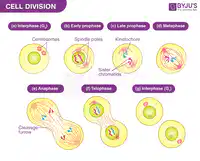


6

7
8
1. How are cancer cells different from normal cells? What key differences do you notice between normal cells and cancer cells in the video, and why do you think these differences lead to uncontrolled growth?
2.In what ways do you think cancer treatments target the cell cycle, and how might this understanding influence the effectiveness of these treatments?
3.What is cell cycle and why is it important to have checkpoints within each level? What controls this checkpoints?
Relevance to the topic - 7 pts
Depth of reflection - 10 pts
Communication of Ideas - 3 pts
20 pts
Questions to Ponder
9

Positive Regulators
Negative Regulators
Checkpoint Mechanism
Importance of Regulations
Regulation of Cell Cycle
10
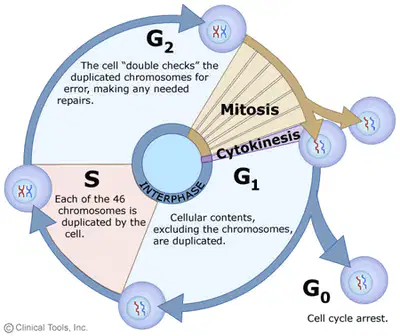
Major Phases
It is traditionally divided into four main phases: G1 (gap 1), S (synthesis), G2 (gap 2), and M (mitosis).
During G1, the cell grows and produces proteins and organelles. The S phase is where DNA is replicated, forming sister chromatids. G2 follows, involving further growth, synthesize protein and preparation for mitosis.
Cell Cycle
Checkpoints
The cell cycle is tightly regulated by checkpoints at the G1, G2, and M phases, ensuring that conditions are favorable for progression to the next phase. For instance, the G1 checkpoint verifies cell size, DNA integrity, and nutrient availability, while the G2 checkpoint checks the accuracy of DNA replication
11
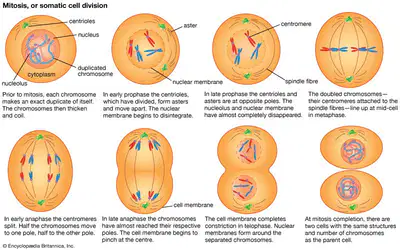
Mitosis consists of four key phases: prophase, metaphase, anaphase, and telophase. Each phase represents specific events in the organization and separation of chromosomes, beginning with their condensation and culminating with the formation of two new nuclei.
The ultimate goal of mitosis is to produce two genetically identical daughter cells from a single parent cell, thereby preserving the same genetic information in both new cells. This process is essential for growth, development, and repair in multicellular organisms, ensuring that each new cell retains a complete set of chromosomes
Mitosis
Divide and Multiply
Show answer
Auto Play
Slide 1 / 11
SLIDE
Similar Resources on Wayground

10 questions
Integumentary
Presentation
•
11th - 12th Grade
10 questions
untitled
Presentation
•
KG
11 questions
Organization of multicellular organism
Presentation
•
11th Grade
8 questions
Homework: U.S. entering WWI --dissenters
Presentation
•
11th Grade
12 questions
Activité retour des Fêtes
Presentation
•
11th Grade
11 questions
Lymphatic system
Presentation
•
11th Grade
12 questions
DNA Technology
Presentation
•
10th Grade
11 questions
Bimbingan dan Konseling
Presentation
•
KG
Popular Resources on Wayground
6 questions
PRIDE Always and Everywhere
Presentation
•
12th Grade
20 questions
Lab Safety Quiz

Quiz
•
6th Grade
26 questions
KOR Review Kahoot Questions
Quiz
•
8th Grade
21 questions
Continents and Oceans
Quiz
•
6th Grade
12 questions
Unit Zero lesson 2 cafeteria
Presentation
•
9th - 12th Grade
20 questions
Parts of Speech
Quiz
•
5th Grade
10 questions
Riddles Riddles fun Riddles
Quiz
•
6th - 12th Grade
16 questions
Subject & Predicate
Quiz
•
5th Grade
Discover more resources for Science
16 questions
Identify Key Characteristics of Living Organisms
Quiz
•
9th - 12th Grade
26 questions
Introduction to Anatomy and Physiology
Quiz
•
11th Grade
19 questions
Explore Macromolecules in Living Organisms
Quiz
•
9th - 12th Grade
20 questions
Reading Graphs in Science
Quiz
•
9th - 12th Grade
30 questions
Identifying Artificially Generated Images
Quiz
•
9th - 12th Grade
5 questions
Ch 14 - Ecology
Quiz
•
9th - 12th Grade
23 questions
Specific heat capacity (conceptual)
Quiz
•
9th - 12th Grade
16 questions
Significant Figures and Scientific Notation Mastery Quiz
Quiz
•
11th Grade