

Electrons in atom

Presentation
•
Chemistry
•
10th Grade
•
Practice Problem
•
Medium

Fajar Hidayatullah
Used 11+ times
FREE Resource
12 Slides • 16 Questions
1
Ionisation Energy
Atomic radius
2
Open Ended
What is definition of 1st ionisation energy?
3
Fill in the Blanks
4
Open Ended
Write the equation of 3rd ionisation energy of calcium
5
The big gap in ionisation energies can determine the valence electrons of an atom and the group

6
Fill in the Blanks
7
Fill in the Blanks
8
Fill in the Blanks
9
Fill in the Blanks
10
Electronic configurations

11
Multiple Choice
Which subshell has 5 orbitals?
s
p
d
f
12
Fill in the Blanks
13
Fill in the Blanks
14
Fill in the Blanks
15
Fill in the Blanks
16
Fill in the Blanks
17
Fill in the Blanks
18
Fill in the Blanks
19
Periodic patterns of atomic and ionic radii
Atomic radius
20
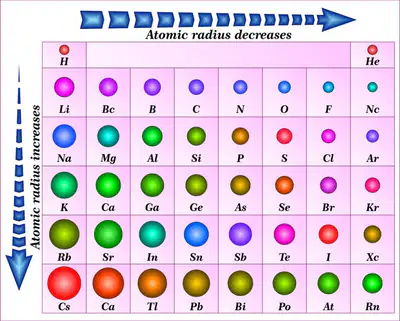
The atomic radius increases down any group. This is because, going down the group, each successive element has one more shell of electrons which is further from the nucleus.
Although there is also an increasing nuclear charge going down the group, the increased effect of inner shell electrons shielding the outer shell electrons is more important.
The atomic radius decreases across any period. This is because the number of protons, and therefore the nuclear charge, increases by one with each successive element. The number of electrons also increases by one but the extra electron added goes into the same (outer) energy level. This means that the shielding does not change significantly. The greater attractive force of the increased nuclear charge on the outer shell electrons pulls them closer to the nucleus.
21
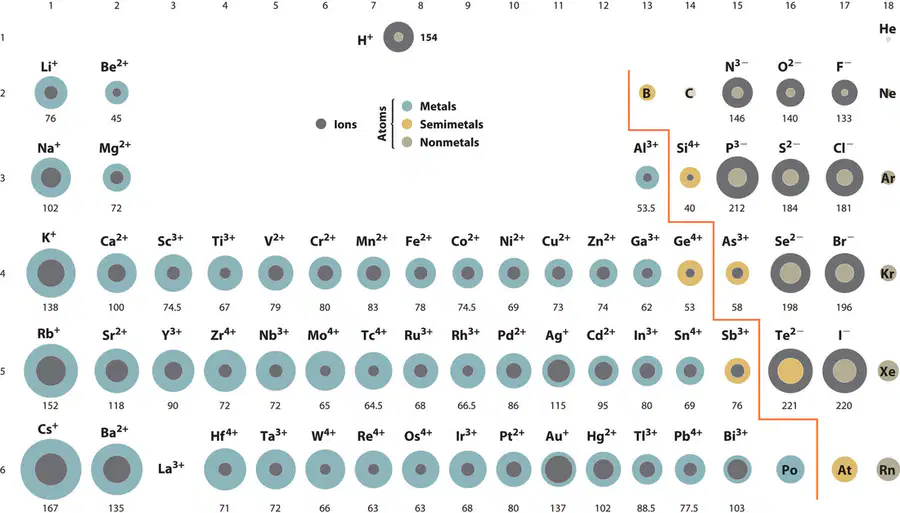
The ionic radius increases down any group (for ions with the same charge).
Positively charged ions are smaller than their original atoms because they have lost their outer shell electrons.
Negatively charged ions in Groups 15 to 18 are larger than their original atoms because each atom will have gained one or more extra electrons into their outer energy level.ncreased
22
Patterns in ionisation energies in the Periodic Table
23
There is a general increase in IE1 across a period.
This applies to Period 1 (hydrogen and helium), Period 2 (lithium to neon) and also to other periods.
As you go across a period the nuclear charge increases. But the electron removed comes from the same shell. The force of attraction between the positive nucleus and the outer negative electrons increases across the period because:
• the nuclear charge increases
•the distance between the nucleus and the outer electron remains reasonably constant
•the shielding by inner shells remains reasonably constant.

Patterns across a period
24
There is a rapid decrease in ionisation energy between the last element in one period and the first element in the next period.
The IE1 for lithium is much smaller than the IE1 for helium. Helium has two electrons. These are in the first quantum shell. But lithium has three electrons.
The third electron must go into the next quantum shell further away from the nucleus.
The force of attraction between the positive nucleus and the outer negative electrons decreases because: •the distance between the nucleus and the outer electron increases
•the shielding by inner shells increases
•these two factors outweigh the increased nuclear charge.constant.
25
There is a slight decrease in IE1 between beryllium and boron.
Although boron has one more proton than beryllium, there is a slight decrease in IE1 on removal of the outer electron.
Beryllium has the electronic structure 1s2 2s2 and boron has the electronic structure 1s2 2s2 2p1.
The fifth electron in boron must be in the 2p sub-shell, which is slightly further away from the nucleus than the 2s sub-shell.
There is less attraction between the fifth electron in boron and the nucleus because:
•the distance between the nucleus and the outer electron increases slightly
•the shielding by inner shells increases slightly
•these two factors outweigh the increased nuclear charge.
26
There is a slight decrease in IE1 between nitrogen and oxygen. Oxygen has one more proton than nitrogen and the electron removed is in the same 2p sub-shell. So, you might think that IE1 would increase.
However, the spin-pairing of the electrons plays a part here.
the electron removed from the nitrogen is from an orbital that contains an unpaired electron.
The electron removed from the oxygen is from the orbital that contains a pair of electrons. The extra repulsion between the pair of electrons in this orbital results in less energy being needed to remove an electron. So, IE1 for oxygen is lower, because of spin-pair repulsion.
27
The first ionisation energy decreases as you go down a group in the Periodic Table.
For example, in Group 1 the values of IE1 are:
Li = 519 kJ mol−1
Na = 494 kJ mol−1
K = 418 kJ mol−1
Rb = 403 kJ mol−1
As you go down the group, the outer electron removed is from the same type of orbital but from a successively higher principal quantum level: 2s for lithium, 3s for sodium and 4s for potassium.
Although the nuclear charge is increasing down the group there is less attraction between the outer electron and the nucleus because:
the distance between the nucleus and the outer electron increases
the shielding by complete inner shells increases
these two factors outweigh the increased nuclear charge
Patterns down a group
28
Open Ended
Why is Oxygen has lower 1st ionisation energy than nitrogen
Ionisation Energy
Atomic radius
Show answer
Auto Play
Slide 1 / 28
SLIDE
Similar Resources on Wayground

21 questions
Cumulative Frequency
Presentation
•
10th Grade
20 questions
Boyle's Law and Charles' Law
Presentation
•
10th Grade
23 questions
Naming Covalent Compounds
Presentation
•
10th Grade
18 questions
Mole to Mole Ratio
Presentation
•
10th Grade
21 questions
Incas
Presentation
•
10th Grade
21 questions
Congruence Theorems
Presentation
•
10th Grade
26 questions
Chemical Bonds
Presentation
•
10th Grade
26 questions
Types of chemical reactions
Presentation
•
10th Grade
Popular Resources on Wayground
24 questions
PBIS-HGMS Day 10

Quiz
•
6th - 8th Grade
10 questions
HCS SCI 03 Summer School Review 3
Quiz
•
3rd Grade
11 questions
Home Scope
Quiz
•
7th - 8th Grade
15 questions
HCS SCI 05 Summer School Assessment 3 Review
Quiz
•
5th Grade
35 questions
Lufkin Road Middle School Student Handbook & Policies Assessment
Quiz
•
7th Grade
18 questions
Geo 11.3 Area of Circles and Sectors
Quiz
•
9th - 11th Grade