

Science Investigation & Reasoning

Presentation
•
Science
•
5th Grade
•
Practice Problem
•
Hard
+19
Standards-aligned

ELIZABETH KERLEY
Used 2+ times
FREE Resource
1 Slide • 28 Questions
1

2
Audio Response

1 Scientists ask questions about the natural world. When scientists have questions, they gather information to try to find an answer. When scientists find an answer, they use the scientific method. Scientific method is also called scientific inquiry or investigation.

3
Audio Response

Scientific investigation is the process scientists use to find answers about the natural world. Science is the area of study that seeks to find answers about the natural world.
4
Audio Response

2 There are several steps in a scientific investigation. The table shows the different steps in a typical scientific investigation.
5
Audio Response

4 A descriptive investigation begins with a scientific question. Not every question is scientific. For example, you might wonder about apples by asking, “Which type of apple is the best?” This is not a scientific question. Some people might think yellow apples taste best, while other might think red apples taste best. Not everyone will agree on which type of apple tastes best.
6
Audio Response

5 A scientific question about an apple might be, “What makes up a red apple?” You do not make a hypothesis, since you just want to know what makes up a red apple.
7
Audio Response

Your investigation could be cutting open the apple and writing notes to describe the apple’s structure. You might even draw a picture showing the different parts of an apple, such as seeds, fruit, skin, and stem. Everyone can agree that a red apple is made of seeds, skin, fruit, and a stem.
8
Audio Response

6 Descriptive investigations often involve measurements. Measurements include weight, mass, length, time, and temperature.
9
Audio Response

You might want to know the temperature outside. You can measure this with a thermometer. You might wonder how long it takes for a pot of water to boil on the stove. You can measure the time it takes using a timing device.
10
Audio Response
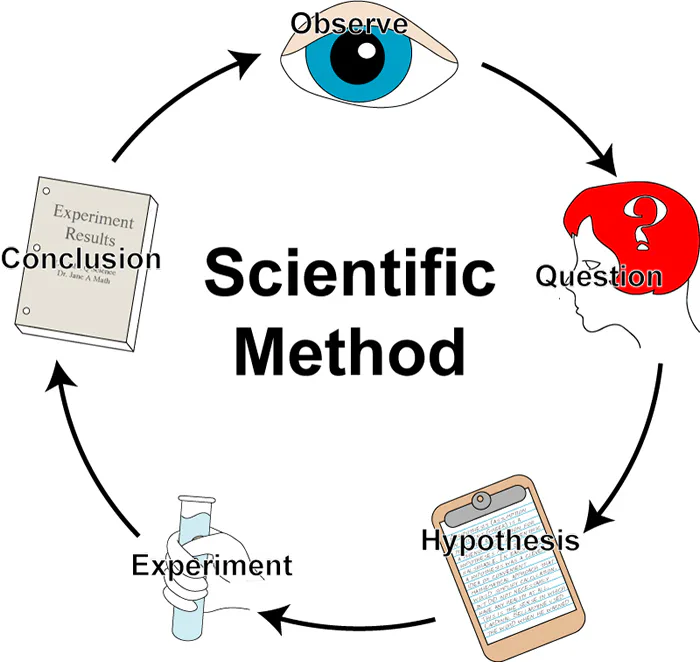
7 An investigation used to find the cause of an event is called an experimental investigation. It begins with a scientist asking questions. A scientist observes events in the natural world and asks questions about the events.
11
Audio Response

An observation is a way to gather information using your senses. After observing and asking questions, a scientist might predict what the thinks will happen. A prediction is a statement of what a scientists things will happen based on an observation.
12
Audio Response

8 Suppose you live near an ocean. You boil water from time to time for cooking. Once week you go on a camping trip in the mountains. When you boil water on your camping trip, the water seems to start to boil sooner in the mountains than on the coastline.
13
Audio Response

You wonder why it would boil sooner in the mountains than on the coastline. You realize that there is less air pressure in the higher mountains. You think that this is the cause, so you predict that the higher up you go, the less time it will take for the water to start boiling.
14
Audio Response

9 You must perform an experiment to find out if your prediction is true. You form a hypothesis. A hypothesis is a statement or question that can be tested by an experiment.
15
Audio Response

An experiment is a set of steps used to test a hypothesis. Your hypothesis might be: The lower the air pressure, the lower the boiling point of water.
16
Audio Response

10 Next, you must plan an experiment to test your hypothesis. You choose the tools you will need, such as water, a beaker, a thermometer, and a hot plate.
17
Audio Response

You are able to use a special room at a college for your experiment. The air pressure in the room can be changed using air pumps and fans.
18
Audio Response

11 During experiments, scientists work with variables. A variable is a condition that changed in an experiment. Usually, only one variable is tested during an experiment. The variable for your experiment is the amount of air pressure.
19
Audio Response

A scientists wants some variables to remain the same. A control, or constant, is a condition in an experiment that does not change. For your experiment, the water you use will be a control. You will use water from the same source.
20
Audio Response

12 During the experiment, you will change the air pressure of the room. Air pressure can be expressed in units called bars. One bar is about the air pressure at sea level. You will boil water at each of the air pressures. Air pressure is measured using a barometer
(bar-o-meter).
21
Audio Response

The starting temperature of the water will be the same for each level or air pressure. You will measure the temperature of the water when it begins to boil and record the temperature.
22
Audio Response

You will then lower the air pressure in the room and boil a new sample of water and record the temperature again. You can repeat these steps until you have several temperatures recorded.
23
Audio Response

13 After the experiment, you will organize the data. Data is the information scientist get by observing or experimenting. Scientists analyze data to find the results of an experiment. You can analyze the data and explain the results to see if the data supports your hypothesis.
24
Audio Response

To help make sure that the results of the experiment are accurate and reliable, more than one experiment should be completed. As more experiments are done, the results become more reliable.
25
Audio Response

14 Many types of data include numbers and units. Such data may include measurements, such as time, length, volume, or distance.
15 One way to organize your data is to record it in a table.
26
Audio Response

16 Another way to display your data is in a bar graph. A bar graph uses bars of different lengths to compare data. A bar graph displays quantitative data. This is information made of numbers. This type of data usually comes from measurements. Temperatures, lengths, heights, and masses all are quantitative data.
27
Audio Response

17 Once you’ve organized your data, you can analyze it. Your hypothesis is: The lower the air pressure, the lower the boiling point of water. Does the information you gathered support your hypothesis? It appears that it does. You may make an inference from the data. You can repeat this experiment to validate your data.
28
Audio Response

18 After experiments are performed to find the answer to a hypothesis, a scientist may make a conclusion. A conclusion is an explanation for a hypothesis based on observations and experiments.
29
Audio Response

19 When you are done with your experiment, you share the results with others. You could also write a report about your experiment. You should explain your hypothesis and the steps you took during the experiment. That way, others can repeat your experiment to find out if your conclusion makes sense.
Show answer
Auto Play
Slide 1 / 29
SLIDE

