Revision for Atomic Structure Topic Test
Presentation
•
Chemistry
•
9th Grade
•
Practice Problem
•
Medium
Standards-aligned
Mandy Mills
Used 1+ times
FREE Resource
4 Slides • 24 Questions
1
Revision for Atomic Structure Topic Test
2
Subatomic Particles
Atoms are composed of protons, neutrons, and electrons.
Protons and neutrons form the nucleus, while electrons move around the nucleus in shells.
Protons have a positive charge, neutrons have a neutral charge, and electrons have a negative charge.
The number of protons in the nucleus is the atomic number and the number of protons + neutrons is the atomic mass (weight of the atom).
3
Electrons and Valence Shells
Atoms are most stable when their valence shells are filled with eight electrons (or 2 in the first shell). This is called the octet rule.
Elements tend to react to achieve a stable electron configuration.
Positive ions form when atoms lose electrons, while negative ions form when atoms gain electrons.
Examples include N3- (nitrogen ion) and Na1+ (sodium ion) in reaching octet configurations.
4
Isotopes
Isotopes are atoms of the same element (same number of protons) with different numbers of neutrons. They behave similarly in chemical reactions but may have different physical properties.
Isotopes are referenced by their mass number, which is the total number of protons and neutrons.
Examples include Hydrogen-1, Hydrogen-2, and Hydrogen-3 with different numbers of neutrons.
5
Multiple Choice
Number of protons in an atom's nucleus, defining its element.
Nuclear number
Atomic mass
Atomic number
Atomic weight
6
Multiple Choice
What is the charge of the calcium ion?
+6
+2
-2
-8
7
Multiple Choice
Particles like protons, neutrons, and electrons that make up atoms.
Proton
Subatomic particles
Atomic number
Scanning tunnelling microscope
8
Multiple Choice
What subatomic particle is the lightest?
Proton
Neutron
Electron
9
Multiple Choice
Process where unstable atoms release energy to become stable
Atomic number
Radioactivity
Gamma radiation
Nuclear decay
10
Fill in the Blanks
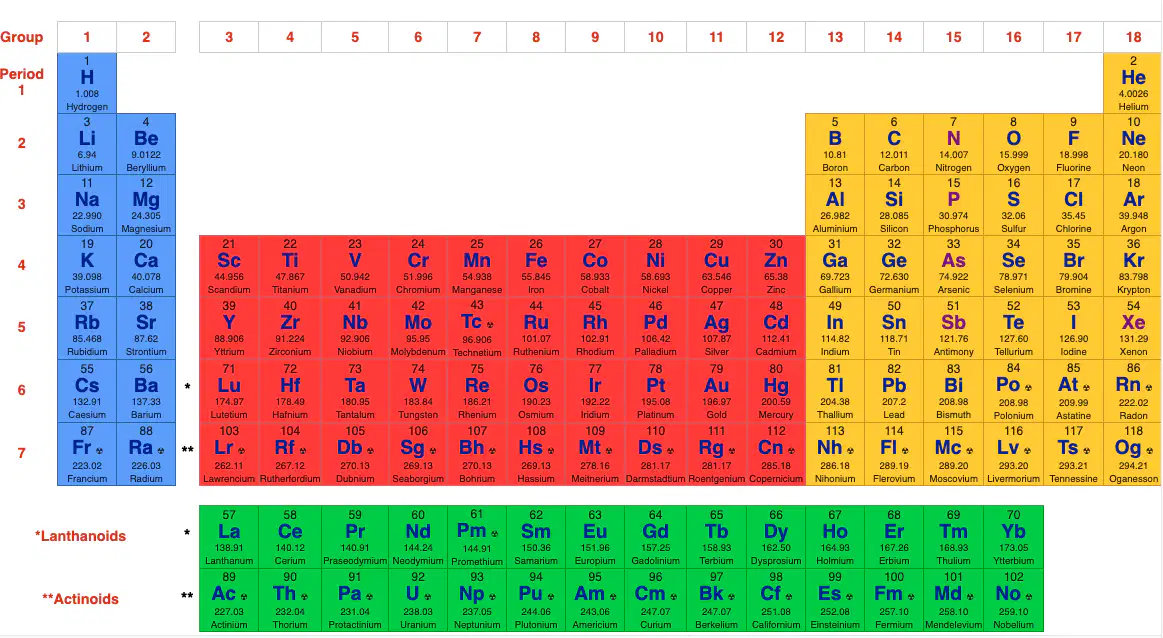
An atom has an electron configuration of 2,6.
Look at the periodic table, and identify which element the atom belongs to.
Type answer...
11
Multiple Choice
How many electrons are in the valence shell of sodium?
1
2
3
4
12
Categorize
Positive charge
Found in the nucleus
Neutral charge
Found in the nucleu
Negative charge
Moves in shells around the nucleus
Has no impact on atomic mass
Sort the following characteristics into their correct subatomic particle.
13
Open Ended
Explain why electrons are not included in the atomic mass of an atom.
14
Open Ended
Describe how an atom becomes a negative ion.
15
Open Ended
What is the relationship between the atomic number and the identity of an element?
16
Open Ended
How does the octet rule influence the formation of ions?
17
Multiple Choice
Which subatomic particle has a negative charge?
Protons
Neutrons
Electrons
18
Multiple Choice
19
Multiple Choice
The yellow atoms are called
20
Multiple Choice
21
Multiple Choice
In the chemical equation below, what is the PRODUCT?
NaCl → Na + Cl
Na + Cl
NaCl
→
N
22
Multiple Choice
In the chemical equation below, what is the REACTANT?
CO2 → C + O2
→
C + O2
CO2
physical change
23
Multiple Choice
Sodium reacts with chlorine to produce sodium chloride. Choose the correct word equation.
sodium chloride → chlorine + sodium
sodium + carbon dioxide → sodium carbonate
sodium + chlorine → sodium chloride
24
Multiple Choice
Magnesium reacts with oxygen to form magnesium oxide. The correct word equation is...
A
B
C
D
25
Multiple Choice
What is the correct formula for Lithium Oxide?
LiO
LiO2
Li2O
Li2O2
26
Multiple Choice
24
27
Multiple Choice
Which of the following elements would you name first when naming the compound?
Lithium
Chlorine
28
Multiple Choice
Which of the following elements would you name first when naming the compound?
Aluminium
Oxygen
Revision for Atomic Structure Topic Test
Show answer
Auto Play
Slide 1 / 28
SLIDE

Similar Resources on Wayground
21 questions
Domain and range
Presentation
•
9th Grade
21 questions
Quadratic Formula
Presentation
•
9th Grade
21 questions
Cultural Geography of Europe
Presentation
•
9th Grade
22 questions
Newton's laws of motion
Presentation
•
9th Grade
22 questions
IB Learner Trait Vocabulary
Presentation
•
9th Grade
23 questions
Chemical Equations-Counting Atoms(TEK 7C)
Presentation
•
10th Grade
21 questions
Integer Operations Review
Presentation
•
9th Grade
21 questions
Factoring GCF, Difference of Squares, and Trinomials Review
Presentation
•
9th Grade
Popular Resources on Wayground
6 questions
PRIDE Always and Everywhere
Presentation
•
12th Grade
20 questions
Lab Safety Quiz
Quiz
•
6th Grade
26 questions
KOR Review Kahoot Questions
Quiz
•
8th Grade
21 questions
Continents and Oceans
Quiz
•
6th Grade
12 questions
Unit Zero lesson 2 cafeteria
Presentation
•
9th - 12th Grade
20 questions
Parts of Speech
Quiz
•
5th Grade
10 questions
Riddles Riddles fun Riddles
Quiz
•
6th - 12th Grade
16 questions
Subject & Predicate
Quiz
•
5th Grade
Discover more resources for Chemistry
12 questions
Significant figures
Quiz
•
9th - 12th Grade
19 questions
Isotopes & Ions
Quiz
•
9th Grade
14 questions
Matter Module Exam Practice Quiz
Quiz
•
9th - 12th Grade
15 questions
Lab Safety & Equpiment
Quiz
•
9th - 12th Grade
20 questions
Chemistry Flame Assessment
Quiz
•
9th - 12th Grade
1 questions
Phase Changes and heat transfer
Quiz
•
9th Grade
15 questions
Solutions: Solute and Solvent
Quiz
•
9th - 12th Grade
40 questions
Metals, Nonmetals, and Metalloids
Quiz
•
7th - 9th Grade