

TEXTURE AND SPACE AS ELEMENTS OF ART Illustration

Presentation
•
Other
•
12th Grade
•
Practice Problem
•
Medium

Jerome Suelto
Used 1+ times
FREE Resource
14 Slides • 9 Questions
1
TEXTURE AND SPACE AS ELEMENT OF ART
2
After completing this lesson, the students should be able to:
1. Define texture and space as elements of Art;
2. Explain how texture and space adds artistic quality in an illustration;
3. Compose an artwork using line drawings to represent texture and space.
3
Multiple Choice
1. It is the tactile quality of the look
and feel of a surface on an object.
space
texture
real texture
implied texture
overlapping
4
Multiple Choice
2. Often called actual textures, these are textures with physical qualities that you can touch.
distance
texture
real texture
implied texture
overlapping
5
Multiple Choice
3. It is the space around the main object.
negative space
texture
real texture
implied texture
overlapping
6
Multiple Choice
4. This is a space illusion created by covering a portion objects at the back.
space
texture
real texture
implied texture
overlapping
7
Multiple Choice
5. It is an element that lies between, around
or within an object.
space
texture
real texture
implied texture
overlapping
8
The Element of Art – Texture

The texture is the tactile quality of the look and feel of a surface on an object. In other words, it is how something feels when touched. Just like line, form, and shape, it can be categorized as to how it is created and its function.
Adding texture is another step to create a dimension in an illustration.
9
Categories of Texture
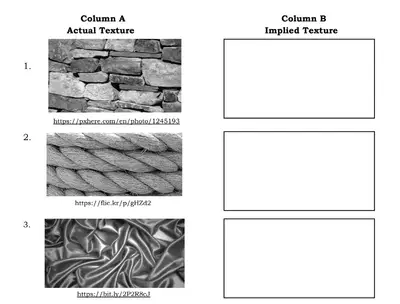
1. Real texture – or often called actual textures are textures with physical
qualities that you can touch. Like the ones in sculptures where artists can add
actual textures like real fur or scales. Or even sculpt it in a way it mimics the same
texture of an actual object.

For two dimensional artworks like paintings, artists usually apply thick coats of paint and brush strokes to create an element of texture in their work. Other artists even add other mediums like fabrics or other objects into their canvass to achieve the same result. Whatever materials an artist use in their work to include texture element, like value, adds up to express realism in an illustration.
10
Categories of Texture
2. Implied texture – are texture illusions or visual textures created through line drawing and value manipulation techniques. Implied textures are said to be an illusion texture
because it can only be felt through the eyes. If you will try running your hands in artwork with implied texture, whatever it is, it will feel the same – drawing surface texture.


11
Function of texture
Texture, like other elements of art, helps to convey the artists' concepts and
ideas in an artwork. Creating texture gives the viewers the idea of what the artwork is about and gives subtle visual cues to show if an object is soft, rough, hard, andsmooth. Its purpose is to let the viewers appreciate art beyond its visual properties.
With pen and ink illustrations as well as graphite illustrations, the texture is
achieved by drawing patterns. Varying the amount of and sizes of line patterns will determine how hard or soft the area is. You can study how Durer created texture in his Rhinoceros illustration and the patterns used to create a rough texture. That is, however, if you are creating something from imagination. Artwork with reference requires careful observation of value, shape, and form to mimic the texture in your drawing surface.
12
The Element of Art - Space
Space is an element of art that is not drawn in a surface for two-dimensional
art, and not sculpted in three-dimensional form. It is an element that lies between, around, or within an object.
Space is how subjects are organized as an illusion or as an actual art form.
Two-dimensional arts like paintings are confined within the borders of the drawing surface, this is why artists often try to create an illusion of space to extend this limit.

13
How to create an illusion of space?
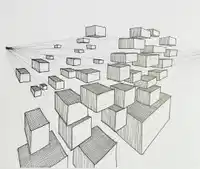
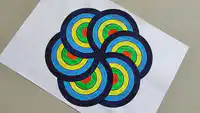
1. Perspective - this method creates an illusion of depth that an object is coming
forward from a specific point in the canvas. Perspectives depend on the number of its vanishing points.
2. Overlapping – this space illusion is created when an object is drawn closer to the viewer's eyes overlapping other images behind to create a three-dimensional illusion.
14
How to create an illusion of space?
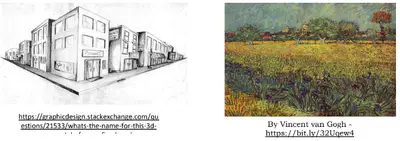
1. Perspective - this method creates an illusion of depth that an object is coming
forward from a specific point in the canvas. Perspectives depend on the number of its vanishing points.
2. Overlapping – this space illusion is created when an object is drawn closer to the viewer's eyes overlapping other images behind to create a three-dimensional illusion.
When an object is drawn on top of another the eyes interpret that there is space between these objects.
15
How to create an illusion of space?
3. Placement on the surface - objects drawn higher the picture plane seems to be
further than the objects below.
4. Size - smaller objects look further than larger objects in an artwork.
5. Detail - the further the object in the space, the lesser the details in comparison
to the objects in front.
6. Color and value - objects in a distance are usually lighter in color and value.
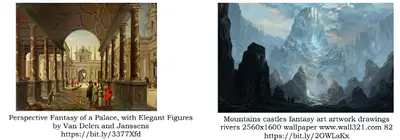
Actual space like in sculptures is the space that the object is occupying and its relation to the space around it. Aside from the three-dimensional scope of space. It can also be positive and negative.
16
Types of Space
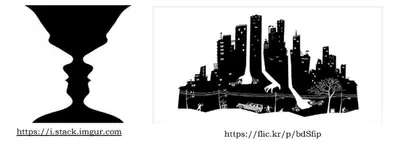
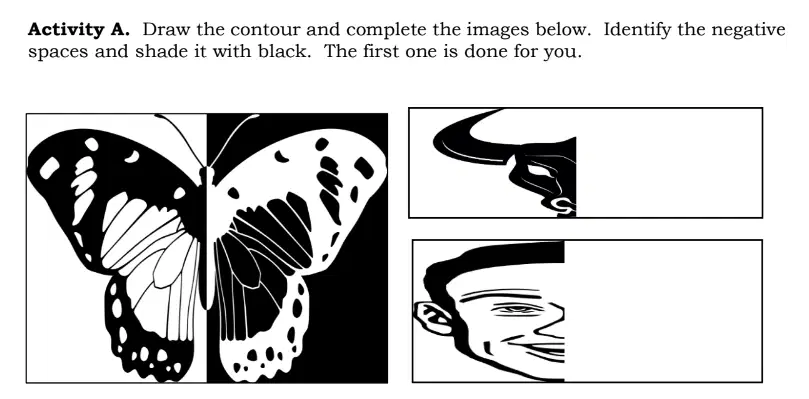
Positive space is taken up by the main objects in artwork or sculptures.
Negative space is the space occupied around the main object.
When you draw something on a surface, you are not only adding an object,
you are also subtracting a portion of the surface to create that object.
Therefore, creating two shapes – one added and one subtracted; positive and negative. There are a lot of existing artworks using positive
and negative space to create clever illusions.
Space is an element of art that can also be the relation of each object in an
artwork. It can make the illustration look spacious, crowded, cluttered, symmetrical,
shallow, or flat. Different artists manipulate the use of space in their artwork to
reinforce their concepts and ideas and better communicate with the viewers
17
18
19
20
Fill in the Blanks
21
Fill in the Blanks
22
Fill in the Blanks
23
Fill in the Blanks
TEXTURE AND SPACE AS ELEMENT OF ART
Show answer
Auto Play
Slide 1 / 23
SLIDE
Similar Resources on Wayground

18 questions
PHS - Ch. 2 (slides 1-19) Personal Traits & HI Careers
Presentation
•
12th Grade
15 questions
Integumentary System
Presentation
•
12th Grade
16 questions
Understanding Primary and Secondary Sources
Presentation
•
KG
19 questions
Cardiovascular Conduction
Presentation
•
12th Grade
18 questions
Medical Record Report
Presentation
•
12th Grade
18 questions
Fractions Intro
Presentation
•
KG - 12th Grade
19 questions
Outdoor Safety Overview
Presentation
•
12th Grade
20 questions
fast food
Presentation
•
KG
Popular Resources on Wayground
11 questions
Hallway & Bathroom Expectations

Quiz
•
6th - 8th Grade
10 questions
HCS SCI 03 Summer School Assessment 2
Quiz
•
3rd Grade
11 questions
Home Scope
Quiz
•
7th - 8th Grade
12 questions
2026 TAP Technology in the Classroom
Presentation
•
Professional Development
15 questions
HCS SCI 05 Summer School Assessment 2 Review
Quiz
•
5th Grade
15 questions
HCS SCI 04 Summer School Review 2
Quiz
•
4th Grade
59 questions
Geometry Unit 3 Review
Quiz
•
9th - 12th Grade
14 questions
FAST ELA READING SMAPLE TEST MATERIALS

Passage
•
3rd Grade