

Nervous system

Presentation
•
Biology
•
6th - 8th Grade
•
Practice Problem
•
Hard

ANGELICA ANTONIO
Used 1+ times
FREE Resource
39 Slides • 3 Questions
1

NEURONS
2

Cassification by structure
3
Fill in the Blanks
How many types of neuros exist according its functions?
4


5

Classification by function
• Sensory neurons are the nerve cells that are activated by sensory input from the environment (Most sensory neurons are pseudounipolar)
• Motor neurons connect to muscles, glands and organs throughout the body. These neurons transmit impulses from the spinal cord to skeletal and smooth muscles (such as those in your stomach), and so directly control all of our muscle movements.
• Interneurons are the ones in between - they connect spinal motor and sensory neurons.
6
Fill in the Blanks
What are the other type of nervous cells?
7

Neuroglia
8


9
Categorize

jellyfihs

planarian

octopus

bird
Organize the following animals according to the complexity of its nervous system (simple to complex)
10


11

Nerve nets
• Diffuse mesh of nerve
cells that take part in
simple reflex
pathways.
• Nerve cells interact
with sensory and
contractile cells.
12

Radial
• Sea stars have a
nerve net connected
by radial nerves to a
central nerve ring.
13

Ganglia and cordons
• Bilateral symmetry.
• Ganglia are a group of
neuron
14

Ventral Cord
15


16

Synapse
Is the junction between two neurons, or between a
neuron and an effector organ (muscle or gland).
Each synapse consists of:
• Presynapticneuron-that sends an impulse to the
synapse.
• Axon–the nerve fiber extends from the
presynaptic neuron, that propagates the impulse
to the synapse
• Synaptic knobs -the round endings of the axon.
17


18


19


20


21

Organization of the
Nervous System
22


23

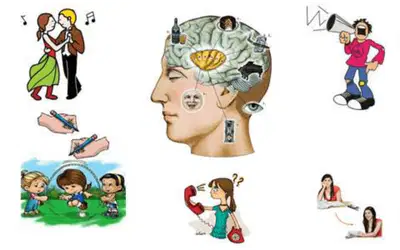
Somatic Nervous System
24

Autonomic Nervous System
25


26


27


28


29


30

HOMEOSTASIS
• Is a state of relative stability within the body.
• Is critical for survival, because the body can
only survive within a narrow range of
conditions.
• The nervous system regulates body structures
and processes to maintain homeostasis
despite fluctuations in the internal and
external environment.
• The human nervous system can regulate tens
of thousands of activities simultaneously.
31

HOMEOSTASIS
32

RESPONSES
33

Three main types of neurons, however, form the
basic impulse-transmission pathway of the
entire nervous system.
This pathway, depends on three overlapping
functions:
• sensory input
• Integration
• motor output.
34


Sensory
Sensory
input:
• Sensory neurons gather information from the sensory
receptors (senses) and transmit these impulses to the
central nervous system (brain and spinal cord).
Integration:
• Interneurons are found entirely within the central nervous
system. They act as a link between the sensory and motor
neurons. They process and integrate incoming sensory
information, and relay outgoing motor information.
Motor
Motor
output:
• Motor neurons transmit information from the central
nervous system to the muscles, glands, and other organs
(effectors).
35

The Reflex Arc
• Some neurons are organized to enable your body to
react rapidly in times of danger, even before you are
consciously aware of the threat. These sudden,
unlearned, involuntary responses to certain stimuli are
called reflexes.
36

• Reflex arcs are simple connections of neurons
that explain reflexive behaviors. They can be
used to model the basic organization of the
nervous system.
• A reflex arc moves directly to and from the
brain or spinal cord, before the brain centers
involved with voluntary control have time to
process the sensory information.
37

Task
• Do a graphic organizer with:
– Senses
• Feautres (structures)
• Sesory receptors
38


39

The Nerve Impulse
•Is an electrical signal that
travels along an axon. There is
an electrical difference
between the inside of the
axon and its surroundings.
•The action potential is the
result of ions moving in and
out of the cell. Specifically, it
involves potassium (K+)
and sodium (Na+) ions. The
ions are moved in and out of
the cell by potassium
channels, sodium channels
and the sodium-potassium
pump.
40


41

Na+K+Pump
42

Na+K+Pump
NEURONS
Show answer
Auto Play
Slide 1 / 42
SLIDE
Similar Resources on Wayground

35 questions
Absolute Value and Additive Inverse Review
Presentation
•
6th - 7th Grade
39 questions
Food web and food chains
Presentation
•
7th Grade
37 questions
Domains and Kingdoms
Presentation
•
6th - 8th Grade
37 questions
Parts of Speech Review
Presentation
•
6th - 8th Grade
38 questions
Los Saludos ***
Presentation
•
6th - 8th Grade
36 questions
Integer Operations Lesson
Presentation
•
6th - 8th Grade
35 questions
The Cell
Presentation
•
6th - 8th Grade
35 questions
Earth, Sun, and Moon System
Presentation
•
6th - 8th Grade
Popular Resources on Wayground
10 questions
Safety Day 2026 – Student Review

Quiz
•
9th Grade
21 questions
Continents and Oceans
Quiz
•
6th Grade
20 questions
Parts of Speech
Quiz
•
5th Grade
16 questions
Subject & Predicate
Quiz
•
5th Grade
25 questions
Multiplication Facts
Quiz
•
5th Grade
12 questions
Map Skills
Quiz
•
3rd Grade
22 questions
Continents and Oceans
Quiz
•
5th Grade
15 questions
Rounding Decimals
Quiz
•
5th Grade
Discover more resources for Biology
10 questions
Exploring the Phases of Mitosis and Cell Division

Interactive video
•
6th - 10th Grade
14 questions
Autosomal Pedigree
Quiz
•
7th Grade
10 questions
Exploring Evidence of Evolution
Interactive video
•
6th - 10th Grade
6 questions
Levels of Organization
Presentation
•
7th Grade
10 questions
Exploring Cell Membrane Transport Mechanisms
Interactive video
•
6th - 10th Grade
13 questions
Fast and Curious: Cell Discovery and Cell Basics
Quiz
•
7th Grade
5 questions
Q2W1- DNA MINI QUIZ 2024
Quiz
•
8th Grade
16 questions
Photosynthesis and Cellular Respiration
Quiz
•
8th Grade