
Elements, atoms and molecules...let's review

Presentation
•
Science
•
9th Grade
•
Practice Problem
•
Easy
+5
Standards-aligned

Paula Corrick
Used 11+ times
FREE Resource
6 Slides • 8 Questions
1
Elements, Atoms and Molecules
2

That means it can't be broken down into a simpler substance. There are 118 elements that make up the UNIVERSE!!!
An element is a pure substance.
3
There are 6 elements that are essential for life:
Carbon
Hydrogen
Oxygen
Nitrogen
Phosphorus
Sulfur
Elements of Life

We use the acronym CHONPS to help us remember that.
4
Multiple Choice
There are _______________ known elements on Earth. These elements make up everything that exists in the Universe.
12
118
365
100
5
Multiple Choice
All of the following are elements that are essential to life, except
hydrogen
nitrogen
6
Atoms
An atom is the smallest unit of an element
Atoms are made of particles of matter (protons and nuetrons), surrounded by particles of negatively charged energy called, electrons. All atoms want to be stable, which means they need full energy levels of electrons. They do this by seeking out other atoms to give electrons to, or share electrons with.

7
Multiple Choice
___________are the smallest units of an element.
carbohydrates
protons
atoms
electrons
8
Multiple Choice
Atoms are made of particles of matter (protons and neutrons) and are surrounded by particles of energy, called ___________
electrons
protons
neutrons
none of these are correct
9

When atoms come together to share energy, thats called a chemical bond. These types of reactions create entirely new substances.
Molecules
10
Multiple Choice
To obtain stablity, atoms give or share electrons with other atoms. This type of reaction is called a _________.
11
Multiple Choice
Which of the following is NOT a macromolecule?
lipids
carbohydrate
protein
All of these are macromolecules
12

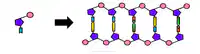
There are 4 macromolecules that make up Carbohydrates, lipids, proteins, and nucleic acids
Macromolecules
13
Multiple Choice
When atoms combine to share energy, they create new substances called ___________________.
atoms
14
Multiple Choice
Molecules can combine to create LARGER more complex molecules called__________
micromolecules
macromolecules
polymers
monomers
Elements, Atoms and Molecules
Show answer
Auto Play
Slide 1 / 14
SLIDE
Similar Resources on Wayground

10 questions
2.4 Day 2 Solving Multi-Step Inequalities
Presentation
•
9th Grade
10 questions
Cellular Respiration
Presentation
•
9th - 10th Grade
10 questions
Ch. 14.2 - Work and Machines
Presentation
•
9th Grade
13 questions
Aquatic Ecosystems
Presentation
•
9th Grade
10 questions
Lesson: Solve Systems by Substitution (part 1)
Presentation
•
9th Grade
10 questions
Area Review
Presentation
•
9th Grade
10 questions
Unit 7.2 Mechanisms of Evolution Notes
Presentation
•
9th Grade
10 questions
Sedimentary rocks
Presentation
•
9th Grade
Popular Resources on Wayground
6 questions
PRIDE Always and Everywhere
Presentation
•
12th Grade
20 questions
Lab Safety Quiz

Quiz
•
6th Grade
26 questions
KOR Review Kahoot Questions
Quiz
•
8th Grade
21 questions
Continents and Oceans
Quiz
•
6th Grade
12 questions
Unit Zero lesson 2 cafeteria
Presentation
•
9th - 12th Grade
20 questions
Parts of Speech
Quiz
•
5th Grade
10 questions
Riddles Riddles fun Riddles
Quiz
•
6th - 12th Grade
16 questions
Subject & Predicate
Quiz
•
5th Grade
Discover more resources for Science
10 questions
Scientific Method (The scientific method)

Interactive video
•
9th Grade
10 questions
Exploring Chemical and Physical Changes
Interactive video
•
6th - 10th Grade
10 questions
Exploring the States of Matter
Interactive video
•
6th - 10th Grade
20 questions
Atomic Structure
Quiz
•
9th Grade
9 questions
Exploring the Steps of the Scientific Method
Interactive video
•
6th - 10th Grade
16 questions
Identify Key Characteristics of Living Organisms
Quiz
•
9th - 12th Grade
20 questions
Photosynthesis
Quiz
•
9th Grade
20 questions
Observation vs. Inference
Quiz
•
7th - 9th Grade