

ielts 4.5-5.5 writing lesson 7

Presentation
•
English
•
Professional Development
•
Practice Problem
•
Medium

Nhi Mỹ
Used 1+ times
FREE Resource
21 Slides • 13 Questions
1

II. How to write
2. Language to describe changes
a. Verbs and adverbs
In paragraphs 3 and 4, you will need to have a good range of grammar
and vocabulary to describe the changes in the graph, including the use of
verbs and adverbs, e.g. The income of Lovely Loaves rose slightly.
2
Match
Match the following
go up grow improve increase rise
double jump rocket shoot up
soar surge
decline decrease drop fall go down
halve plummet plunge
go up grow improve increase rise
double jump rocket shoot up
soar surge
decline decrease drop fall go down
halve plummet plunge
3
Match
Match the following
level off remain stable
fluctuate
hit/reach a peak
bottom out
level off remain stable
fluctuate
hit/reach a peak
bottom out
4

Movement
Verb
decline
decrease
drop
fall
go down
Movement
Verb
halve
plummet
plunge
5

2. Language to describe changes
a. Verbs and adverbs
Verbs that describe big increases or decreases, like soared
or plummeted, don't need an adverb, because we already
know that they describe a large change. However, other
verbs need an adverb, to tell the reader what kind of
increase or decrease you are talking about.
6
Drag and Drop
a big change?
a small change?
a medium-size change?
a fast change?
7
Drag and Drop
a slow change?
a comment by the writer?
a consistent increase or decrease?
8
Drag and Drop

The income of Bernie's Buns
The amount of money earned by Robbie's Bakery
Earnings of Lovely Loaves
9

II. How to write
2. Language to describe changes
b. Adjectives and nouns
You can also describe changes using adjectives and nouns. Most of the vocabulary is the
same, but you need to learn the adjective and noun forms.
There was a considerable rise in the income of Robbie's Bakery.
The income of Robbie's Bakery saw/experienced/witnessed a considerable rise.
10
Match
Match the verb with its noun
fell
levelled off
declined
soared
plummeted
a fall
a levelling off
a decline
a soar
a plummet
a fall
a levelling off
a decline
a soar
a plummet
11
Match
Match the verb with its noun
increased
dropped
fluctuated
decreased
plunged
an increase
a drop
a fluctuation
a decrease
a plunged
an increase
a drop
a fluctuation
a decrease
a plunged
12
Match
Match the verb with its noun
dipped
recovered
jumped
surged
grew
a dip
a recover
a jumped
a surged
a growth
a dip
a recover
a jumped
a surged
a growth
13
dramatically dramatic
steadily
considerably
negligibly
remarkably
14
Fill in the Blanks
Write the adjectival form of these adverbs.
dramatically dramatic
steadily _____
considerably _____
negligibly _____
remarkably _____
Type answer...
15

II. How to write
2. Language to describe changes
c. Prepositions
● With started and finished, use at
Example: Income started at £55,000.
● With increases or decreases, use (from)…to
Example: There was a sharp rise (from £40,000) to £70,000.
● With remained stable and levelled off, use at
Example: Income remained stable at £65,000.
16

II. How to write
2. Language to describe changes
c. Prepositions
● With peaked, use at
Example: Income remained stable at £120,000.
● To describe how much something increases or decreases, use by with verb and of with noun
Example: The figure went up by around £30,000.
There was a slight increase of £30,000.
● To describe the range of fluctuation, use between…and
Example: Earnings fluctuated between £80,000 and £90,000.
17

18

19

II. How to write
3. Structures to
describe changes
20

The graph shows data about the annual earnings
of three bakeries in London, 2000-2010.
Summarize the information by selecting and
reporting
the
main
features,
and
make
comparisons where relevant.
21

Structure 1. [Time period], [X] + verb + adverb +
to/by
From 2005 to 2007, the income of Robbie’s
Bakery increased gradually by £12,000.
Structure 2. [Time period], there was a/an +
adjective + noun + to/of [number]+ in + [X]
Between 2005 and 2007, there was a gradual
increase of £12,000 in the income of Robbie’s
Bakery.
22

Structure 3. [Time period] + saw/witnessed/experienced + a/an +
adjective + noun + to/of [number] + in + [X]
The period from 2005 to 2007 saw a gradual increase of £12,000 in the
income of Robbie’s Bakery.
23

Try to use academic phrases for describing future trends to make your writing
more interesting. For example:
Structure 1. [X] is/are expected/estimated/predicted to + verb + adverb
The number of students of Spanish is expected to rise significantly.
Structure 2. It is expected/estimated/predicted that [X] will + verb + adverb
It is estimated that the number of students of Spanish will rise significantly.
24

25
Open Ended

Write a sentence with an adjective and noun to describe each of these changes in the graph above.
Robbie's Bakery, 2007-2008
26
Open Ended
Write a sentence with an adjective and noun to describe each of these changes in the graph above.
Bernie's Buns, 2001-2002
27
Open Ended
Write a sentence with an adjective and noun to describe each of these changes in the graph above.
Lovely Loaves, 2004-2005
28
29

30
Drag and Drop
There was a
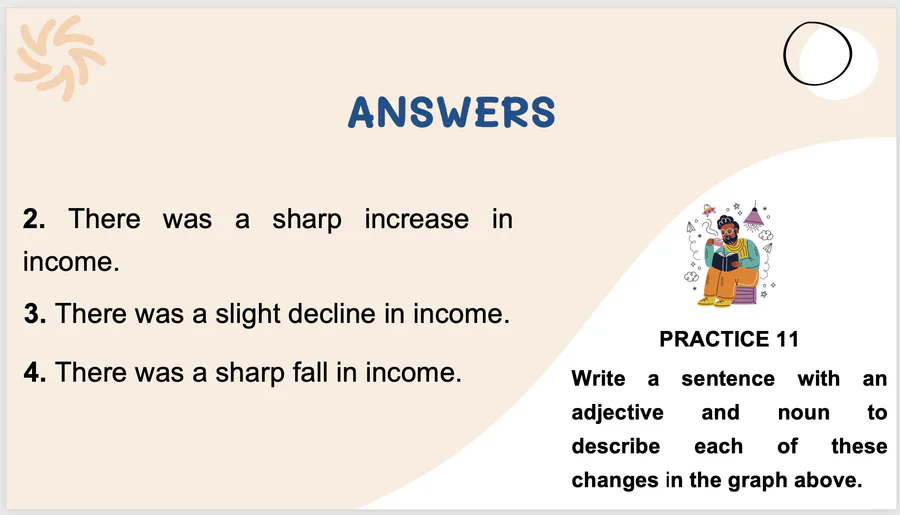
1.Chocolate production in Colombia saw a significant fall.
Chocolate production in Colombia
1.There was a steady growth in average incomes in Europe between 1998 and 2004.
Average incomes in Europe
31

II. How to write
4. Joining two changes together
In paragraphs 3 and 4, you need to join changes
together into longer sentences.
Income remained stable between 2000 and 2004, and
then there was a steady rise in the next two years.
There are lots of ways you can join two ideas together
in an interesting way.
32

…., after that + clause
…., after which + clause
…., (but) this was followed by + N
Following this, …
At this point, …
Next, …
Subsequently, …
33

34

II. How to write
2. Language to describe changes
a. Verbs and adverbs
In paragraphs 3 and 4, you will need to have a good range of grammar
and vocabulary to describe the changes in the graph, including the use of
verbs and adverbs, e.g. The income of Lovely Loaves rose slightly.
Show answer
Auto Play
Slide 1 / 34
SLIDE
Similar Resources on Wayground

26 questions
Articles & prepositions
Presentation
•
Professional Development
28 questions
GR7_W4_L7_FAT
Presentation
•
KG
25 questions
Past Simple & Past Participle Irregular verbs
Presentation
•
Professional Development
27 questions
NOW TV
Presentation
•
Professional Development
28 questions
G8_ Environmental protection (2)
Presentation
•
Professional Development
27 questions
Present simple / To be
Presentation
•
Professional Development
27 questions
The conditionals
Presentation
•
Professional Development
27 questions
Specialized 1 - Midterm exam feedback
Presentation
•
Professional Development
Popular Resources on Wayground
10 questions
Safety Day 2026 – Student Review

Quiz
•
9th Grade
21 questions
Continents and Oceans
Quiz
•
6th Grade
20 questions
Parts of Speech
Quiz
•
5th Grade
16 questions
Subject & Predicate
Quiz
•
5th Grade
25 questions
Multiplication Facts
Quiz
•
5th Grade
12 questions
Map Skills
Quiz
•
3rd Grade
22 questions
Continents and Oceans
Quiz
•
5th Grade
15 questions
Rounding Decimals
Quiz
•
5th Grade