

Eastern Woodlands Region

Presentation
•
Social Studies
•
1st - 5th Grade
•
Easy

Kaitlin Tutt
Used 17+ times
FREE Resource
14 Slides • 12 Questions
1
Native Americans of the Eastern Woodlands

2
The land east of the Mississippi River was once almost completely covered in forests. This area was home to many groups of Native Americans.
The languages spoken by the Native Americans of these Eastern Woodlands belonged to one of two groups. The larger one was Algonquian. The other group was Iroquois.
Background


3
Multiple Choice

Which color represents the Eastern Woodlands?
Blue
Green
Yellow
Red
4
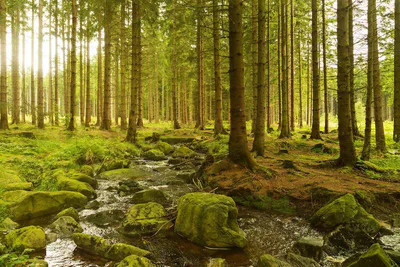
The Eastern Woodlands is a huge area. It stretches from the Atlantic Ocean to the Mississippi River and from Canada to Florida. Its forests, lakes, rivers, and the Atlantic Ocean provide many natural resources for the many different people who live there.
In the forests were many kinds of animals to hunt for food. Forests also provided wood for building homes and canoes. Many wild plants and berries could be eaten or used for medicine. The soil was rich and the river valleys was ideal for farming. Its bodies of water were filled with fish, shellfish, and sea animals.
A Rich Environment


5
Multiple Choice
The Eastern Woodlands region stretches from the Atlantic Coast in the east to the ______ River in the west.
St. Lawrence
Ohio
Oswegatchie
Mississippi
6
Multiple Choice
The Eastern Woodlands region of the U.S. is mostly covered by _____.
ocean water
glaciers
grasslands
forests
7
The Native Americans of the Eastern Woodlands were mostly farmers who lived in permanent villages. They hunted also for their meat. Many Woodland people built wigwams. Wigwams were homes with bent sapling frames. They were covered with cattail mats or elm bark. Many people fished and traveled far in canoes made of birchbark.
The Wigwam
8
Multiple Choice
Many Woodland people lived in homes called _____.
igloos
tepees
huts
wigwams
9
Multiple Choice
Most people of the Eastern Woodlands got their food from ______.
hunting and gathering
shopping
hunting and farming
gathering and begging
10


People of the Eastern Woodlands
• The people of the Eastern Woodlands
hunted animals such as deer and Moose.
(left) Iroquois hunter, 1950
• They also planted crops such as
corn, beans, squash, and pumpkins.
These are called the Three Sisters.
(above) Iroquois women grinding corn or dried berries. 1664
engraving
11
Multiple Choice
What did the Iroquois Indians farm for food?
Three Sisters
Corn, Beans and Squash
Deer
Buffalo
tomatoes, rice and beans
12
Today we know the Haudenosaunee as the Iroquois because they spoke the Iroquoian language. The Haudenosaunee lived mainly in what is now New York State. They included 5 groups, the Seneca, the Cayuga, the Onondaga, the Oneida, and the Mohawk.
The Haudenosaunee

13
Haudenosaunee means "people of the longhouse" in Iroquoian language. Longhouses are long buildings made of poles covered with sheets of bark. Each longhouse held several families.
"The People of the Longhouse"

14
Multiple Choice
Longhouses were different than wigwams because they were ______.
larger and held multiple families
smaller and covered in elm bark
the same size but covered with animal skins
made of saplings only
15
What do you see in these images?
Inside the Longhouse


16
The Haudenosaunee made fine beadwork called wampum. Wampum was a belt or string of small polished beads made from shells and strung or woven together. Wampum was used in ceremonies, to seal agreements, or as a gift. Wampum was very time-consuming to make, but very valuable to the people.
Wampum



17
Multiple Choice
Wampum was made from _____.
tree bark
saplings
seaweed
sea shells
18
Open Ended
How would the Native Americans in the Eastern Woodlands use their environment to meet their wants and needs?
19
Iroquois Confederacy
supporting question:
How do the iroquois create peace among others?

20
Iroquois Confederacy
A confederacy is a form of government where many parts are joined together or unified.
The Iroquois Tribes consisted of...
Cayuga
Onondaga
Mohawk
Seneca
Oneida

21
Multiple Choice
A confederacy means
a form of government where one person or group has all the power
a form of government where there is a king or queen
a form of government that contains city-states
a form of government where many parts are joined together or unified
22
The Great Council
The Iroquois Confederacy was created because of conflicts between each nation.
This was created for each nation.
The primary purpose was to keep The Great Law of Peace.
This law stated:
The Iroquois could not kill one another
They also made decisions and laws for each tribe and village.
23
Multiple Choice
What is the primary purpose of the Great Council?
To keep the Great Law of Peace
To maintain order in the tribes
To keep the Great Law of the Land
To establish who has the most power
24
Government
Each tribe in the Iroquois League had its own elected officials called chiefs.
These chiefs would attend the Iroquois council where major decisions were made regarding the Five Nations.
Each tribe also had its own leaders to make local decisions.

25

Iroquois Government:
• A council of 50 members, chosen by women, made decisions for the League.
• Each nation had one vote.
-All of the nations had to agree before any action could be taken.
This is a meeting of the Iroquois Six Nations Council. Note the flags
symbolizing the many clans among these tribes. Ontario Canada, 1914
26
Open Ended
Answer the supporting question:
Make sure you restate and type in complete sentences.
How do the Iroquois create peace among others?
Native Americans of the Eastern Woodlands
Show answer
Auto Play
Slide 1 / 26
SLIDE
Similar Resources on Wayground

21 questions
Cold War Intro
Presentation
•
KG
18 questions
Women's History Month Introduction
Presentation
•
1st - 5th Grade
20 questions
The American Colonies Take Shape 1607-1765
Presentation
•
1st - 5th Grade
21 questions
Early Civilizations in MesoAmerica
Presentation
•
KG
19 questions
Types of houses - reading EOW unit 5, level 2
Presentation
•
1st - 5th Grade
20 questions
Would You Rather?
Presentation
•
KG
20 questions
G1-2 iPad, Seesaw, Code.org Basics
Presentation
•
1st - 5th Grade
21 questions
Best Method: Solving Systems of Equations
Presentation
•
7th - 10th Grade
Popular Resources on Wayground
20 questions
"What is the question asking??" Grades 3-5

Quiz
•
1st - 5th Grade
20 questions
“What is the question asking??” Grades 6-8
Quiz
•
6th - 8th Grade
10 questions
Fire Safety Quiz
Quiz
•
12th Grade
20 questions
Equivalent Fractions
Quiz
•
3rd Grade
34 questions
STAAR Review 6th - 8th grade Reading Part 1
Quiz
•
6th - 8th Grade
20 questions
“What is the question asking??” English I-II
Quiz
•
9th - 12th Grade
20 questions
Main Idea and Details
Quiz
•
5th Grade
47 questions
8th Grade Reading STAAR Ultimate Review!
Quiz
•
8th Grade
Discover more resources for Social Studies
36 questions
Social Studies STAAR Review - 8th Grade
Quiz
•
4th - 8th Grade
8 questions
Events Leading to the Civil War (Grade 5 SS)

Interactive video
•
5th Grade
14 questions
Producer and Consumer Quiz
Quiz
•
2nd Grade
16 questions
Community & Traditions Quiz
Quiz
•
3rd Grade
10 questions
Three Branches Of Government
Quiz
•
4th Grade
10 questions
Exploring the Impact of the Industrial Revolution
Interactive video
•
5th Grade
13 questions
Texas and Traditions Assessment - 3rd Grade
Quiz
•
3rd Grade
12 questions
Supply and Demand 3rd Grade
Quiz
•
3rd - 5th Grade