

Les verbes réfléchis au présent

Presentation
•
World Languages
•
University
•
Practice Problem
•
Hard

Allan Issenchmidt
FREE Resource
11 Slides • 0 Questions
1

© 2019 by Vista Higher Learning, Inc. All rights reserved.
10A.1-1
Point de départ
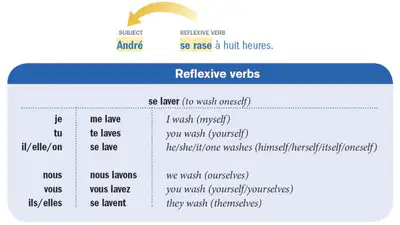
A reflexive verb usually describes what a person does to
or for himself or herself. It “reflects” the action of the
verb back to the subject. Reflexive verbs always use
reflexive pronouns (me, te, se, nous, vous).
2

© 2019 by Vista Higher Learning, Inc. All rights reserved.
10A.1-2
3


© 2019 by Vista Higher Learning, Inc. All rights reserved.
10A.1-3
The pronoun se before an infinitive identifies the verb
as reflexive: se laver.
4


© 2019 by Vista Higher Learning, Inc. All rights reserved.
10A.1-4
When a reflexive verb is conjugated, the reflexive pronoun
agrees with the subject. Except for se, reflexive pronouns
have the same forms as direct and indirect object pronouns
(me, te, nous, vous); se is used for both singular and plural
third-person subjects.
5


© 2019 by Vista Higher Learning, Inc. All rights reserved.
10A.1-5
Note that the reflexive pronouns nousand vousare identical
to the corresponding subject pronouns.
6

© 2019 by Vista Higher Learning, Inc. All rights reserved.
10A.1-6
7


© 2019 by Vista Higher Learning, Inc. All rights reserved.
10A.1-7
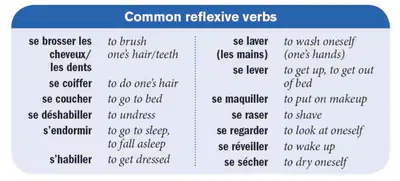
S’endormir is conjugated like dormir. Se lever and se
sécher follow the same spelling-change patterns as
acheterand espérer, respectively.
8


© 2019 by Vista Higher Learning, Inc. All rights reserved.
10A.1-8
Some verbs can be used reflexively or non-reflexively.
If the verb acts upon something other than the subject
(for example, son fils in the second example below),
the non-reflexive form is used.
9


© 2019 by Vista Higher Learning, Inc. All rights reserved.
10A.1-9
When a body part is the direct object of a reflexive verb,
it is usually preceded by a definite article.
10


© 2019 by Vista Higher Learning, Inc. All rights reserved.
10A.1-10
Form the imperative of a reflexive verb as you would
that of a non-reflexive verb. Add the reflexive pronoun to
the end of an affirmative command. In negative
commands, place the reflexive pronoun between ne and
the verb. (Remember to change te to toi in affirmative
commands.)
11


© 2019 by Vista Higher Learning, Inc. All rights reserved.
10A.1-11
In the futur proche and passé récent, place the
reflexive pronoun after the conjugated forms of aller
and venirand before the infinitive. Note that although
the reflexive pronoun changes according to the subject,
the second verb stays in the infinitive.
© 2019 by Vista Higher Learning, Inc. All rights reserved.
10A.1-1
Point de départ
A reflexive verb usually describes what a person does to
or for himself or herself. It “reflects” the action of the
verb back to the subject. Reflexive verbs always use
reflexive pronouns (me, te, se, nous, vous).
Show answer
Auto Play
Slide 1 / 11
SLIDE
Similar Resources on Wayground

10 questions
BAHASA INDONESIA
Presentation
•
12th Grade
7 questions
2018-2019 Toronto Raptors
Presentation
•
KG - University
7 questions
Integrales indefinidas
Presentation
•
University
6 questions
ACTIVIDAD PREGUNTAS
Presentation
•
University
10 questions
Solving Equations
Presentation
•
6th Grade
9 questions
Journal Voces en Resistencia | Contra las Falacias y el Negacion
Presentation
•
University
10 questions
Meet and Greet your Teacher
Presentation
•
12th Grade
10 questions
El ensayo argumentativo
Presentation
•
12th Grade
Popular Resources on Wayground
6 questions
Secondary Safety Quiz
Presentation
•
9th - 12th Grade
10 questions
MyPath Diagnostic Overview
Presentation
•
6th - 8th Grade
20 questions
Lab Safety Quiz

Quiz
•
6th Grade
21 questions
Continents and Oceans
Quiz
•
6th Grade
20 questions
Adding and Subtracting Decimals
Quiz
•
5th Grade
20 questions
Parts of Speech
Quiz
•
5th Grade
16 questions
Subject & Predicate
Quiz
•
5th Grade
21 questions
Lab Safety
Quiz
•
10th Grade