
2.2 The Stages of Labor and Newborn Care

Presentation
•
Other
•
9th - 12th Grade
•
Easy

Margeaux Cronce
Used 3+ times
FREE Resource
15 Slides • 9 Questions
1

Welcome to Real World Parenting with Mrs. Cronce!

Today's Lesson 2.2:
Labor and Newborn Care
Do Now:
1) Connect to Wayground
2) Annote and vote ---->
3) Get your bingo card ready

2
Multiple Choice
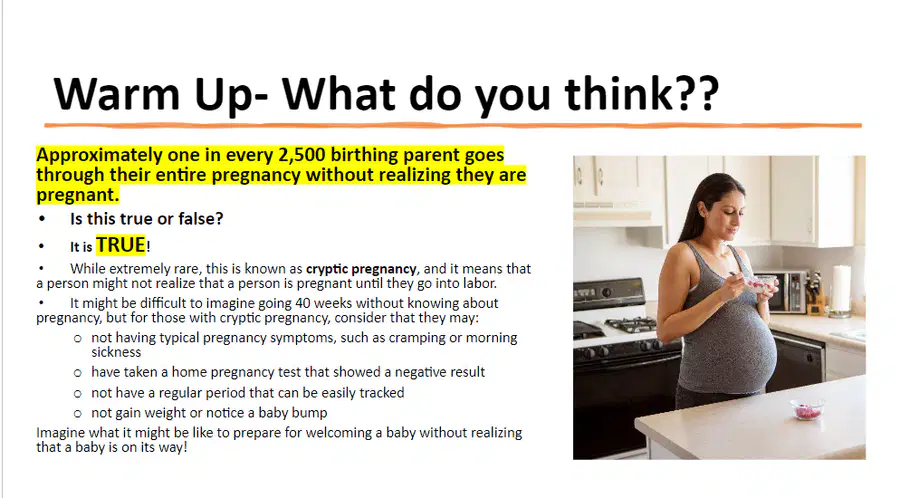
True or False: Approximately one in every 2,500 birthing parent goes
through their entire pregnancy without realizing they are
pregnant.
True
False
3
4


Preparing for Delivery
Most people are aware of their pregnancies and
have plenty of time to prepare for their little one’s
arrival!
• By the end of the second trimester, a birthing
parent is starting to plan for the arrival of their
baby by getting a space for them organized in
their home.
• This is also a great time to start planning for
what to expect during the stages of labor that
a birthing parent will experience and how to
care for a newborn immediately after birth.
5
Word Cloud
What is an adjective to describe what it might feel like to be expecting?
6
7

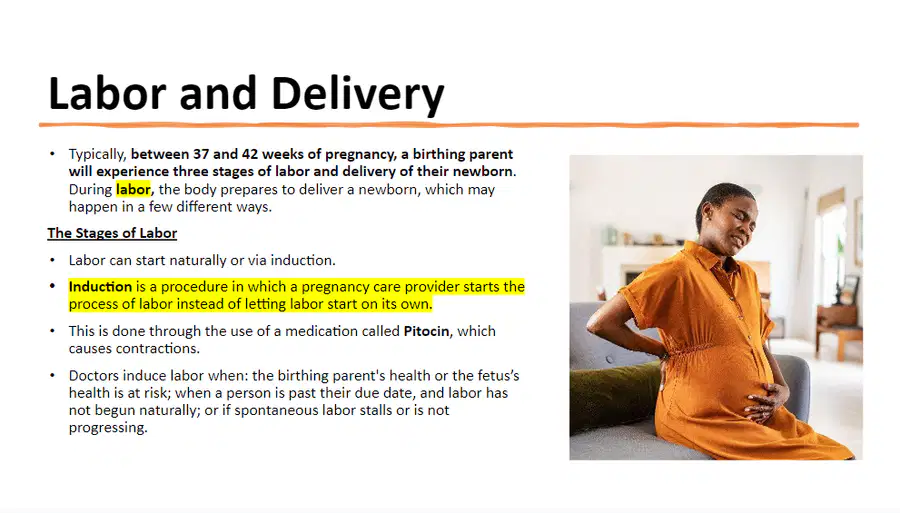
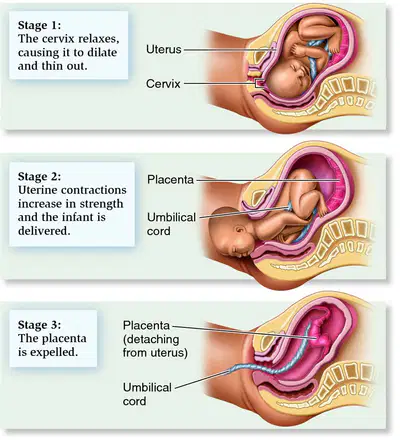
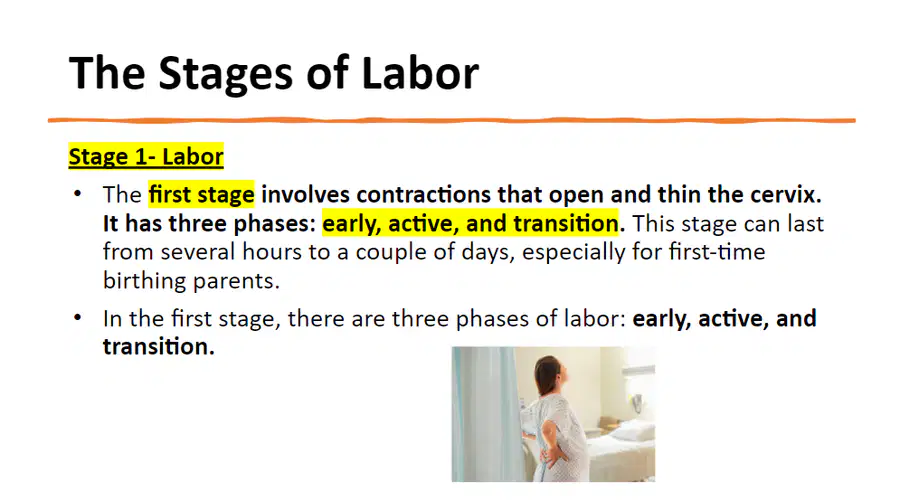
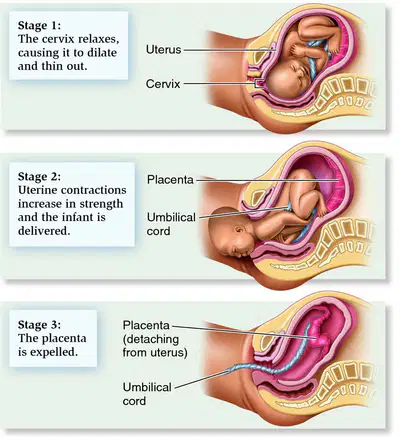
Three stages of labor.
8
9
Multiple Choice
Of the three stages of labor, which one has three sub stages in itself?
The first stage- Labor.
The body prepares itself for delivery.
The second stage- Delivery. The baby comes out completely.
Stage three- Post-Delivery.
The body dispenses the placenta and umbilical cord.
10

11

Stage 2:
Delivery
• The second stage starts when the cervix is
fully dilated and ends with the birth of the
baby.
• This stage involves pushing, guided by a
doctor or midwife. It might take a few
minutes to a few hours.
• Delivery occurs when one or more babies
exit a pregnant person's body and enter the
world. This usually happens after the
birthing parent has gone through labor,
which involves contractions to help the
cervix open up.
12
13


Stage 3:
Post-Delivery
The third stage begins after the baby is born and ends when the placenta is
delivered, typically within 30 minutes.
•During this stage, mild contractions help expel the placenta and shrink the uterus
back to its normal size.
•While each person and each newborn is different, there is a general timeline for
what to expect immediately and in the days and weeks after a birthing parent
delivers their baby.
•If they deliver at a birthing center, they will generally receive instructions for
newborn care and go home within several hours of giving birth. If they deliver
at a hospital, they will likely have a slightly longer stay with support for
newborn care before they leave.
o vaginal delivery aftercare
o C-section aftercare
o feeding support
o newborn soothing
o diapering
o hospital discharge
o birthing center discharge
14
Multiple Choice
Which part of labor involves pushing that is guided by a doctor or midwife?
The third stage
The second stage
The first stage
15
Match
Match the scenario to whether it describes labor or delivery.
Anna's contractions are five minutes apart, and her cervix dilated to 6 centimeters. She requests an epidural.
Lana's cervix dilated to 10 centimeters and her contractions are frequent and intense. She begins pushing.
Manuela's back and stomach started to feel dull pain. Over time, the pain has increased in intensity. Her pelvis feels a lot of pressure.
Labor
Delivery
Labor
Labor
Delivery
Labor
16

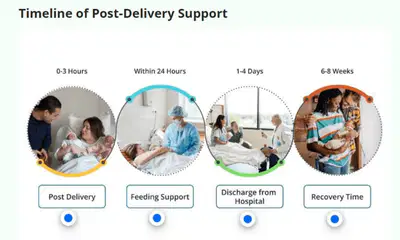
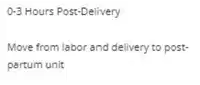
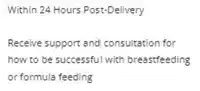
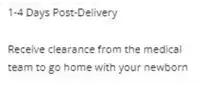

Timeline of
Post-Delivery
Support
17
Match
Matching! Is it post-delivery care of discharge?
Takes approximately 4-6 weeks
Shorter for birthing center than a hospital
Must include permanent name for your newborn
May include checks for infection
Post-delivery care
Discharge
Post-delivery care
Discharge
Post-delivery care
Discharge
Post-delivery care
Discharge
18
Multiple Select
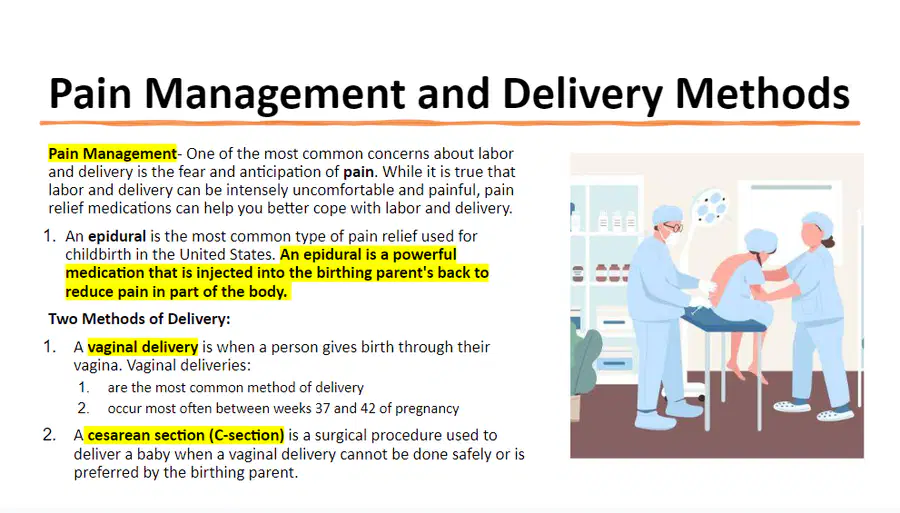
Which of the following is a type of delivery that a birthing parent might experience?
Select all that apply.
Induction
Vaginal delivery
C-section
Preterm birth
19


Newborn Care
Safe Sleep Practices
• When a birthing parent brings their newborn home, it is also
essential to protect a child's safety by following safe sleep
practices.
• Be sure to do the following:
• Place a baby on their back for all sleep times, naps, and at night.
• Use a firm, flat (not at an angle or inclined) sleep surface, such as a
mattress in a safety-approved crib covered by a fitted sheet.
• If possible, try to keep the baby's sleep area (for example, a crib or
bassinet) in the same room where a parent sleeps, for at least the first
few weeks or months.
• Keep soft bedding like blankets, pillows, bumper pads, and soft toys
out of the baby’s sleep area.
• Do not cover a baby’s head or allow your baby to get too hot.
20
Multiple Choice
Should there be ANYTHING in the crib with an infant? (ie, toys, pillows, blankets)
No
Yes
21
Correct!
NOTHING should be in the crib with your baby.


22

Postpartum Mental
Health
•
It is important to meet all the needs of a
newborn while doing self-care.
•
Many birthing parents will experience some
degree of "baby blues" shortly after birth due to
the hormonal fluctuations that follow childbirth.
This typically resolves on its own within a few
days.
•
A much more serious condition is known as
postpartum depression. We will learn more
about this in an upcoming lesson!
23

Summary
• In this lesson, you learned:
o common considerations regarding labor
and delivery;
o the procedures and factors related to
birth; and
o factors relating to bringing a newborn
home for the first time.
• On our next lesson, you will learn about
common medical considerations for
newborns and what parents should know
before reaching out to a doctor.
• Ticket out...
24
Multiple Choice
What will a birthing parent be advised to do after leaving the hospital?
Start working out immediately
Limit activities for several weeks
Resume all normal activities
Call doctors every day to check in
Welcome to Real World Parenting with Mrs. Cronce!
Today's Lesson 2.2:
Labor and Newborn Care
Do Now:
1) Connect to Wayground
2) Annote and vote ---->
3) Get your bingo card ready
Show answer
Auto Play
Slide 1 / 24
SLIDE
Similar Resources on Wayground

19 questions
Circulatory & Respiratory Anatomy Review
Presentation
•
9th - 12th Grade
19 questions
SAT math practice
Presentation
•
9th - 12th Grade
19 questions
Ionic Compounds
Presentation
•
9th - 12th Grade
19 questions
Resume Writing
Presentation
•
9th - 12th Grade
17 questions
Permutations and Combinations
Presentation
•
9th - 12th Grade
17 questions
Making Inferences in Reading
Presentation
•
9th - 12th Grade
21 questions
Parent Functions & Transformations
Presentation
•
8th - 12th Grade
20 questions
Simple Past Continuous Tense
Presentation
•
9th Grade - University
Popular Resources on Wayground
6 questions
Secondary Safety Quiz
Presentation
•
9th - 12th Grade
10 questions
Afterschool Activities & Sports

Quiz
•
6th - 8th Grade
19 questions
ROAR Week 2026
Quiz
•
9th - 12th Grade
20 questions
Lab Safety Quiz
Quiz
•
6th Grade
15 questions
Cool Tool:Chromebook
Quiz
•
6th - 8th Grade
22 questions
would you rather
Quiz
•
3rd - 11th Grade
21 questions
Continents and Oceans
Quiz
•
6th Grade
20 questions
Parts of Speech
Quiz
•
5th Grade
Discover more resources for Other
6 questions
Secondary Safety Quiz
Presentation
•
9th - 12th Grade
19 questions
ROAR Week 2026
Quiz
•
9th - 12th Grade
22 questions
would you rather
Quiz
•
3rd - 11th Grade
55 questions
CHS Student Handbook 26-27
Quiz
•
9th Grade
21 questions
Lab Safety
Quiz
•
10th Grade
10 questions
Fact Check Ice Breaker: Two truths and a lie
Quiz
•
5th - 12th Grade
12 questions
Lab Safety Quizizz
Quiz
•
9th Grade
20 questions
1.1 (a) Classifying Polynomials
Quiz
•
9th Grade