

Cell Transport

Presentation
•
Science
•
9th - 12th Grade
•
Medium
+14
Standards-aligned

Adrienne Aguilar
Used 6+ times
FREE Resource
17 Slides • 19 Questions
1
Cell Transport Notes

2
Instructions:
Use this presentation to take notes on the different types of cell transport and how it helps the cell maintain function.
3
Cell Membrane
Cell Membranes surround ALL cells!
Controls what molecules enter and leave the cell
- food & oxygen molecules must enter the cell
- waste products need to be released
SEMIPERMEABLE – it allows some things through but not others

4
Multiple Choice
5
Phospholipid bilayer
Polar heads “love” water (hydrophilic)
Nonpolar tails “fear” water (hydrophobic)


6
Multiple Choice
Which type of biological macromolecule is the main component of the plasma membrane?
carbohydrate
lipid
protein
nucleic acid
7
Multiple Choice

Which part of the phospholipid is hydrophobic?
The head
The tails
Only one tail
The heart
8
Fluid Mosaic Model
Describes the various molecules found in the cell membrane
Example:
-Proteins: forms channels and pumps to move materials across membranes
- Carbohydrates: act like identification cards so cells can identify one another

9
Multiple Choice
10
Multiple Choice
Which image correctly shows the way phospholipids arrange themselves in the cell (plasma) membrane?
11
Transport Across a Membrane
Molecules can enter/leave the cell in 2 ways:
1. Passive Transport
* Diffusion
* Facilitated (“helped”) Diffusion
* Osmosis
2. Active transport
* Protein Pump
* Endocytosis
* Exocytosis

12
Passive Transport
Energy (ATP) is NOT REQUIRED for movement of substances across the membrane
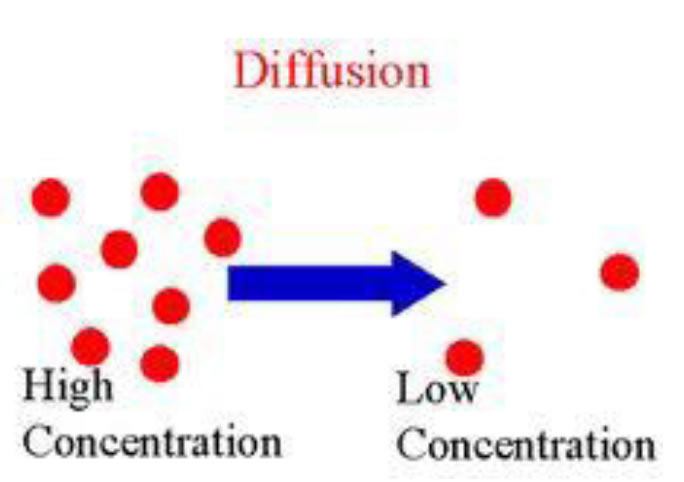
Molecules move from an area of high concentration to an area of low concentration to reach equilibrium (same concentration on both sides)- Think of it like riding a bike downhill

13
Dropdown
14
Multiple Choice
15
(Simple) Diffusion
No energy is required
Movement of molecules through a membrane to reach equilibrium
Molecules move from area of high concentration to area of low concentration
Occurs because molecules constantly move and collide with each other

16
Facilitated Diffusion
No energy is required
Molecules are "helped" across by carrier or channel proteins
Molecules move from area of high concentration to area of low concentration
Helps large or polar molecules get into the membrane

17
Osmosis
No energy is required
The diffusion of WATER through a semipermeable membrane
Molecules move from area of high concentration to area of low concentration

18
Multiple Choice
19
Multiple Choice
20
Multiple Choice

Which type of diffusion is represented?
Facilitated diffusion
Osmosis
Diffusion
21
Multiple Choice

Which molecule is in equilibrium? How can you tell?
Molecule A; equal amounts inside and outside
Molecule B; passive movement into the cell
Molecule C; equal amounts inside and outside
Molecule C; all molecules are inside the cell
22
Osmosis- Water Balance in Cells
Isotonic Solutions | Hypotonic Solutions | Hypertonic Solutions |
|---|---|---|
Concentration of solutes (Dissolved substance) is the same in and out of the cell Equal amount of water leaving and entering cell | Solution has a lower solute concentration than the inside of cell
| Solution has a higher solute concentration than the inside of the cell. More water leaves cell, causing cell to shrink |
23
Osmosis- Water Balance in Cells

Animal Cells
Plant Cells
The cell wall prevents plant cells from bursting in hypotonic solutions. Plant cells are referred to a "turgid" when like this and this helps hold plants upright.
24
Match
Hypertonic
Hypotonic
Isotonic
The solution contains a high concentration of solute an and low concentration of water
The solution contains a low concentration of solute an and high concentration of water
The solution has an equal concentration of solute and water compared to the inside of the cell
The solution contains a high concentration of solute an and low concentration of water
The solution contains a low concentration of solute an and high concentration of water
The solution has an equal concentration of solute and water compared to the inside of the cell
25
Multiple Choice

The cell shrunk in size, which means it was placed in a ____ solution.
Isotonic
Hypertonic
Hypotonic
26
Multiple Choice

27
Multiple Choice

The cell expanded in size to the point of lysing (bursting), which means it was placed in a ____ solution.
Isotonic
Hypertonic
Hypotonic
28
Active Transport
Energy (ATP) is REQUIRED for movement of substances across the membrane
Molecules "pumped" from an area of low concentration to an area of high concentration against the concentration gradient- Think of it like riding a bike uphill

29
Multiple Choice
Active transport across a cell membrane from low to high concentration, requires
energy (ATP)
no energy
water
oxygen
30
Protein Pump
Energy is required
Protein pumps in membrane "pull" molecules through using ATP
Molecules move from area of high concentration to area of low concentration

31
Endocytosis
Energy is required
When the cell membrane engulfs larger molecules to bring into the cell
Molecules can move with or against the concentration gradient, depending on what the cell needs
This is the same process certain cells in our immune system use to engulf and destroy invaders!

32
33
Exocytosis
Energy is required
When a membrane of a vacuole surrounding material (protein or lipids produced or waste products) fuses with the cell membrane, releasing the material outside of the cell
Molecules can move with or against the concentration gradient, depending on what the cell needs

34
Match
Match the following processes to the illustration:
Diffusion
facilitated diffusion
active transport
exocytosis
endocytosis
Diffusion
facilitated diffusion
active transport
exocytosis
endocytosis
35
Match
Simple Diffusion
Facilitated Diffusion
Osmosis
Endocytosis
Exocytosis
When molecules passively cross the plasma membrane through the phospholipid bilayer
When molecules passively cross the plasma membrane through a channel protein
The movement of water across the cell membrane
Bringing in large materials through the cell membrane into a vacuole.
Moving larger amounts or large quantities of materials through the cell membrane
When molecules passively cross the plasma membrane through the phospholipid bilayer
When molecules passively cross the plasma membrane through a channel protein
The movement of water across the cell membrane
Bringing in large materials through the cell membrane into a vacuole.
Moving larger amounts or large quantities of materials through the cell membrane
36
Match
Match the following
oxygen & carbon dioxide move into and out of blood and lungs
insulin produced and pushed out of cell in vesicles
cell pulls in glucose to produce ATP
white blood cells engulf and destroy invading bacteria
water moves out of plant cells when plant watered with salt solution
diffusion
exocytosis
active transport
endocytosis
osmosis
diffusion
exocytosis
active transport
endocytosis
osmosis
Cell Transport Notes
Show answer
Auto Play
Slide 1 / 36
SLIDE
Similar Resources on Wayground

30 questions
Solid Waste Management
Presentation
•
9th - 12th Grade
28 questions
Marine Science Midterm Review Part 1
Presentation
•
9th - 12th Grade
31 questions
Preterite of -ir Stem-Changing Verbs
Presentation
•
9th - 12th Grade
30 questions
Properties of Quadrilaterals
Presentation
•
9th - 12th Grade
30 questions
Eukaryotic Cell Structure
Presentation
•
9th - 12th Grade
30 questions
Evidence of Evolution
Presentation
•
9th - 12th Grade
33 questions
Population Ecology Review
Presentation
•
9th - 12th Grade
31 questions
Genetic Technologies
Presentation
•
8th Grade - University
Popular Resources on Wayground
6 questions
PRIDE Always and Everywhere
Presentation
•
12th Grade
20 questions
Lab Safety Quiz

Quiz
•
6th Grade
26 questions
KOR Review Kahoot Questions
Quiz
•
8th Grade
21 questions
Continents and Oceans
Quiz
•
6th Grade
12 questions
Unit Zero lesson 2 cafeteria
Presentation
•
9th - 12th Grade
20 questions
Parts of Speech
Quiz
•
5th Grade
10 questions
Riddles Riddles fun Riddles
Quiz
•
6th - 12th Grade
16 questions
Subject & Predicate
Quiz
•
5th Grade
Discover more resources for Science
10 questions
Scientific Method (The scientific method)

Interactive video
•
9th Grade
10 questions
Exploring Chemical and Physical Changes
Interactive video
•
6th - 10th Grade
10 questions
Exploring the States of Matter
Interactive video
•
6th - 10th Grade
20 questions
Atomic Structure
Quiz
•
9th Grade
30 questions
Atomic Structure and Periodic Table Review
Quiz
•
10th Grade
9 questions
Exploring the Steps of the Scientific Method
Interactive video
•
6th - 10th Grade
16 questions
Identify Key Characteristics of Living Organisms
Quiz
•
9th - 12th Grade
20 questions
Photosynthesis
Quiz
•
9th Grade