

Brake Technology

Presentation
•
Instructional Technology
•
10th Grade
•
Practice Problem
•
Hard

Jeremy Oskins
Used 16+ times
FREE Resource
66 Slides • 0 Questions
1

2

80
Brake System
Technology
Chapter
3

Permission granted to reproduce for educational use only.
© Goodheart-Willcox Co., Inc.
Objectives
After studying this chapter, you will be able to:
• Explain the hydraulic and mechanical principles of
a brake system.
• Identify the major parts of an automotive brake
system.
• Define the basic functions of the major parts of a
brake system.
4

Permission granted to reproduce for educational use only.
© Goodheart-Willcox Co., Inc.
Objectives
• Compare drum and disc brakes.
• Explain the operation of power brakes.
• Describe the operation of parking brakes.
• Correctly answer ASE certification test questions
requiring a knowledge of automotive brake
systems.
5

Permission granted to reproduce for educational use only.
© Goodheart-Willcox Co., Inc.
Brake System Technology
Introduction
• Automotive brakes
– Provide means of using friction to either slow, stop,
or hold wheels of vehicle
• Moving car has tremendous amount of stored
energy in form of inertia
– Tendency to keep moving
• To stop vehicle, brakes convert mechanical energy
into heat energy
6

Permission granted to reproduce for educational use only.
© Goodheart-Willcox Co., Inc.
Brake System Technology
Introduction (Cont.)
• Hydraulic brakes
– Confined brake fluid used to transfer power and
motion from brake pedal to wheel cylinders and
brakes
• Hybrid brakes
– Conventional hydraulic brake system combined
with electric regenerative braking system provided
by hybrid’s driveline
7

Permission granted to reproduce for educational use only.
© Goodheart-Willcox Co., Inc.
Basic Brake System
Basic parts include
• Brake pedal assembly
– Foot lever for operating master cylinder and power
booster
• Master cylinder
– Hydraulic-piston pump that develops pressure for
hydraulic brake system
• Brake booster
– Vacuum, electric, or power steering-operated
device that assists brake pedal application
8

Permission granted to reproduce for educational use only.
© Goodheart-Willcox Co., Inc.
Basic Brake System (Cont.)
• Brake lines and hoses
– Metal tubing and rubber hose that transmit
pressure to wheel brake assemblies
• Wheel brake assemblies
– Hydraulic-mechanical mechanisms that use
hydraulic pressure to produce friction to slow or
stop each wheel
• Emergency or parking brakes
– Mechanical or electric systems for applying rear
brake assemblies
9


Permission granted to reproduce for educational use only.
© Goodheart-Willcox Co., Inc.
Basic Brake System (Cont.)
(Honda)
10


Permission granted to reproduce for educational use only.
© Goodheart-Willcox Co., Inc.
Drum and Disc Brakes
• Disc brakes are
frequently used on two
front wheels of vehicle
• Drum brakes are often
used on rear wheels
• Disc or drum brakes may
be used on all four
wheels
11

Permission granted to reproduce for educational use only.
© Goodheart-Willcox Co., Inc.
Drum and Disc Brakes (Cont.)
Components of disc brake assembly
• Caliper
– Assembly that holds hydraulic cylinder, piston,
seals, and brake pads
• Caliper cylinder
– Machined hole in caliper
– Piston fits into this cylinder
12

Permission granted to reproduce for educational use only.
© Goodheart-Willcox Co., Inc.
Drum and Disc Brakes (Cont.)
• Brake pads
– Friction members that push against disc by action
of master cylinder, caliper cylinder, and piston
• Brake disc
– Large metal rotor that holds wheel and tire and
uses friction from brake pads to stop or slow wheel
rotation
13

Permission granted to reproduce for educational use only.
© Goodheart-Willcox Co., Inc.
Drum and Disc Brakes (Cont.)
Components of drum brake assembly
• Wheel cylinder assembly
– Houses hydraulic piston that force outward by fluid
pressure
• Brake shoes
– Friction units that push against rotating brake drum
by action of hydraulic wheel cylinder
• Brake drum
– Rubs against brake shoes to stop or slow wheel
rotation
14

Permission granted to reproduce for educational use only.
© Goodheart-Willcox Co., Inc.
Braking Ratio
• Comparison of front wheel braking effort to rear
wheel braking effort
• Typically, front wheel brakes handle 60%–70% of
the braking power
• Rear wheel brakes typically handle 30%–40% of
braking
• Front-wheel-drive cars can have even higher
braking ratio at front wheels
15

Permission granted to reproduce for educational use only.
© Goodheart-Willcox Co., Inc.
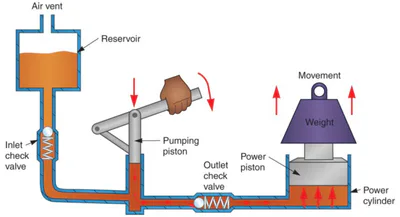
Brake System Hydraulics
• Hydraulic system uses liquid to transmit motion or
pressure from one point to another
• Several principles apply to operation of hydraulic
system
– Liquids in confined area will not compress
• Air in confined area will compress
– When pressure is applied to closed system,
pressure exerts equally in all directions
– Hydraulic system can increase or decrease force or
motion
16


Permission granted to reproduce for educational use only.
© Goodheart-Willcox Co., Inc.
Hydraulic System Action
(OTC)
17

Permission granted to reproduce for educational use only.
© Goodheart-Willcox Co., Inc.
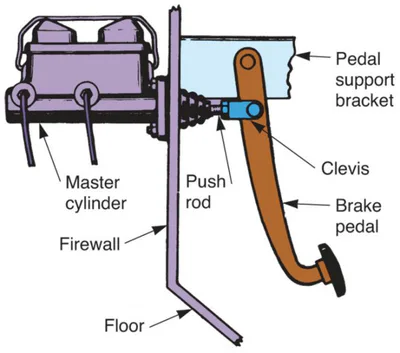
Brake System Components
• Know location and construction of major brake
system components
• This will better prepare you to troubleshoot and
repair these important parts
18

Permission granted to reproduce for educational use only.
© Goodheart-Willcox Co., Inc.
Brake Pedal Assembly
• Lever arm increases
force applied to
master cylinder piston
• Manual master
cylinder bolts directly
to engine’s firewall
• Brake pedal assembly
bolts under dash
(Bendix)
19

Permission granted to reproduce for educational use only.
© Goodheart-Willcox Co., Inc.
Master Cylinder
Four basic functions
• Develops pressure, causing wheel cylinder pistons
to move toward discs or drums
• After all shoes or pads produce sufficient friction,
it helps equalize pressure required for braking
• Keeps system full of fluid as brake linings wear
• Maintains slight pressure to keep contaminants
from entering system
– Air and water
20

Permission granted to reproduce for educational use only.
© Goodheart-Willcox Co., Inc.
Master Cylinder Construction
• Housing
• Reservoir
• Piston
• Rubber cup
• Return spring
• Rubber boot
21

Permission granted to reproduce for educational use only.
© Goodheart-Willcox Co., Inc.
Master Cylinder Construction
(Cont.)
• Cup and piston
– Pressurize brake system
– When pushed forward, they trap fluid, building
pressure
• Intake port or vent
– Allows fluid to enter rear of cylinder as piston slides
forward
22

Permission granted to reproduce for educational use only.
© Goodheart-Willcox Co., Inc.
Master Cylinder Construction
(Cont.)
• Compensating port
– Releases extra pressure when piston returns to
released position
– Fluid can flow back into reservoir through
compensating port
• Residual pressure valves
– Maintain residual fluid pressure of approximately
10 psi to help keep contaminants out of system
23

Permission granted to reproduce for educational use only.
© Goodheart-Willcox Co., Inc.
Master Cylinder Construction
(Cont.)
• Rubber boot
– Prevents dust, dirt, and moisture from entering
back of master cylinder
• Master cylinder reservoir
– Stores an extra supply of brake fluid
– Reservoir may be cast as part of housing, or it may
be removable plastic part
24

Permission granted to reproduce for educational use only.
© Goodheart-Willcox Co., Inc.
Dual Master Cylinder
• Older vehicles used single-piston, single-reservoir
master cylinders
– Dangerous
• If brake fluid leak developed, sudden loss of
braking ability could occur
• Modern vehicles use dual master cylinder for
added safety
25


Permission granted to reproduce for educational use only.
© Goodheart-Willcox Co., Inc.
Dual Master Cylinder
(Cont.)
(Bendix)
26

Permission granted to reproduce for educational use only.
© Goodheart-Willcox Co., Inc.
Dual Master Cylinder
(Cont.)
• Dual or tandem master cylinder
– Has two separate hydraulic pistons and two fluid
reservoirs
– If there is system leak in one of hydraulic circuits,
other circuit can still provide braking action on two
wheels
• Rear piston assembly is called primary piston
• Front piston is secondary piston
27


Permission granted to reproduce for educational use only.
© Goodheart-Willcox Co., Inc.
Dual Master Cylinder Operation
(Delco)
28

Permission granted to reproduce for educational use only.
© Goodheart-Willcox Co., Inc.
Power Brakes
• Use booster and either engine vacuum, electric
pump, or hydraulic pressure to assist brake pedal
application
• Booster is located between brake pedal linkage
and master cylinder
29

Permission granted to reproduce for educational use only.
© Goodheart-Willcox Co., Inc.
Power Brake Vacuum Boosters
• Vacuum booster
– Uses engine vacuum to apply hydraulic brake
system
– Or vacuum created by separate pump on diesel
engines
• When vacuum is applied to one side of booster,
piston or diaphragm moves toward low-pressure
area
– This movement helps force piston into master
cylinder
30

Permission granted to reproduce for educational use only.
© Goodheart-Willcox Co., Inc.
Vacuum Booster Types
Two types of vacuum brake boosters
• Atmospheric suspended brake booster
– Has atmospheric pressure on both sides of
diaphragm or piston when brake pedal is released
• Vacuum suspended brake booster
– Has vacuum on both sides of piston or diaphragm
when brake pedal is released
31

Permission granted to reproduce for educational use only.
© Goodheart-Willcox Co., Inc.
Power Brake Hydraulic Boosters
• Hydraulic booster, hydro-boost or hydra-booster
– Uses power steering pump pressure to help driver
apply brake pedal
• Fluid pressure, instead of vacuum, helps force
piston forward
• Commonly used on vehicles equipped with diesel
engines
32

Permission granted to reproduce for educational use only.
© Goodheart-Willcox Co., Inc.
Brake Fluid
• Specially blended hydraulic fluid that transfers
pressure to wheel brake assemblies
• Automakers recommend brake fluid that meets or
exceeds SAE and DOT specifications
– Society of Automotive Engineers
– Department of Transportation
• Only use brake fluid that satisfies their
requirements
33

Permission granted to reproduce for educational use only.
© Goodheart-Willcox Co., Inc.
Brake Fluid (Cont.)
Brake fluid must have these characteristics
• Maintain correct viscosity
– Free flowing at all temperatures
• High boiling point
– Remains liquid at highest system operating
temperature
• Noncorrosive
– Does not attack metal or rubber brake system parts
34

Permission granted to reproduce for educational use only.
© Goodheart-Willcox Co., Inc.
Brake Fluid (Cont.)
• Water tolerant
– Absorbs moisture collecting in system
• Lubricates
– Reduces wear of pistons and cups
• Low freezing point
– Does not freeze in cold weather
35

Permission granted to reproduce for educational use only.
© Goodheart-Willcox Co., Inc.
Brake Lines and Hoses
• Transfer fluid pressure from master cylinder to
wheel brake assemblies
• Brake lines are made of double-wall steel tubing
and usually have double-lap flares on their ends to
prevent high pressure leakage
36

Permission granted to reproduce for educational use only.
© Goodheart-Willcox Co., Inc.
Brake Lines and Hoses (Cont.)
• Brake hoses are reinforced braided rubber
hydraulic hoses with threaded metal end fittings
• Junction block is used where single brake line
must feed two wheel cylinders
– Hollow fitting with one inlet and two or more outlets
37


Permission granted to reproduce for educational use only.
© Goodheart-Willcox Co., Inc.
Brake Lines and Hoses (Cont.)
• Longitudinally split brake
system
– Pistons operate front
and rear
• Diagonally split brake
system
– Pistons operate
opposite corners
(Delco)
38


Permission granted to reproduce for educational use only.
© Goodheart-Willcox Co., Inc.
Disc Brake Assemblies
• Friction elements are
squeezed inward to
clamp against rotating
disc, or wheel
• Disc brake assembly
consists of caliper,
brake pads, disc, and
related hardware
39

Permission granted to reproduce for educational use only.
© Goodheart-Willcox Co., Inc.
Brake Caliper
• Brake caliper assembly includes caliper housing,
piston, piston seal, dust boot, brake pads, special
hardware, and bleeder screw
• When brake pedal is applied, brake fluid flows into
caliper cylinder
• Piston is then pushed outward by fluid pressure,
forcing the brake pads into disc
40

Permission granted to reproduce for educational use only.
© Goodheart-Willcox Co., Inc.
Brake Caliper (Cont.)
• Piston seal
– Prevents pressure leakage between piston and
cylinder
• Piston boot
– Keeps road dirt and water off caliper piston and
wall of cylinder
• Bleeder screw
– Allows air to be removed from hydraulic brake
system
41


Permission granted to reproduce for educational use only.
© Goodheart-Willcox Co., Inc.
Brake Caliper (Cont.)
(Chrysler)
42

Permission granted to reproduce for educational use only.
© Goodheart-Willcox Co., Inc.
Disc Brake Pads
• Steel plates to which linings are riveted or bonded
• Each caliper has inner and outer brake pad that
fits inside hydraulic brake caliper
• Brake pad linings
– Made of heat-resistant organic or semimetallic
friction material
43

Permission granted to reproduce for educational use only.
© Goodheart-Willcox Co., Inc.
Disc Brake Pads (Cont.)
• Anti-rattle clips
– Keep brake pads from vibrating and rattling
– Snap onto brake pad to produce force fit in caliper
• Pad-wear sensor
– Metal tab on brake pad that informs driver of worn
brake pad linings
44

Permission granted to reproduce for educational use only.
© Goodheart-Willcox Co., Inc.
Brake Disc
• Brake disc or brake rotor
– Uses friction from brake pads to slow or stop wheel
rotation
• Normally made of cast iron
• May be integral part of wheel hub
– In many front-wheel-drive vehicles, disc and hub
are separate units
• May be solid or ventilated
45

Permission granted to reproduce for educational use only.
© Goodheart-Willcox Co., Inc.
Disc Brake Types
• Floating caliper disc brake
– Mounted on two bolts supported by rubber
bushings
– This one-piston caliper is free to shift, or float, in
rubber bushings
• Sliding caliper disc brake
– One-piston caliper that is mounted in slots
machined in caliper adapter
– Caliper is free to slide sideways in slots or grooves
as linings wear
46

Permission granted to reproduce for educational use only.
© Goodheart-Willcox Co., Inc.
Disc Brake Types
• Fixed caliper disc brake
– Uses more than one piston and caliper cylinder
– The caliper is bolted directly to the steering knuckle
• It is not free to move in relation to the disc
– Severe vibrations can occur with a slight runout of
the disc
47


Permission granted to reproduce for educational use only.
© Goodheart-Willcox Co., Inc.
Disc Brake Assembly
(Chrysler and Toyota)
48

Permission granted to reproduce for educational use only.
© Goodheart-Willcox Co., Inc.
Drum Brake Assemblies
• Drum brakes
– Have large drum that surrounds brake shoes and
hydraulic wheel cylinder
• Drum brake assembly consists of backing plate,
wheel cylinder, brake shoes and linings, retracting
springs, hold-down springs, brake drum, and
automatic adjusting mechanism
49


Permission granted to reproduce for educational use only.
© Goodheart-Willcox Co., Inc.
Drum Brake Assembly
(Chrysler and Toyota)
50

Permission granted to reproduce for educational use only.
© Goodheart-Willcox Co., Inc.
Backing Plate
• Brake backing plate
– Holds shoes, springs, wheel cylinder, and other
parts inside brake drum
• Helps keep road dirt and water off brakes
• Backing plate bolts to axle housing or spindle
support
51

Permission granted to reproduce for educational use only.
© Goodheart-Willcox Co., Inc.
Wheel Cylinder Assembly
• Wheel cylinder
– Consists of cylinder or housing, expander spring,
rubber cups, pistons, dust boots, and bleeder
screw
• Wheel cylinder housing
– Forms enclosure for other parts of assembly
• Wheel cylinder boots
– Keeps road dirt and water out of cylinder
52

Permission granted to reproduce for educational use only.
© Goodheart-Willcox Co., Inc.
Wheel Cylinder Assembly (Cont.)
• Wheel cylinder pistons
– Metal or plastic plungers transfer force out of wheel
cylinder assembly
• Wheel cylinder cups
– Rubber seals that keep fluid from leaking past
pistons
• Wheel cylinder spring
– Helps hold rubber cups against pistons when wheel
cylinder assembly is not pressurized
53

Permission granted to reproduce for educational use only.
© Goodheart-Willcox Co., Inc.
Wheel Cylinder Assembly (Cont.)
• Cup expanders
– Press outer edges of cups against wall of wheel
cylinder
• Bleeder screw
– Provides means of removing air from brake system
– Threads into hole in back of wheel cylinder
54

Permission granted to reproduce for educational use only.
© Goodheart-Willcox Co., Inc.
Drum Brake Shoes
• Drum brake shoe assemblies or brake shoes
– Rub against revolving brake drum to produce
braking action
• Primary brake shoe
– Front shoe, it has slightly shorter lining than
secondary shoe
• Secondary brake shoe
– Rear shoe, it has largest lining surface area
55

Permission granted to reproduce for educational use only.
© Goodheart-Willcox Co., Inc.
Retracting Springs and Hold-Down Springs
• Retracting springs
– Pull brake shoes away from brake drums when
brake pedal is released
• Hold-down springs
– Hold brake shoes against backing plate when
brakes are in released position
56

Permission granted to reproduce for educational use only.
© Goodheart-Willcox Co., Inc.
Brake Shoe Adjusters
• Brake shoe adjusters
– Maintain correct drum-to-lining clearance as brake
linings wear
• Many vehicles use star wheel-type brake shoe
adjusting mechanism
– Adjusting screw assembly
• Other vehicles use latch-type adjusters
• Automatic brake shoe adjusters function when
brakes are applied with vehicle moving in reverse
57


Permission granted to reproduce for educational use only.
© Goodheart-Willcox Co., Inc.
Brake Drums
• Provide rubbing surface
for brake shoe linings
• Fits over wheel lug studs
• Large hole in middle of
drum centers drum on
front hub or rear axle
flange
• Wheel and drum turn as
unit
(Ford)
58


Permission granted to reproduce for educational use only.
© Goodheart-Willcox Co., Inc.
Brake Shoe Energization
• When brake shoes are
forced against rotating
drum, they are pulled
away from their pivot
point by friction
• This self-energizing
action draws shoes
tighter against drum
(EIS)
59


Permission granted to reproduce for educational use only.
© Goodheart-Willcox Co., Inc.
Brake Shoe Energization (Cont.)
• With most drum brake
designs, shoe
energization is
supplemented by servo
action
• Servo action results
when primary (front)
shoe helps apply
secondary (rear) shoe
(EIS)
60

Permission granted to reproduce for educational use only.
© Goodheart-Willcox Co., Inc.
Brake System Switches
Three types of switches
• Stoplight switch
• Brake warning light switch
• Low-fluid warning light switch
61

Permission granted to reproduce for educational use only.
© Goodheart-Willcox Co., Inc.
Brake System Switches (Cont.)
• Stoplight switch
– Spring-loaded electrical switch that operates rear
brake lights of vehicle
• Brake warning light switch or pressure differential
valve
– Warns driver of pressure loss on one side of dual
brake system
• Low-fluid warning light switch
– Turns on dash light if brake fluid in master cylinder
becomes low
62

Permission granted to reproduce for educational use only.
© Goodheart-Willcox Co., Inc.
Brake System Control Valves
• Metering valve
– Designed to equalize braking action at each wheel
during light brake applications
• Proportioning valve
– Used to equalize braking action in systems with
front disc brakes and rear drum brakes
• Combination valve
– Single unit that functions as brake warning light
switch, metering valve, and/or proportioning valve
63

Permission granted to reproduce for educational use only.
© Goodheart-Willcox Co., Inc.
Parking Brakes
• Parking brakes or emergency brakes
– Provide mechanical means of applying brakes
• Cable and levers
• Electric parking brake
– Uses brake system control module to operate
electric servo motor that mechanically engages rear
brakes
64


Permission granted to reproduce for educational use only.
© Goodheart-Willcox Co., Inc.
Parking Brakes (Cont.)
(Toyota)
65


Permission granted to reproduce for educational use only.
© Goodheart-Willcox Co., Inc.
Parking Brakes (Cont.)
(Chrysler and Ford)
66

Permission granted to reproduce for educational use only.
© Goodheart-Willcox Co., Inc.
Hybrid Brakes
• Today’s hybrid vehicles are equipped with
regenerative braking systems
• Electric braking systems
• Work with conventional hydraulic brakes to slow
vehicle and generate electricity to recharge
vehicle’s HV battery at the same time
Show answer
Auto Play
Slide 1 / 66
SLIDE
Similar Resources on Wayground

58 questions
Classroom Procedures
Presentation
•
10th Grade
63 questions
Porifera and Cnidaria Notes
Presentation
•
9th - 12th Grade
62 questions
Meiji Restoration
Presentation
•
9th - 12th Grade
55 questions
Argumentative Writing Regents Prep
Presentation
•
11th Grade
54 questions
Medieval Vocabulary Part 2
Presentation
•
11th Grade
63 questions
Style and Techniques in Contemporary Arts
Presentation
•
12th Grade
62 questions
Lesson 9.2: Social Characteristics of Europe
Presentation
•
9th Grade
Popular Resources on Wayground
10 questions
Safety Day 2026 – Student Review

Quiz
•
9th Grade
21 questions
Continents and Oceans
Quiz
•
6th Grade
20 questions
Parts of Speech
Quiz
•
5th Grade
16 questions
Subject & Predicate
Quiz
•
5th Grade
25 questions
Multiplication Facts
Quiz
•
5th Grade
12 questions
Map Skills
Quiz
•
3rd Grade
22 questions
Continents and Oceans
Quiz
•
5th Grade
15 questions
Rounding Decimals
Quiz
•
5th Grade
Discover more resources for Instructional Technology
26 questions
SLIME!!!!!
Quiz
•
KG - 12th Grade
20 questions
Cell organelles and functions
Quiz
•
10th Grade
10 questions
Exploring Chemical and Physical Changes

Interactive video
•
6th - 10th Grade
20 questions
Cell Transport
Quiz
•
9th - 12th Grade
10 questions
Exploring the Basics of Exponents
Interactive video
•
6th - 10th Grade
20 questions
Budgeting
Quiz
•
9th - 12th Grade
20 questions
Investing
Quiz
•
9th - 12th Grade
20 questions
Preterite vs. Imperfect
Quiz
•
10th Grade