

09.16_2.6G_Deleon_E

Presentation
•
English
•
2nd Grade
•
Practice Problem
•
Hard
Standards-aligned

Franklin Valdez-Deleon
FREE Resource
36 Slides • 0 Questions
1


1
Teacher Facing
September 16, 2024
Unit 2: The Ancient Greek Civilization
Lesson 3
Grade 2
Read/Write
2
Icons
2
Click to open link
Materials needed
Students discuss using sentence stem or frame
Comprehension Check
Student Activity
Cross-linguistic
Connections (CLC)
3


Materials
Student
Teacher
●
Student Activity
●
Civilization Chart (Activity Book
1.1)
●
1 White Board
●
1 White Board Marker
●
Slide Deck
●
Amplify Domain 2 TG
3
4

4
This lesson
uses
Amplify
Domain 2
Lesson 11
Lesson at a Glance by Amplify from Amplify Texas (CC BY 3.0)
5


This lesson introduces students to the accomplishments of
Alexander the Great. Students will learn about key historical
events including battles that occurred during this time.
Some images/topics may be sensitive to students. Be sure
to read the text first and choose which ones you would like
to show to students.
Teacher Facing Sensitive Content Slide
6
66
Do Now
1.
Read the sentence.
Hiram’s father was happy his son
would follow in his steps and become
a doctor.
What is the meaning of follow in his
steps as used in the sentence?
A.
walk behind him
B.
borrow his shoes
C.
do the same job
D.
take his advice
2.
Read the sentence.
Jason set his eyes on a shiny, sports
car for sale.
What is the meaning of set his eyes
on as used in the sentence?
A.
noticed
B.
blinked
C.
rolled
D.
closed
7


Student Facing
September 16, 2024
Grade 2
Read/Write
Unit 2: The Ancient Greek Civilization
Lesson 3
8

8
LO:
SWBAT distinguish between what is important and not
important.
The Ancient Greek Civilization
DOL: Given a narrative nonfiction text, SW correctly distinguish
between what is important and not important in at least 3
of 4 questions.
Ⓡ ELA 2.6G
Evaluate details read to determine key ideas.
9
9
The study of
philosophy
began in
ancient
Greece.
The people of ancient
Greece fought many
great battles to protect
themselves and expand
their territory.
The mythical gods and
goddesses played an
important role in the
lives of ancient
Greeks.
The Olympic
Games started
in ancient
Greece.
Knowledge Objective
SWBAT identify the contributions
that the ancient Greek civilization
made to modern day government,
sports, and education.
The idea of
democracy
began in
ancient
Greece.
10


10
11

11
Key Idea: Philip the Second
built a strong kingdom.
Important
Not Important
Philip the Second
Philip the Second was the king
of Macedonia. Philip was very
important because he built a strong
kingdom. He was a smart leader.
He trained his army to be very good
at fighting. To train his army, he
would change out of his royal robes
and into armor. Philip also wanted
to unite different lands under his
rule by building cities in them.
King of
Macedonia
Smart leader
He would change
into armor to
train.
His army was
good at fighting.
He ruled different
lands and built
cities in them.
12

12
ambitious
adjective
having a strong desire for success or
achievement
13


13
devoted
adjective
feeling strong loyalty or commitment
14


14
retreat
verb
to withdraw or go back
15

15
Make a Prediction
What will happen that will take
away King Philip’s worry?
16

16
Correct or Confirm
Prediction
Are you able to correct or confirm
your prediction?
17

17
Alexander was determined to be the best at everything he did. He
constantly practiced with sword and spear, hour after hour. Even
full-grown soldiers told one another, “Keep your guard up when
you practice against Prince Alexander, or you will find his sword
point at your throat!” Alexander trained himself to swim in icy
rivers and run for miles without stopping. He became an excellent
wrestler and a champion horseman, and was constantly
challenging other riders. Do you think all of Alexander’s practice
helped him succeed? But Alexander was more than strong and
sturdy. He was intelligent, too. Realizing this, Philip told his son, “I
have arranged to have the greatest thinker in the world come
here to teach you. He is the famous Aristotle. Treat him with
respect.”
18

18
Alexander was athletic. = Important because good leader needs to be
athletic to fight battles.
Alexander was careless. = Not Important because a good leader does not
need to swim icy rivers.
Alexander was strong. = Important because a good leader needs to be
strong.
Alexander was arrogant. = Not Important because a good leader does not
need to challenge other horsemen.
Alexander was intelligent. = Important because a good leader needs to be
intelligent.
19

19
Key Idea: Alexander’s father realized even as a young man Alexander had the
qualities to be a good leader.
Important
Not Important
Alexander was athletic.
Alexander was athletic.
Alexander was careless.
Alexander was strong.
Alexander was strong.
Alexander was careless.
Alexander was arrogant.
Alexander was arrogant.
Alexander was intelligent.
Alexander was intelligent.
20

20
21

21
Alexander came to love and honor the wise Aristotle,
and tried to learn all that he could from him. Pleased
with his student, Aristotle taught the prince more than
science and mathematics. He also tried to pass along all
that the Greeks, especially the Athenians, had learned
about leading a civilized and well-balanced life.
Alexander loved to study the poems of Pindar.
Alexander listened when Aristotle taught him the
importance of observing and studying facts before
making decisions.
Key Idea:Aristotle taught Alexander important lessons
about making decisions.
22

22
Key Idea: Aristotle taught Alexander important lessons about being a leader.
Important
Not Important
He learned math and science.
He learned to live a balanced
life.
He learned to live a balanced life.
He learned how to make
decisions by observing and
studying facts.
He loved to study the poems of Pindar.
He learned math and science.
He loved to study the poems of
Pindar.
He learned how to make decisions by
observing and studying facts.
23

23
What is not important about what
Alexander learned from Aristotle?
A. Living a balanced life
B. Reading the poems of Pindar
C. Making decisions
D. Observing and studying facts
24

24
25

Alexander realized he would
have to use his mind as well as
his muscles to tame the horse.
Alexander the Great Part I. Retrieved from “Amplify Texas” (2024). Used with permission. (CC BY 4.0)
25
“Alexander the Great Part I” Vocabulary
26

26
27

27
Why was Alexander fighting
battles in Greece?
Alexander was fighting battles in
Greece because _____.
What two things did Alexander do
while riding into battle with his army?
28

28
Soon Alexander was leading troops into
battle for his father. He developed a habit
that stayed with him all his life: he always
rode in the front line of fighters. The soldiers
were proud of their brave prince and loved
him for taking risks as great as those he
asked them to take. A number of times
when a battle might have been lost,
Alexander would yell, “Charge!” and ride
ahead. His devoted or loyal and committed
soldiers would think, “We cannot let him be
killed or captured!” They had no choice but
to follow him and win the battle, for they
knew Alexander would never retreat.
29

29
Key Idea: Alexander proved to be a strong leader.
Important
Not Important
Alexander led his army from the front.
Alexander led his army from
the front.
Alexander never retreated from battle.
Alexander never retreated from
battle.
Alexander took risks during battle.
Alexander took risks during
battle.
30

30
After conquering Greece, where
does Alexander want to go next?
Alexander wants to go to _____.
31

31
Key Idea: Alexander proved to be a strong leader.
Important
Not Important
Alexander conquered Greece.
Alexander led his army from
the front.
Alexander put his advisors in charge of
Greece.
Alexander never retreated from
battle.
Alexander took risks during
battle.
Alexander conquered Greece.
Alexander put his advisors in
charge of Greece.
32

32
What is most important about Alexander’s leadership?
Select TWO correct answers.
A. Alexander led his army from the front.
B. Alexander’s father died and he became king.
C. Alexander put his advisors in charge of Greece.
D. Alexander took risks during battle.
E. Alexander never retreated from battle.
33

33
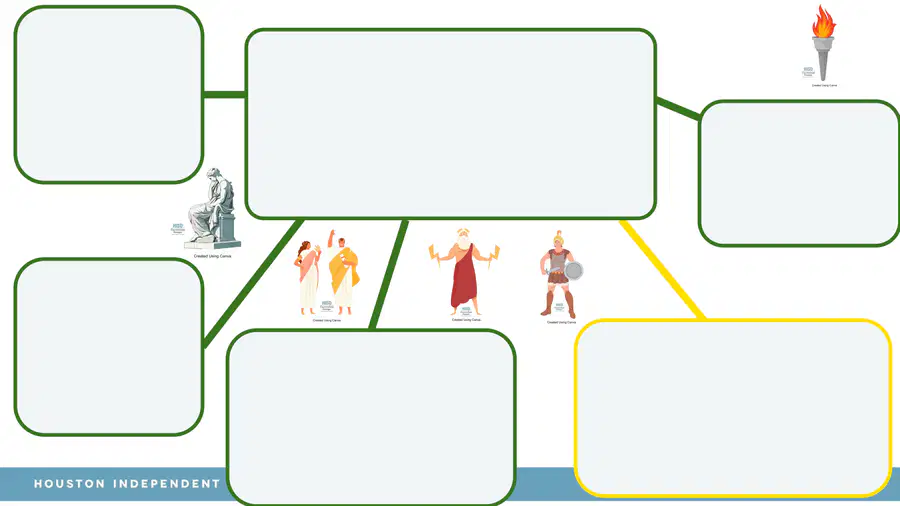
Ancient Greek Civilization Chart
Jobs
Religion
City-States
Leaders
Contributions
farming
shepherding
seafaring
philosophy
Alexander
the Great
34

34
Closing
Name one key idea
you learned about
Alexander and an
important detail to
support it.
35


35
DOL: Given a
narrative nonfiction
text, SW correctly
distinguish between
what is important and
not important in at
least 3 of 4 questions.
Demonstration of Learning
36

●Slide 19-20, 23, 26-29, 31, 34: Image Cards. Retrieved from “Amplify Texas ” (2024).
Used with permission. (CC BY 4.0)
●Alexander the Great Part I. Retrieved from “Amplify Texas” (2024). Used with permission.
(CC BY 4.0)
●Slides 6-7, 13-14, 16-19, 22, 25, 29, 31, 33, 35: Images created by HISD Curriculum
Design using Canva.
●Slide 15: Text created by HISD Curriculum Design.
36
Copyright Attributions
1
Teacher Facing
September 16, 2024
Unit 2: The Ancient Greek Civilization
Lesson 3
Grade 2
Read/Write
Show answer
Auto Play
Slide 1 / 36
SLIDE
Similar Resources on Wayground

29 questions
CKLA Skills 5 Lesson 26.2 Review
Presentation
•
2nd Grade
29 questions
Vowel Team Long E
Presentation
•
2nd Grade
33 questions
Guía 2do
Presentation
•
2nd Grade
32 questions
Skills 4 grammar review
Presentation
•
2nd Grade
33 questions
Grade 2 - U3,4,5 Review
Presentation
•
KG
28 questions
MODALS REVIEW
Presentation
•
KG
31 questions
School Supplies
Presentation
•
2nd Grade
32 questions
Post-test English 2
Presentation
•
2nd Grade
Popular Resources on Wayground
6 questions
PRIDE Always and Everywhere
Presentation
•
12th Grade
20 questions
Lab Safety Quiz

Quiz
•
6th Grade
26 questions
KOR Review Kahoot Questions
Quiz
•
8th Grade
21 questions
Continents and Oceans
Quiz
•
6th Grade
12 questions
Unit Zero lesson 2 cafeteria
Presentation
•
9th - 12th Grade
20 questions
Parts of Speech
Quiz
•
5th Grade
10 questions
Riddles Riddles fun Riddles
Quiz
•
6th - 12th Grade
16 questions
Subject & Predicate
Quiz
•
5th Grade
Discover more resources for English
24 questions
CKLA Domain 1 review (Fairy tales/ tall tales)
Quiz
•
2nd Grade
13 questions
Nouns!
Quiz
•
2nd Grade
20 questions
nouns verbs adjectives test
Quiz
•
2nd Grade
5 questions
Grandma and the Great Gourd Vocabulary
Quiz
•
2nd - 3rd Grade
13 questions
R Blends
Quiz
•
1st - 2nd Grade
20 questions
Sentence or Fragment?
Quiz
•
2nd - 5th Grade
20 questions
Statements and Questions
Quiz
•
2nd Grade
11 questions
Picture Day Perfection
Quiz
•
2nd Grade