Search Header Logo
1st 6 weeks Review

1st 6 weeks Review

Assessment

Presentation

Science

6th - 8th Grade

Practice Problem

Easy

NGSS
MS-ESS1-1, MS-PS1-1, MS-PS1-2

+15

Standards-aligned

Created by

Ruby Lopez

Used 6+ times

FREE Resource

27 Slides • 38 Questions

1

media

2

media

3

Physical Changes (Term)

  • Are easily reversible, have no new products, and are often just a change of state of matter (Definition)

  • Examples include:

  • Solid to liquid

  • Liquid to gas

  • Gas to liquid

  • Liquid to solid

media

4

Multiple Choice

What is an example of a physical change?

1

baking brownies

2

explosion

3

cutting paper

4

rust on metal

5

media

6

Multiple Choice

Is baking a cake a physical or chemical change?

1

Physical

2

Chemical

7

media

8

media

9

media

10

media

11

media

12

Multiple Choice

Chopping wood

1

physical change

2

chemical change

13

Multiple Choice

Mixing different colored marbles

1

physical change

2

chemical change

14

Multiple Choice

Firework

1

physical change

2

chemical change

15

Multiple Choice

Making eggs for breakfast

1

physical change

2

chemical change

16

Multiple Choice

Burning wood

1

physical change

2

chemical change

17

The Rate of Dissolution

media

18

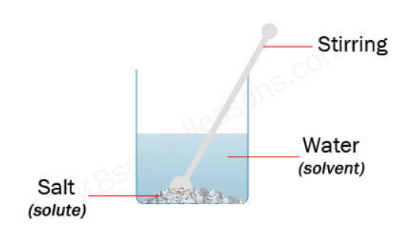
One factor that affect the rate of dissolving is:

Stirring

  • Stirring a solute into a solvent speeds up the rate of dissolving because it helps distribute the solute particles throughout the solvent. .

  • For example, when you add sugar to iced tea and then stir the tea, the sugar will dissolve faster

  • If you don’t stir the iced tea, the sugar may eventually dissolve, but it will take much longer.

19

One factor that affect the rate of dissolving is: Temperature


  • The temperature of the solvent is another factor that affects how fast a solute dissolves. Generally, a solute dissolves faster in a warmer solvent than it does in a cooler solvent because particles have more energy of movement. 

  • For example, if you add the same amount of sugar to a cup of hot tea and a cup of iced tea, the sugar will dissolve faster in the hot tea.


20

One factor that affect the rate of dissolving is: Particle Size

  • Smaller particles have greater surface area. With greater surface area, there can be more contact between particles of solute and solvent

  • If you put granulated sugar in a glass of iced tea, it will dissolve more quickly than the same amount of sugar in a cube, because all those tiny particles of granulated sugar have greater total surface area than a single sugar cube.


media

21

Multiple Choice

True or False

The rate of dissolving of a solute in a solvent is faster when the solute and solvent are stirred.

1

True

2

False

22

Multiple Choice

True or False

The rate of dissolving is affected if the solute consists of smaller particles with more surface area.

1

True

2

False

23

Multiple Choice

You want to make chocolate milk using Hershey's syrup. How could you speed up the rate of the syrup dissolving in your milk?

1

Put the syrup in the fridge to cool before putting it in the milk

2

Put the syrup in the milk and let it sit

3

Increase the amount of syrup you put into the milk

4

Warm up the syrup before putting it into the milk

24

Multiple Choice

Jackson is making dinner and is trying to dissolve salt into a pot of water. The salt is dissolving slowly. What should Jackson do to speed up the rate of dissolving?

1

He should put larger salt particles in the water.

2

He should heat the water to a higher temperature.

3

He should completely stop stirring the pot of water.

4

He should slow down the speed he is stirring the pot.

25

Multiple Choice

What combination would dissolve a solid solute the fastest?

1

high temperature, no stirring

2

no heat, no stirring

3

sugar cube, no heat

4

high temperature, stirring

26

Multiple Choice

Which of the following statements is true about how using smaller salt crystals would affect the rate of making a salt solution in water?
1
Smaller crystals increase the surface area and slow down dissolving.
2
Smaller crystals decrease the surface area and speed up dissolving.
3
Smaller crystals increase the surface area and speed up dissolving.
4
Smaller crystals decrease the surface area and slow down dissolving.

27

Multiple Choice

The smaller the particle size the faster the rate of dissolution (rate of dissolving).

1

True

2

False

28

Multiple Choice

Stirring the solution increases the rate of dissolution (rate of dissolving).

1

True

2

False

29

By crushing the solute to smaller pieces the amount of surface area for the solute to contact the solvent INCREASES.

The more solute/solvent interactions that occur the faster will be the rate of dissolution!

This is why Kool-aid is such a fine powder!

***Important to note that molecular bonds are NOT being broken, the molecules are just in smaller pieces.

Size of solute - explained

media

30

Agitation - Recap

Stirring or agitating a solution increases the amount of solute/solvent interactions mechanically.

Increasing solute/solvent interactions increases rate of dissolution.

This is why you stir the Kool-aid when you add it to the water.

media

31

media

32

Multiple Choice

What is a substance that is dissolved in another substance? 
1
solution
2
solute
3
solvent
4
compound

33

Multiple Choice

What is a solvent?
1
The substance that does the dissolving in a solution.
2
The substance that is being dissolved in a solution.
3
The mixing of different substances.
4
The process in which neutral molecules lose or gain electrons

34

Fill in the Blank

A aqueous solution means that a salt has been dissolved in _______.

35

Multiple Choice

Question image

The ___ does the dissolving, while the ____ gets dissolved.

1

solvent, solute

2

solute, solvent

3

solute, solution

4

solution, solute

36

media

37

media

38

Multiple Choice

Which part of the solution does the dissolving?

1

solute

2

solution

3

solvent

39

Multiple Choice

Which part of the solution is dissolved?

1

solute

2

solution

3

solvent

40

Elements and Compounds

By Hanadi Mohammed 6/A

41

​a substance that occurs when atoms of two or more different elements are bonded together.​​

​Example: Suger, table salt, water, carbon dioxide.

Compounds is :-

a substance made of only one type of atom .

Example : ​iron, copper, silver, gold, hydrogen, carbon, nitrogen, and oxygen.

Elements is :-

What ​Is elements and compounds :-

​Then Let's Start The Multiple questions :-

42

Multiple Choice

Question image

What is elements ?

1

elements are smallest unit of the matter

2

element are the substance that contains two or more type of atom

3

element are the substance that contains only one type of atom

4

element are the cells

43

Multiple Choice

Question image

What is compounds ?

1

Compounds are the substance that contains two or more types of atoms

2

Compounds are the substance that contains one types of atoms

44

- Remember it -

​This is one of an element that represents in periodic table "Hydrogen 2 + Oxygen = Water"

This ​is knows as chemical Formula : is a group of chemical symbols and numbers that represent the elements and the number of atoms of each elements that make up of compounds.

media

45

Multiple Choice

Question image

Which of the following is a compound?

1

O2

2

H2O

3

C

4

He

46

Multiple Choice

Question image

What is the chemical formula for this picture

1

C2O

2

2CO

3

CO2

4

all non incorrect

47

Multiple Choice

Question image

Write the correct Chemical formula

Red : Oxygen

Blue : Nitrogen

White : Hydrogen

1

H2ON

2

OHN2

3

NHO2

4

2OHN

48

Multiple Choice

Question image

Is Hydrogen a compound?

1

True

2

False

49

Multiple Choice

Question image

Is this table correct?

1

True

2

False

50

Multiple Choice

Question image

What do you think this picture is .........

1

Air Molecule

2

Nitrogen Molecule

3

Water Molecule

4

Hydrogen Molecule

51

media

52

media

53

media

54

Multiple Choice

Question image

This picture represents which of the following?

1

element

2

compound

55

Multiple Choice

Elements are written with ___ capital letter.

1

ONE

2

TWO

3

TWO OR MORE

56

Multiple Choice

Which of the following represents an element?
1
H2O
2
H2
3
NaCl
4
CaCO3

57

media

58

media

59

media

60

Multiple Choice

Which of the following represents an element?

1

H2O

2

HCl

3

NaCl

4

Au

5

CaCO3

61

Multiple Choice

Is water an element or a compound?
1
Element
2
Compound

62

Multiple Choice

Is sugar (C12H22O11) an element or a compound?
1
Element
2
Compound

63

Multiple Choice

Which of the following is a compound?

1

Si

2

CO2

3

Cl

4

He

5

Ti

64

Multiple Choice

Which of the following is an example of an ELEMENT?

1

Water - H2O

2

Salt - NaCl

3

Neon - Ne

4

Methane - CH4

65

Multiple Choice

Which of the following is an example of a COMPOUND?

1

Cobalt - Co

2

Ammonia - NH3

3

Carbon - C

4

Lithium - Li2

media

Show answer

Auto Play

Slide 1 / 65

SLIDE