
Chemical Formulas and Equations

Presentation
•
Science
•
8th Grade
•
Practice Problem
•
Easy
+3
Standards-aligned

Jaimee Pantel
Used 13+ times
FREE Resource
12 Slides • 1 Question
1
Match
Identify the Reactants and Products
CH₄ + 2O₂ → CO₂ + 2H₂O
Reactants
Products
Arrow
CH₄ + 2O₂
CO₂ + 2H₂O
--->
CH₄ + 2O₂
CO₂ + 2H₂O
--->
2
3
What is a Chemical Formula?
Definition:
A chemical formula shows the types of atoms and the number of each type in a compound.Water: H₂O
How many hydrogen atoms? ______
How many oxygen atoms? ______
4
5
II. What is a Subscript?
Definition:
A small number written to the lower right of an atom’s symbol that tells you how many of that atom are present.Example:
H₂OWhat does the “₂” next to hydrogen (H) mean? ___________
If there is no subscript:
It means there is only ______ atom of that element.
6
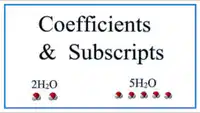
III. What is a Coefficient?
Definition:
A large number written in front of a chemical formula that multiplies the entire formula.Example:
2H₂OWhat does the “2” in front of H₂O mean? ________
How many hydrogen atoms in total? __________
How many oxygen atoms in total? __________
7
IV. Counting Atoms in a Chemical Formula
Step-by-Step Process:
Identify the atoms:
Write down the symbols of all the elements in the formula.Look at subscripts:
Write down how many of each atom you have (if there is no subscript, assume it is 1).
Look at coefficients:
Multiply the number of atoms of each element by the coefficient.
8
V. Practice Example 1: CO₂
Step 1: Identify the elements: C, O
Step 2: Subscripts:
Carbon (C): ______
Oxygen (O): ______
Step 3: Coefficient (assume 1 if none): ______
Total number of atoms:
Carbon (C): ______
Oxygen (O): ______
9
VI. Practice Example 2: 3NaCl
Step 1: Identify the elements: Na, Cl
Step 2: Subscripts:
Sodium (Na): ______
Chlorine (Cl): ______
Step 3: Coefficient: 3
Total number of atoms:
Sodium (Na): ______
Chlorine (Cl): ______
10
VII. Complex Formula Example: 2Ca(OH)₂
Step 1: Identify the elements: Ca, O, H
Step 2: Subscripts:
Calcium (Ca): ______
Oxygen (O): ______
Hydrogen (H): ______
Step 3: Coefficient: 2
Total number of atoms:
Calcium (Ca): ______
Oxygen (O): ______
Hydrogen (H): ______
11
VIII. Practice Problem Set: Counting Atoms
CH₄
Carbon (C): ______
Hydrogen (H): ______
2H₂SO₄
Hydrogen (H): ______
Sulfur (S): ______
Oxygen (O): ______
4Fe₂O₃
Iron (Fe): ______
Oxygen (O): ______
12
IX. Chemical Equations
Definition:
A chemical equation represents a chemical reaction, showing reactants (what you start with) and products (what you end with).
General Form:
Reactants → Products
13
X. Balancing Chemical Equations
Why Balance?
The number of atoms of each element must be the same on both sides of the equation to follow the Law of Conservation of Mass.Example:
H₂ + O₂ → H₂O (Is this equation balanced? ______ Why or why not? ______)
Identify the Reactants and Products
CH₄ + 2O₂ → CO₂ + 2H₂O
Reactants
Products
Arrow
CH₄ + 2O₂
CO₂ + 2H₂O
--->
CH₄ + 2O₂
CO₂ + 2H₂O
--->
Show answer
Auto Play
Slide 1 / 13
MATCH
Similar Resources on Wayground

10 questions
EXPRESSÕES ALGÉBRICAS - OPERAÇÕES COM MONÔMIOS E POLINÔMIOS
Presentation
•
8th Grade
9 questions
DESAFIO_PROVAPR_8_EF_LP_001
Presentation
•
8th Grade
11 questions
Dichotomous Key
Presentation
•
7th Grade
9 questions
Energy types and transfers
Presentation
•
8th Grade
10 questions
Memory
Presentation
•
8th Grade
9 questions
Tejidos
Presentation
•
7th - 9th Grade
13 questions
Speed, Velocity, Acceleration
Presentation
•
8th Grade
10 questions
DESAFIO_PROVAPR_8_EF_LP_006
Presentation
•
8th Grade
Popular Resources on Wayground
6 questions
PRIDE Always and Everywhere
Presentation
•
12th Grade
20 questions
Lab Safety Quiz

Quiz
•
6th Grade
26 questions
KOR Review Kahoot Questions
Quiz
•
8th Grade
21 questions
Continents and Oceans
Quiz
•
6th Grade
12 questions
Unit Zero lesson 2 cafeteria
Presentation
•
9th - 12th Grade
20 questions
Parts of Speech
Quiz
•
5th Grade
10 questions
Riddles Riddles fun Riddles
Quiz
•
6th - 12th Grade
16 questions
Subject & Predicate
Quiz
•
5th Grade
Discover more resources for Science
20 questions
Lab Safety
Quiz
•
5th - 8th Grade
20 questions
Scientific Method and Variables
Quiz
•
8th Grade
20 questions
Scientific method and variables
Quiz
•
8th Grade
27 questions
Counting Atoms - Subscripts
Quiz
•
8th Grade
22 questions
Scientific Method and Variables
Quiz
•
8th Grade
18 questions
Counting Atoms
Quiz
•
7th - 8th Grade
10 questions
Exploring Chemical and Physical Changes

Interactive video
•
6th - 10th Grade
18 questions
Elements, Compounds, and Mixtures
Quiz
•
8th Grade