

"Self" Development: Socialization Unit 3

Presentation
•
History
•
12th Grade
•
Practice Problem
•
Easy

Kelly Mcvey
Used 4+ times
FREE Resource
11 Slides • 17 Questions
1
Multiple Choice
Review: What is the term for learning to participate in group behavior?
2
Multiple Choice
Review: What is required for socialization to occur?
Intensive and Prolonged contact
3
Multiple Choice
Review: What is the name of the person who experimented on Rhesus monkeys to analyze the power of early childhood development?
4
Multiple Choice
Review: In the experiments on Rhesus monkeys, what version of the mother did the babies prefer?
5

Objective: Know the two contributors to the development of self and the steps for both processes
6
The Looking-glass self
Image we have of ourselves based on what we THINK others think
Charles Cooley
Development of Self
Game stage, play stage, imitation stage
Self-concept
George Herbert Mead
7

STEPS
We imagine how we appear to others
We interpret others reactions to our appearance or behavior.
We develop our self-image.
We often misinterpret others reactions and develop a false or flawed sense of self
We are GUESSING what people think
Charles Cooley : other people’s views build, change and maintain our self image
This is called the LOOKING-GLASS SELF

8
Scroll down on the website on the next slide to "Sociological Perspectives on Self-Development"
Read over the information & answer the questions.
9

Perception Is Reality: The Looking-Glass Self | Lesley University
You can open this webpage in a new tab.
10
Multiple Choice
Which of the following best describes the three components of the Looking-Glass Self theory?
11
Multiple Choice
In the context of the Looking-Glass Self, what might a student feel after performing in a school play and reflecting on the audience's reactions?
A sense of pride and happiness based on the audience's positive feedback.
Anxiety about their future performances.
Disappointment in their acting skills regardless of the audience's response.
Indifference to their performance.
12
Multiple Choice
Why is understanding the Looking-Glass Self important for personal relationships?
It provides insight into how others' perceptions can shape our interactions and self-esteem.
13
Multiple Choice
What is name of the person who is responsible for the Looking-glass self?
14
15
Draw
Sketch out the Looking-glass self.
16
17
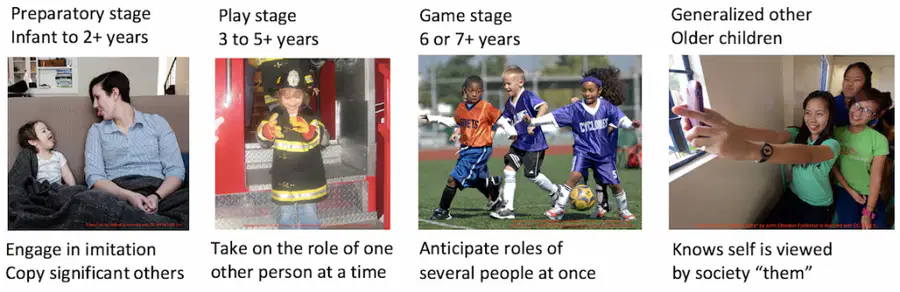
1) Imitation stage: Babies learn to play based on observing and imitating their parents.
2) Play stage: The child has learned to use language and meanings of certain symbols. They are not only acting out but allowing their imagination to let them BE that person.
3) Game stage: Child now becomes capable of putting themself in the role of several others at the same time and be able to understand the relationship between those roles. (Empathy)
George Herbert Mead & the development of “self”
18
Read over the information on the website about the Looking-glass self & answer the questions.
19
20
Multiple Choice
According to Mead, what is "self"?
21
Multiple Choice
What are the stages of the Development of Self, according to Mead?
The stages of the Development of Self are: Imitation/Preparatory Stage, Play Stage, Game Stage.
22
Multiple Choice
In the "Play" stage of the "Development of Self" theory, what occurs?
Children use language and symbols
23
Multiple Choice
What does the generalized other mean?
24
Multiple Choice
Who is the researcher that developed the "Genesis of Self" theory in which children go through stages of imitation, play, and games?
25
26
Draw
Draw a quick sketch of Mead's stages of how we develop our sense of "self"
27
Match
Match the following stage of development of self to the example
Follow a parent mowing the lawn with a fisher price mower
Playing house with assigned gender roles
Initiate a strategy game
Imitation Stage
Play Stage
Play Stage
Imitation Stage
Play Stage
Play Stage
28
Match
Match the following the person to their contribution to Socialization.
Development of "self"
Attachment theory/Rhesus Monkeys
Looking-glass self
George Herbert Mead
Harry Harlow
Charles Cooley
George Herbert Mead
Harry Harlow
Charles Cooley
Review: What is the term for learning to participate in group behavior?
Show answer
Auto Play
Slide 1 / 28
MULTIPLE CHOICE
Similar Resources on Wayground

20 questions
States of Matter Review
Presentation
•
3rd Grade
20 questions
PRE TEST SEJARAH PERGERAKAN KEBANGSAAN INDONESIA
Presentation
•
12th Grade
24 questions
World War II: The War in Europe
Presentation
•
11th Grade
21 questions
VSC 3.3 and 3.4--Constitutional Convention
Presentation
•
KG - 11th Grade
22 questions
7.1 Stages of pregnancy
Presentation
•
12th Grade
22 questions
11.2.5
Presentation
•
12th Grade
20 questions
The Federal Bureaucracy
Presentation
•
12th Grade
20 questions
Negative Exponents
Presentation
•
12th Grade
Popular Resources on Wayground
10 questions
Safety Day 2026 – Student Review

Quiz
•
9th Grade
21 questions
Continents and Oceans
Quiz
•
6th Grade
20 questions
Parts of Speech
Quiz
•
5th Grade
16 questions
Subject & Predicate
Quiz
•
5th Grade
25 questions
Multiplication Facts
Quiz
•
5th Grade
12 questions
Map Skills
Quiz
•
3rd Grade
22 questions
Continents and Oceans
Quiz
•
5th Grade
15 questions
Rounding Decimals
Quiz
•
5th Grade