
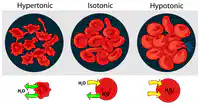
Osmosis in Cells

Presentation
•
Science
•
9th - 12th Grade
•
Practice Problem
•
Medium
+10
Standards-aligned

Adrienne Aguilar
Used 3+ times
FREE Resource
9 Slides • 13 Questions
1
2
Osmosis is the passive movement of water (no ATP) across a semipermeable membrane to reach equilibrium.
Moves from an area of high concentration of water to an area of low concentration of water

3
Water Movement- the ability to predict which direction the water will move in a system is important in health care.
When deciding the direction water will move, you must first identify the area of high concentration (of water) and the area of low concentration (of water). Then draw an arrow from high to low.

4
A cell is placed into a solution where there is a higher concentration water outside the cell.
Which way will the water move?
Start by identifying where there is a higher concentration of water a write an H, then do the same with low concentration and identify with an L.

5
A cell is placed into a solution where there is a higher concentration water outside the cell.
Which way will the water move?
The water will move INTO the cell to reach equilibrium (where concentrations are equal on BOTH sides of the membrane)

H
L
6
Labeling
A cell has been provided. Identify the areas of high and low concentration using the information below.
A cell is placed into a solution where it gained water.
High
Low
7
Multiple Choice
For the last problem, identify the direction the water will move.
A cell is placed into a solution where it gained water.
Into cell
Out of cell
No net movement of water
8
Labeling
A cell has been provided. Identify the areas of high and low concentration using the information below.
A cell was placed into a solution that has a lower concentration of water.
High
Low
9
Multiple Choice
For the last problem, identify the direction the water will move.
A cell was placed into a solution that has a lower concentration of water.
Into cell
Out of cell
No net movement of water
10
Labeling
A cell has been provided. Identify the areas of high and low concentration using the information below.
A cell that is 86% water is placed into a solution that is 20% water.
Low
High
11
Multiple Choice
For the last problem, identify the direction the water will move.
A cell that is 86% water is placed into a solution that is 20% water.
Into cell
Out of cell
No net movement of water
12
Labeling
A cell has been provided. Identify the areas of high and low concentration using the information below.
A cell is placed into a solution that has a lower concentration of solutes (dissolved substances) and higher concentration of water than inside the cell.
Low
High
13
Multiple Choice
For the last problem, identify the direction the water will move.
A cell is placed into a solution that has a lower concentration of solutes (dissolved substances) and higher concentration of water than inside the cell.
Into cell
Out of cell
No net movement of water
14
Labeling
A cell has been provided. Identify the areas of high and low concentration of water using the information below.
A cell with 5% protein concentration is placed into a solution that has a 12% protein concentration.
Remember, you are tracking water movement.
High
Low
15
Multiple Choice
For the last problem, identify the direction the water will move.
A cell with 5% protein concentration is placed into a solution that has a 12% protein concentration.
Into cell
Out of cell
No net movement of water
16
Osmotic Solutions

17
Multiple Choice

A cell with 9% salt concentration is placed into a solution that has a 5% salt concentration.
Which answer best describes the type of solution and what happens to the shape of the cell.
Hypertonic-cell will shrink
Hypertonic-cell will swell
Hypotonic-cell will shrink
Hypotonic-cell will swell
Isotonic-cell shape will remain the same
18
Multiple Choice
A cell with 13% glucose concentration is placed into a solution that has a 23% glucose concentration
Which answer best describes the type of solution and what happens to the shape of the cell.
Hypertonic-cell will shrink
Hypertonic-cell will swell
Hypotonic-cell will shrink
Hypotonic-cell will swell
Isotonic-cell shape will remain the same
19
Open Ended
Real Life Scenario:
A patient comes into the ER suffering from dehydration after hiking in the Florida sun all day. Their cells are dehydrated because they have lost so much water due to sweating that their cells have minimal water compared to the hiker’s bloodstream. The doctors need to administer fluids to restore the balance.
Question: Should the doctors give the patient a hypertonic, hypotonic, or isotonic IV solution to rehydrate the cells? (Ivs inject directly into the bloodstream) Explain how you determined your answer.
20
Answer the following on PG 25
Real Life Scenario:
When you drink a glass of water, most of it is absorbed into your bloodstream by osmosis through cells lining your small intestine. Drinking seawater can actually dehydrate the body. How?
21
Answer the following on PG 25
Real Life Scenario:
You are a nurse working in the ER. A patient in your care has suffered severe burns, and you need to replenish his body fluids using an IV. A trainee suggests that you use distilled water, since it is pure water and contains no solutes(dissolved substances like salt). She thinks this will help avoid infection. Explain why this is a bad idea.
22
Answer the following on PG 25
Real Life Scenario:
Instead of distilled water, you will use an IV containing Ringer’s solution. Ringer's solution is a solution of several salts dissolved in water for the purpose of creating an isotonic solution relative to the body fluids of an animal. Explain why Ringer’s solution is an acceptable fluid to administer to a patient.
Show answer
Auto Play
Slide 1 / 22
SLIDE
Similar Resources on Wayground

19 questions
Comparative Anatomy
Presentation
•
8th - 12th Grade
20 questions
Forces Mastery Lesson 8.9A
Presentation
•
KG - University
21 questions
Climate Part 1: Spheres of the Earth
Presentation
•
9th - 12th Grade
16 questions
Earth Sciences: Water Cycle
Presentation
•
9th - 12th Grade
13 questions
Unit 10 - Acceleration
Presentation
•
9th - 12th Grade
17 questions
Climate change
Presentation
•
9th - 12th Grade
15 questions
Reading solubility curves
Presentation
•
9th - 12th Grade
19 questions
Ionic Compounds
Presentation
•
9th - 12th Grade
Popular Resources on Wayground
10 questions
How much do you know about our Portrait of an Eagle?

Quiz
•
10th Grade
10 questions
Fast Food Slogans
Quiz
•
6th - 8th Grade
21 questions
Continents and Oceans
Quiz
•
6th Grade
20 questions
Parts of Speech
Quiz
•
5th Grade
16 questions
Subject & Predicate
Quiz
•
5th Grade
25 questions
Multiplication Facts
Quiz
•
5th Grade
12 questions
Map Skills
Quiz
•
3rd Grade
22 questions
Continents and Oceans
Quiz
•
5th Grade
Discover more resources for Science
10 questions
Exploring Chemical and Physical Changes

Interactive video
•
6th - 10th Grade
20 questions
Atomic Structure
Quiz
•
9th Grade
10 questions
Decoding the Periodic Table of Elements
Interactive video
•
6th - 10th Grade
10 questions
Exploring the Periodic Table
Interactive video
•
6th - 10th Grade
14 questions
Physical and Chemical Changes
Quiz
•
10th Grade
22 questions
Periodic Table Review
Quiz
•
9th - 12th Grade
20 questions
Observation vs. Inference
Quiz
•
7th - 9th Grade
14 questions
Periodic Trends
Interactive video
•
11th Grade