

PE400 Test 2

Presentation
•
Other
•
KG - Professional Development
•
Hard

Jessica Talmage
Used 4+ times
FREE Resource
29 Slides • 0 Questions
1
Replace this with a sub-header that can be in multiple lines.
Duplicate this text as many times as you would like.
2
Physical health domain includes the following:
Health-related components
Cardiorespiratory, muscular strength and endurance, body composition, and flexibility
Skill-related components
Agility, balance, coordination, power, speed, and reaction time
Medical-related components
Integumentary, musculoskeletal, cardiovascular/lymphatic, respiratory, neurologic, endocrine, digestive/excretory/urinary, immune, and reproductive
3

4

5
Percentage of age-predicted maximal heart rate (APMHR)
207 - (0.7 X age), provide desired intensity percentages
6
Aerobic exercises are categorized by intensity and skill demands (Table 8.3).
Type A exercises: recommended for all adults; little skill is needed, and the intensity is easily modified.
Type B exercises: typically performed at vigorous intensities, recommended for those with average physical fitness who have been exercising on a regular basis
Type C exercises: require skill to perform; best for individuals with reasonable motor skills and physical fitness
Type D exercises: recreational sports, generally recommended as ancillary physical activities, only recommended for those with motor skills and physical fitness adequate to perform safely
7
Aerobic exercise volume is the product of frequency, intensity, and time.
Aerobic exercise progression may consist of increasing any of the components of the FITT principle.
Rate of exercise progression depends on:
Health status
Physical fitness
Training responses
Program goals
When initiating an exercise program:
Light-to-moderate intensity and then increasing exercise time as tolerated is recommended.
5–10 minutes every 1–2 weeks for the first 4–6 weeks
8
Chapter 9
9
Pregnancy
Primarily distributed in the abdominal region
Weight gain can lead to:
Translation of the center of gravity
Increases the risk for balance complications
Functional imbalance between hip flexors and hip extensors
Altered glenohumeral and cervical spine mechanics
10

11
Special Considerations
Body position
Supine position
Contraindicated after 16th week of gestation
Can impact uterine blood flow and maternal venous return
Prone position
i.e., Lying on stomach
Avoid after 1st trimester
12
13
For individuals with coronary heart disease (CHD), exercise is a critical intervention and should be prioritized.
Slows the progression of disease
Prevents or reverses physical deconditioning
Angina is chest pain, pressure, discomfort, or fullness that is the manifestation of diminished blood flow resulting in inadequate oxygen delivery to the myocardium.
Brought on by exertion or psychological stress
Resolved with rest or medications
Management of symptoms is of paramount importance.
Unstable angina: worsening angina, sudden-onset angina at rest, and angina lasting more than 15 minutes
Chronic angina: usually related to myocardial ischemia, typically presents with the initiation of physical activity, and symptoms are typically nonexistent at rest
14
CABGS is an invasive methods that involves harvesting and surgically grafting a blood vessel.
Bypasses an area of the coronary artery that has restricted blood flow as a result of atherosclerosis
Recovery time is typically 6–8 weeks for sternum-splitting incision and 2–4 weeks for minimally invasive surgeries.
Upper body weight restrictions are typically in place for 5–8 weeks.
Lower intensity, lower body, and aerobic exercise can begin as early as 2 weeks postsurgery.
15
Chapter 11:
Ventricular Assist Devices, Total Artificial Heart, and Heart Transplantation
16
LVAD is a battery-powered pump surgically implanted in the upper abdomen that provides circulatory support by pulling blood from the left ventricle and pumping it to the aorta.
Commonly used for:
Maintaining patient viability while waiting for a heart transplant
Permanent solution for patients deemed not suitable for transplantation
17
Heart Transplant
Orthotopic transplantation: excision of diseased heart and anastomosis of the donor heart to the great vessels and atria of the recipient
More common surgical technique
Heterotopic transplantation: Diseased heart is left intact, and donor heart is sewn in parallel.
18
There are four types of rejection:
Hyperacute: caused by preformed antibodies to the donor heart.
Acute cellular: caused by T-lymphocyte and macrophage infiltration of the myocardium.
Acute humoral (vascular): initiated by antibodies which can impair coronary vasodilatory reserve resulting in ventricular dysfunction.
Chronic: an unusually accelerated form of coronary artery disease affecting epicardial and intramyocardial coronary arteries and veins
19
Responses to acute exercise in transplant patients are unique and related to the following factors:
Donor heart does not receive direct input from autonomic nervous system or provide direct afferent signals to the central nervous system.
Heart rate
Resting HR is elevated.
Exercising HR will elevate more gradually and peak HR will be lower than normal, highest HR typically during recovery.
Blood pressure
Cardiac output
Impaired due to lower stroke volume and HR responses
20
Chapter 12
Cardiovascular Disease: Heart Failure
21
Symptom-limited exercise test using a low-intensity protocol should be performed prior to exercise prescription.
Exercise testing considerations include the following:
Monitoring postexercise symptoms closely
Hypotension, arrhythmias, or disproportionate dyspnea
Low-intensity protocols with small, 1-MET increases between stages should be used.
Modified Naughton or ramp protocols
Six-minute walk test may be used as an alternative in this population.
Test termination criteria should be focused on symptoms instead of target HR.
22
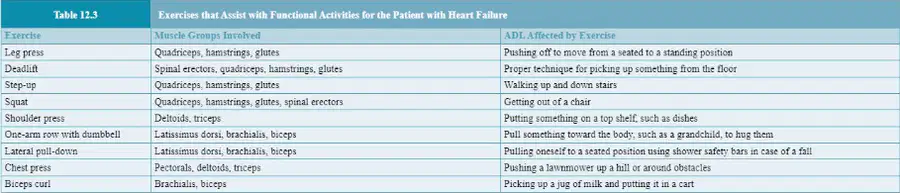
HF is associated with skeletal muscle abnormalities resulting in decreased exercise tolerance and function.
The importance of resistance training cannot be underestimated.
Resistance training recommendations
At least 1–2 nonconsecutive days per week
1–2 sets, 10–15 repetitions; begin 40% 1-RM for lower body and 50% 1–RM for upper body
May progress to 70% 1-RM as tolerated
Power training is also essential.
23
24
Valvular Heart Disease and Peripheral Artery Disease
25
Valvular heart disease (VHD) is any disease of a single heart valve or any combination of the four valves.
Aortic and mitral valve diseases are most prevalent due to higher pressure on the left side of the heart
Exercise prescription and progression depends on:
Severity of disease
Presence of symptoms
Type of treatment
Patients with asymptomatic VHD can participate in competitive sports and vigorous activity.
Patients with more than mild VHD or additional limitations, like anticoagulant therapy, should avoid competitive sports and/or vigorous activities.
26
Chapter 14
Special Considerations for Type 1 and Type 2 Diabetes Mellitus
27
Glycemic control is assessed by measuring HbA1C.
Time-averaged blood glucose concentration over the previous 2–3 months.
HbA1C goal = <7.0%, measured every 3–4 months
Exercise facilitates improved blood glucose control for T2DM but does not uniformly provide glycemic control for T1DM.
Exercise also assists with:
Risk of CVD in patients with diabetes
Reductions in BP
Exercise-related risks associated with diabetes
Hypoglycemia
Hyperglycemia
28
Metabolic Syndrome, Hypertension, and Dyslipidemia
29

Replace this with a sub-header that can be in multiple lines.
Duplicate this text as many times as you would like.
Show answer
Auto Play
Slide 1 / 29
SLIDE
Similar Resources on Wayground

23 questions
Muslim Daily Life and Islamic Achievements
Presentation
•
7th Grade
22 questions
Nutrients
Presentation
•
11th Grade
22 questions
Emotional Intelligence
Presentation
•
6th - 8th Grade
21 questions
Cold War Intro
Presentation
•
KG
20 questions
Digital Ethics
Presentation
•
9th Grade
20 questions
Ludwig Van Beethoven
Presentation
•
6th - 8th Grade
22 questions
FIRST AID
Presentation
•
9th Grade
21 questions
Phonics and Reading
Presentation
•
2nd Grade
Popular Resources on Wayground
10 questions
Safety Day 2026 – Student Review

Quiz
•
9th Grade
21 questions
Continents and Oceans
Quiz
•
6th Grade
20 questions
Parts of Speech
Quiz
•
5th Grade
16 questions
Subject & Predicate
Quiz
•
5th Grade
25 questions
Multiplication Facts
Quiz
•
5th Grade
12 questions
Map Skills
Quiz
•
3rd Grade
22 questions
Continents and Oceans
Quiz
•
5th Grade
15 questions
Rounding Decimals
Quiz
•
5th Grade
Discover more resources for Other
10 questions
Safety Day 2026 – Student Review
Quiz
•
9th Grade
21 questions
Continents and Oceans
Quiz
•
6th Grade
20 questions
Parts of Speech
Quiz
•
5th Grade
16 questions
Subject & Predicate
Quiz
•
5th Grade
25 questions
Multiplication Facts
Quiz
•
5th Grade
22 questions
Continents and Oceans
Quiz
•
5th Grade
12 questions
Map Skills
Quiz
•
3rd Grade
15 questions
Rounding Decimals
Quiz
•
5th Grade