Search Header Logo
T Level Waves Recap

T Level Waves Recap

Assessment

Presentation

Physics

11th - 12th Grade

Medium

Created by

T Southerden

Used 2+ times

FREE Resource

37 Slides • 26 Questions

1

Waves Review

2

There are 2 categories of waves

​Mechanical Waves

  • Require a medium

  • cannot travel through space

  • ex: sound, ocean waves

​Electromagnetic Waves

  • Don't require medium

  • can travel through space

  • ex: light, uv rays, radio waves​

3

There are 2 types of waves

​Transverse Waves

  • travel up and down

  • perpendicular to flow of energy​

​Longitudinal Waves

  • Travel side to side

  • parallel to flow of energy

4

Transverse Waves

media

​Know the 4 parts of the transverse wave

Crests and Troughs are used for measuring wavelength

Amplitude is how high the wave goes​

5

Longitudinal Waves

​Know the 2 parts of the wave

Compressions and Rarefactions are used for measuring wavelength

​​

media

6

Multiple Choice

Question image

What is number 2 called?

1

crest

2

trough

3

wavelength

4

amplitude

7

Multiple Choice

Question image

What is number 3 called?

1

crest

2

trough

3

wavelength

4

amplitude

8

Measuring Wavelength

Make sure you can measure the wavelength when given a picture of a wave​

Always remember you are measuring from one point to that same point later in the wave

​​

media

9

Fill in the Blank

Question image

What is the wavelength of the wave shown in the picture?

10

Multiple Choice

Question image

If this wave was traveling at a speed of 3m/s what would be the frequency of the wave?

1

3 Hz

2

1.5 Hz

3

1.33 Hz

4

0.75Hz

11

Multiple Choice

What type of wave requires a medium?

1

Electromagnetic

2

Gamma

3

Mechanical

4

Radio

12

Calculating velocity of waves

Velocity (m/s)

Frequency (Hz)

wavelength (m)​

​​

Ex:​

A tuning fork has a frequency of 120 Hz, and the wavelength of the sound produced is 4 meters. What is the velocity of the wave rounded to the nearest whole number? 

media

13

Calculating frequency

f = Frequency (Hz)

T = Period (s)​

​​

This equation is used when you need to find frequency and all you have is time. Also can be rearranged to find period if you have the frequency by switching the f and the T in the equation

media

14

Fill in the Blank

A wave with a frequency of 800 Hz is traveling at a speed of 900 m/s. What is the wavelength rounded to the nearest tenth?

v=λ×fv=\lambda\times f

.

15

Fill in the Blank

A wave has a frequency of 12.56 Hz. What is the period of the wave?

(round to the nearest hundredths)

f=1Tf=\frac{1}{T}

16

Fill in the Blank

A wave has a wavelength of 155 meters and is moving at a speed of 230 m/s. What is its frequency? (round to the nearest hundredths place)

v=λ×fv=\lambda\times f

.

17

Fill in the Blank

What is the velocity of a wave if it has a period of 3.4 s and a wavelength of 2 m?

(round to the nearest hundredths place)

f= 1Tf=\ \frac{1}{T} v=λ×fv=\lambda\times f

18

Electromagnetic spectrum

media

19

Multiple Choice

Question image

Based on the electromagnetic spectrum who's lightsaber has more energy? (think about the color of the lightsaber)

1

Luke Skywalker

2

Darth Vader

20

Multiple Choice

Question image

Which wave would have the highest frequency

1

microwaves

2

x-rays

3

blue light

4

Infra red

21

Wave interactions: Reflection

media

​Reflection happens when a wave hits a surface and bounces off.

If the wave comes in at an angle, it will bounce away at that same angle​

22

Wave interactions: Diffraction

​Diffraction happens when a wave hits an opening or a corner and bends around the corners causing it to spread in all directions on the other side.

media

23

Wave interactions: Refraction

​Refraction happens when a wave changes mediums causing it to change in speed and bend as a result.

media

24

media

25

media

26

Multiple Choice

Question image

Is a convex lens thicker or thinner in the middle?

1

Thicker

2

Thinner

27

Multiple Choice

A diverging lens is also known as a ____lens.

1

refracted

2

diffracted

3

convex

4

concave

28

Multiple Choice

What does the word "diverging" mean?

1

to spread apart

2

to come together

3

parallel

4

perpendicular

29

Multiple Choice

A converging lens is also known as a ____ lens.

1

convex

2

concave

3

double

4

refracted

30

Multiple Choice

What does the word "converging" mean?

1

to separate

2

to come together

3

parallel

4

perpendicular

31

media

32

media

33

Multiple Choice

Question image

This image is.....

1

inverted and smaller

2

inverted and larger

3

not inverted and smaller

4

not inverted and larger

34

Multiple Choice

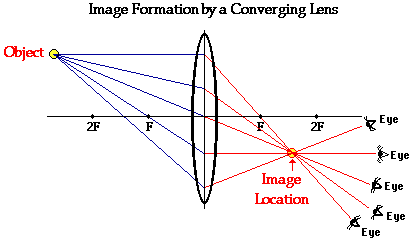
When an object is placed between the focal point and the convex lens, the image produced is ___.

1

real, reduced, and inverted

2

real, enlarged, and inverted

3

virtual, enlarged, and upright

4

virtual, reduced, and upright

35

media

36

37

38

​WHEN THE OBJECT IS:

​WHEN THE IMAGE IS:

  • Beyond 2F

  • At 2F

  • Between 2​F and F

  • At F

  • ​Between F and lens

  • Between 2F and F

  • At 2F

  • Beyond 2F

  • No image

  • Virtual image​

39

media

40

Multiple Choice

Question image

help boats and submarines travel safely in the ocean and in lakes; map the seafloor​

1

sonar

2

ultrasonography​

3

vehicle parking sensor​

4

wave power generators​

41

Multiple Choice

Question image

create images of body tissues for scientists to study tissue function and to determine if treatment is needed

1

sonar

2

ultrasonography​

3

vehicle parking sensor​

4

wave power generators​

42

media

43

Multiple Choice

Question image

generate power by converting mechanical energy from water into electrical energy

1

sonar

2

ultrasonography​

3

vehicle parking sensor​

4

wave power generators​

44

media

45

media

46

media

47

media

48

media

49

media

50

Multiple Choice

If a wave reflected off a media boundary with no inversion, what kind of reflection would this be?

1

Free-end reflection

2

Fixed-end reflection

3

Opposite reflection

4

I'm not sure

51

media

52

media

53

media

54

Think of these two waves for the next question.

media

55

Multiple Choice

If the two waves just shown interact, how would we get the amplitude of the resultant wave?

1

Adding the two wave

2

Subtracting the two waves

3

Nothing

4

I'm not sure

56

Think if the next two waves for the next question.

media

57

Multiple Choice

If the two waves just shown interact, how would we get the amplitude of the resulting wave?

1

Adding the two waves

2

Subtracting the two waves

3

Nothing

4

I'm not sure

58

media

59

media

60

Multiple Choice

What type of wave reflections could create constructive and destructive interference?

1

Fixed-end reflection = Constructive

Free end reflection = Destructive

2

Free-end reflection = Constructive

Fixed end reflection = Destructive

3

I'm not sure

61

media

62

Open Ended

A good example of two point source interference would be setting up 2 speakers. Why is it important to know about waves and intereference when setting up stereo speakers?

63

media

Waves Review

Show answer

Auto Play

Slide 1 / 63

SLIDE