

Topic 6: Reviewing Nationalism: Friday, November 8

Presentation
•
Social Studies
•
10th Grade
•
Practice Problem
•
Medium

Shelly Tinsley
Used 4+ times
FREE Resource
10 Slides • 20 Questions
1
Reviewing Nationalism
Friday, November 8
2
What are the main causes and consequences of the European revolutions of the 1830s?
Nationalism and liberalism inspired revolutions that challenged traditional, conservative ruling powers throughout Europe in the 1830s. Nationalism inspired many regions to try to break away from the imperialist empires that controlled them. While this led to some successes, such as the creation of Belgium, imperial armies crushed revolts in place such as Poland and the Italian kingdoms.
3
Why did it take so long for Germany and Italy to emerge as independent, unified nations?
Powerful European empires and monarchies limited nationalist revolts in these regions for many years. Things began to change with the weakening of major powers after the Crimean War and the rise of strong nationalist leaders such as Giuseppe Garibaldi and Otto von Bismarck. They served as romantic heroes who united their people, but were also skilled political and military leaders capable of achieving the creation of new nations.
4
5
What political, economic, and social problems related to slavery did the newly independent Latin American countries face?
Political, economic, and social problems related to slavery included debate between liberals and conservatives about whether the colonial system of slavery should be dismantled, how quickly slavery should be ended, whether Enlightenment ideas applied to enslaved people, and whether the institution of slavery was necessary for an economy that required labor to produce cash crops.
6
What were the role of creoles in Mexican and South American independence movements?
Creoles were people of European descent, often Spanish, who were born in the Americas. They usually held important local leadership roles. Independence movements in Mexico and South America did not gain much success until creoles joined the fight. Most leaders in the newly independent countries were creoles.
7


8
9
What are some common themes among reform movements of the 1800s?
Most reform movements of the 1800s shared the common theme of greater freedom and representation among the people. This included expanding universal male suffrage in some places and ending slavery or serfdom in others. The movements had mixed results in improving the lives of ordinary people.
10
The next twenty slides are mostly multiple-choice questions and a few "putting events in order." You have unlimited attempts. Take advantage of that opportunity

11
Multiple Select
Nineteenth-century art changed as a result of romanticism by (choose two)
showcasing heroic images.
promoting nationalistic ideals.
highlighting the strength of monarchies.
arguing for a return to feudalism.
12
Multiple Choice
How did Francois-Dominique Toussaint-Louverture’s guidance for the new government indicate that the application of Enlightenment ideals differed in Haiti from those in France and America?
A free press would be established to safeguard the people against abuses from the government, unlike in other areas.
Free trade would be established to encourage the economic independence the other revolutions had not achieved.
The ideal of equality would immediately apply to all and not just to land-owning men or free men.
Property rights would be protected by the government, and land would not be redistributed as it had in other revolutions.
13
Multiple Select
Because of the French Revolution of 1848, the people of France (choose three)
no longer had a king.
were part of the Second Republic.
had a new constitution.
were the strongest nation in Europe.
14
Multiple Choice
Revolutions in the Austrian Empire during the 1840s failed because the Austrian
Empire was spread over a large geographic area.
people wanted everyone to have equal rights under the law.
leaders convinced the people to accept monarchial rule.
government fought back with military force.
15
Multiple Choice
The Crimean War was caused by the
refusal of the British to support the Ottomans in battle.
alliance between the Turks and the Russians.
Russian invasion of Moldavia and Walachia.
conflicts over trade between the Ottomans and the British.
16
Multiple Select
As a result of the Crimean War, the (choose three)
Austrians and Russians became enemies.
Concert of Europe was destroyed.
European monarchies refused to cooperate with each other
Silk Road was reopened to international trade.
17
Multiple Choice
Art was affected by realism by
showcasing ordinary people as they actually lived and worked.
highlighting romantic settings and heroic accomplishments
including two-dimensional rather than three-dimensional images.
portraying scenes that celebrated life in an ideal world
18
Multiple Choice
Great Britain’s Slavery Abolition Act of 1833 was partly due to the
influence and efforts of the abolitionists in the United States.
increase of machine-produced goods during the Industrial Revolution.
importation of cotton from the United States.
demise of British colonies in Western Africa.
19
Multiple Choice
France’s Napoleon III liberalized his regime in the 1860s by
taking complete control of the government.
giving the legislature more power.
limiting civil liberties.
focusing on expanding the economy.
20
Multiple Select
During the reform movement in Russia, Czar Alexander II (choose three)
freed the serfs and allowed them to own property
improved Russia’s railway system.
sponsored industrialization programs to help improve the economy
prohibited foreign investors from providing funds for Russian industry.
21
Multiple Choice
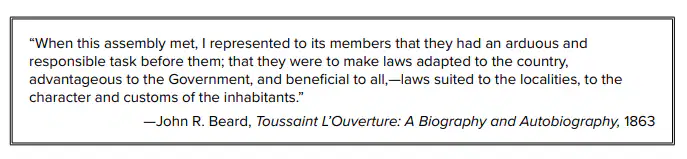
In this quote, Toussaint Louverture is referring to his work during the
Haitian Revolution.
Crimean War.
American Civil War.
French Revolution.
22
Multiple Choice

The map shows that
there were more revolutions in 1848 than in 1830.
the Ottoman Empire was untouched by the revolutions.
Paris was the inspiration for revolutions throughout Europe.
Switzerland stayed neutral throughout the revolutions of the 1800s.
23
Multiple Choice

Based on the map, it can be concluded that the revolutions of the 1830s
were totally unsuccessful.
inspired revolutions in later years.
were put down quickly by governments.
did not reflect democratic ideals.
24
Multiple Select
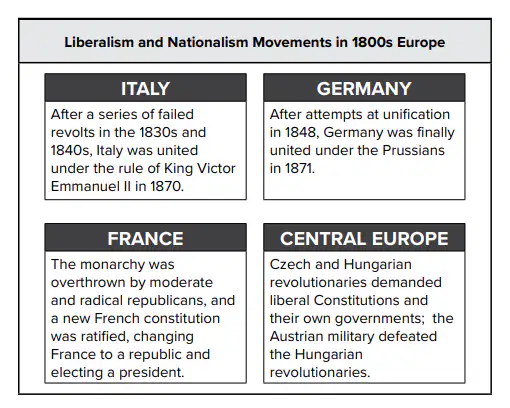
According to this table, the French and central European revolutionaries wanted (choose three)
a constitution.
freedom from monarchies.
a say in their government.
freedom from foreign rulers.
25
Multiple Choice

This table shows that Italy and Germany both
desired suffrage for all citizens.
were inspired by the United States.
wanted to be free of outside influences.
finally achieved their goals in the 1870s.
26
Multiple Choice
Latin American colonies were inspired by the French and American Revolutions to
set up democracies and free elections.
abolish slavery and redistribute land.
gain independence from Europe.
dismantle all colonial systems.
27
Multiple Choice
Because they controlled land and businesses, creoles were attracted to the Enlightenment ideal of
free press.
equality for all.
imperialism.
free trade.
28
Multiple Choice
How was the revolt led by Francois-Dominique Toussaint-Louverture on Saint Domingue different from the other revolutions?
The revolt was led by enslaved people.
The revolt was led by local officials.
The revolt was led by indigenous people.
The revolt was led by the creole elite.
29
Reorder
Independence in Latin America 1804-1822
Reorder the following
Saint Domingue, now Haiti
Argentina
Chile
Mexico
Brazil
30
Reorder
Key Events of The Era of Nationalism
Reorder the following
Haiti declares independence from France
Congress of Vienna meets
Mexico declares independence from Spain
Greece declares independence from the Ottoman Empire
French Revolution creates a constitutional monarchy
Reviewing Nationalism
Friday, November 8
Show answer
Auto Play
Slide 1 / 30
SLIDE
Similar Resources on Wayground

22 questions
Chapter 13 Section 4 Lecture
Presentation
•
10th Grade
23 questions
Trigonometry
Presentation
•
10th Grade
21 questions
Industrial Revolution Vocabulary
Presentation
•
9th Grade
24 questions
Acids and bases
Presentation
•
10th Grade
22 questions
Similar Triangles SAS, SSS, AA
Presentation
•
10th Grade
24 questions
Urbanization
Presentation
•
10th Grade
26 questions
The Crusades
Presentation
•
9th - 10th Grade
21 questions
Chapter 5 Section 3 Lecture
Presentation
•
10th Grade
Popular Resources on Wayground
24 questions
PBIS-HGMS Day 10

Quiz
•
6th - 8th Grade
10 questions
HCS SCI 03 Summer School Review 3
Quiz
•
3rd Grade
11 questions
Home Scope
Quiz
•
7th - 8th Grade
15 questions
HCS SCI 05 Summer School Assessment 3 Review
Quiz
•
5th Grade
35 questions
Lufkin Road Middle School Student Handbook & Policies Assessment
Quiz
•
7th Grade
18 questions
Geo 11.3 Area of Circles and Sectors
Quiz
•
9th - 11th Grade