
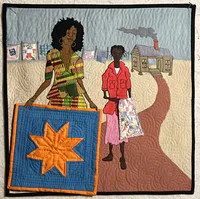
Everyday Use by Alice Walker

Presentation
•
English
•
10th Grade
•
Practice Problem
•
Medium
+15
Standards-aligned

Wyndie Mayfield
Used 9+ times
FREE Resource
7 Slides • 9 Questions
1
Everyday Use

Literary Elements
2
Multiple Choice
Which of the following best represents the exposition of the short story "Everyday Use"?
The reader learns that Mama made the decision to give Maggie the quilts due to her being more deserving and family-oriented than Dee.
The reader finally understands that tradition and heritage are meant to be lived and celebrated not preserved as observation only.
The reader "sees" Maggie and Mama on the porch smiling in comfort as Dee leaves in a hurry.
The reader learns the general background concerning the primary characters of Dee, Maggie, and Mama. The setting of a three-room farm house is also established.
3
Characterization
The process by which the writer reveals the personality of a character.
Characterization is revealed through direct characterization and indirect characterization.
4
Characterization
Direct Characterization TELLS the audience about the personality of the character.
Example: “The patient boy and quiet girl were both well mannered and did not disobey their mother.”
Explanation: The author is directly telling the audience the personality of these two children. The boy is “patient” and the girl is “quiet.”
5
Characterization
Indirect Characterization SHOWS things that reveal the personality of a character.
There are five different methods of indirect characterization:
Speech
Thoughts
Effects on others
Actions
Looks
6
Multiple Choice
What is the difference between direct and indirect characterization?
Direct characterization relates to the beginning of the plot when each character is described and introduced.
Indirect characterization comes at the end of a short story and is when the character's true colors are revealed.
Direct characterization is when the reader needs to infer a character's personality/motivations through close reading and analysis.
Indirect characterization is when the reader is told explicitly what a character is like.
Direct characterization is when the character is so firmly described using imagery that the reader can fully picture the characters' appearance and attire.
Indirect characterization is when the reader is left with questions as to what a character looks like.
Direct characterization is when the reader is told explicitly what a character is like.
Indirect characterization is when the reader needs to infer a character's personality/motivations through close reading and analysis.
7
Multiple Choice
What does this quote from "Everyday Use" reveal about the characterization of Dee? Choose the BEST answer.
"She used to read to us without pity; forcing words, lies, other folks' habits, whole lives upon us two, sitting trapped and ignorant underneath her voice. She washed us in a river of make-believe, burned us with a lot of knowledge we didn't necessarily need to know."
This reveals that Dee is a self-absorbed character. She is only concerned with others listening to her talk. She wants her opinions and ideas to be heard despite the wishes of others.
This reveals that Dee is a forceful character. She gives her family worldly information without regard to their need and/or want to be educated beyond their own experiences.
This reveals that Dee is an educator character. She is well versed in most wordly topics and is very aware of the outlooks and perspectives of others.
This reveals that Dee is a compassionate character who wants to see her family gain knowledge about the world they live in.
8
Multiple Choice
What type of characterization is BEST represented here?
"In real life I am a large, big-boned woman with rough, man-working hands."
Indirect Characterization: Thoughts
Indirect Characterization: Effects on Others
Direct Characterization
Indirect Characterization: Actions
9
Multiple Choice
Which Indirect Characterization technique is best represented here in describing DEE when discussing the few friends Dee had while growing up?
"She had a few. Furtive boys in pink shirts hanging about on washday after school. Nervous girls who never laughed/ Impressed with her they worshipped the well-turned phrase, the cute shape, the scalding humor that erupted like bubbles."
Speech
Actions
Effects on Others
Looks
10
Multiple Choice
How does Maggie's character contrast with Dee's in the story?
Maggie is outgoing and ambitious, while Dee is shy and reserved.
Maggie is practical and humble, while Dee is superficial and self-centered.
Maggie is rebellious and defiant, while Dee is obedient and compliant.
Maggie is wealthy and educated, while Dee is poor and uneducated.
11
Internal Conflict
Internal conflict occurs when a character in the story struggles against him or herself.
Often, the most dynamic characters in a story have complex inner lives. They struggle against their thoughts and beliefs; they are frustrated by their actions; they hesitate when making big decisions.
12
External Conflict
External conflict is a struggle between a character in the story and an outside force.
13
External Conflict
Character vs. Character
Character vs. Society
Character vs. Nature
Character vs. Supernatural
Character vs. Technology
14
Multiple Choice
What is the primary conflict between Dee and her mother in the story?
Dee wants to move to the city, but her mother wants her to stay.
Dee wants to take family heirlooms for decoration, while her mother values their practical use.
Dee wants to sell the family house, but her mother refuses.
Dee wants to change her name, but her mother disapproves.
15
Multiple Choice
Which of the following best represents a theme developed throughout "Everyday Use"?
Children who seek to embarrass their parents will embarrass themselves in the end.
Heritage should be valued and cherished.
The future means more than the past.
Outgoing individuals will always succeed in their goals.
16
Multiple Choice
What might the quilts in "Everyday Use" symbolize?
Oppression.
The irreplaceable bond between siblings.
The desire to improve financial stability.
The bonding of generations through passed-down traditions.
Everyday Use
Literary Elements
Show answer
Auto Play
Slide 1 / 16
SLIDE
Similar Resources on Wayground

11 questions
Context Clues
Presentation
•
10th Grade
10 questions
Looking Back
Presentation
•
10th Grade
10 questions
How to read year in English?
Presentation
•
10th Grade
10 questions
Pronunciation of ED endings
Presentation
•
10th Grade
10 questions
The Refusal Quiz
Presentation
•
9th - 10th Grade
12 questions
Lessons 9–10 Sea transport and seaports
Presentation
•
10th Grade
12 questions
Reading Journal Practice
Presentation
•
10th Grade
15 questions
Parallel Construction
Presentation
•
10th Grade
Popular Resources on Wayground
20 questions
"What is the question asking??" Grades 3-5

Quiz
•
1st - 5th Grade
20 questions
“What is the question asking??” Grades 6-8
Quiz
•
6th - 8th Grade
10 questions
Fire Safety Quiz
Quiz
•
12th Grade
20 questions
Equivalent Fractions
Quiz
•
3rd Grade
34 questions
STAAR Review 6th - 8th grade Reading Part 1
Quiz
•
6th - 8th Grade
20 questions
“What is the question asking??” English I-II
Quiz
•
9th - 12th Grade
20 questions
Main Idea and Details
Quiz
•
5th Grade
47 questions
8th Grade Reading STAAR Ultimate Review!
Quiz
•
8th Grade
Discover more resources for English
20 questions
“What is the question asking??” English I-II
Quiz
•
9th - 12th Grade
10 questions
Fire Prevention
Quiz
•
9th - 12th Grade
50 questions
STAAR English 2 Review
Quiz
•
10th Grade
20 questions
Figurative Language Review
Quiz
•
10th Grade
20 questions
Grammar
Quiz
•
9th - 12th Grade
17 questions
semicolons and colons
Quiz
•
10th Grade
10 questions
Test Taking Strategies for State Reading Assessments

Interactive video
•
6th - 10th Grade
20 questions
Context clues
Quiz
•
10th Grade