

Resource Availability

Presentation
•
Science
•
7th Grade
•
Medium
+1
Standards-aligned

NaaJah Richardson
Used 9+ times
FREE Resource
15 Slides • 14 Questions
1
Resource Availability
2
Standard 6
7.ECO.6 Analyze and interpret data to predict how environmental conditions, genetic factors, and resource availability will impact the growth of individual organisms and populations of organisms in an ecosystem.
3
Essential Question
Can you explain how resource availability affects both populations of organism and the ecosystem?
4
5
Ecosystem
Ecosystem: A community of organisms interacting with the biotic (living) and abiotic (non-living) factors in their physical environment.
6
Abiotic Factors
Definition: Non-living components of an ecosystem, such as water, sunlight, and soil.
Impact on Ecosystems: Availability of abiotic resources can affect the growth and survival of organisms.
Ex. Without water, organisms will not be able to survive. All living things require water.
7
Biotic Factors
Definition: Living components of an ecosystem, including plants, animals, and microorganisms.
Relationship with Abiotic Factors: Biotic factors rely on abiotic resources for survival.
Ex. Animals depend on water, temperature, and the sun for survival.
8
Multiple Choice
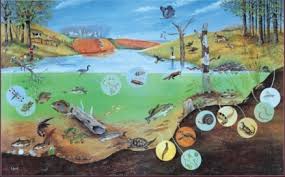
The specific environment in which all the biotic and abiotic factors in an area interact.
Ecosystem
Organism
Struggle
Competitive Interaction
9
Multiple Choice
Which of the following lists contains only abiotic factors?
water, air, temperature
grass, air, people
trees, fish, polar bears
grass, water, sand
10
Resources in an Ecosystem
Definition of Resources: Anything an organism needs to survive, such as food, water, and shelter.
Types of Resources: Renewable (e.g., sunlight) and non-renewable (e.g., minerals).
Renewable- can be replaced by nature
Nonrewable- fixed amount that can't be easily replaced
11
Competition for Resources
Competition: When organisms or populations vie (compete) for the same resources.
Example: Plants competing for sunlight or animals competing for water.
Example: Two birds fighting over a worm.
12
Multiple Choice

A ____________________ Relationship is when two living things "fight" for limited resources.
Dependent
Competitive
13
Multiple Choice
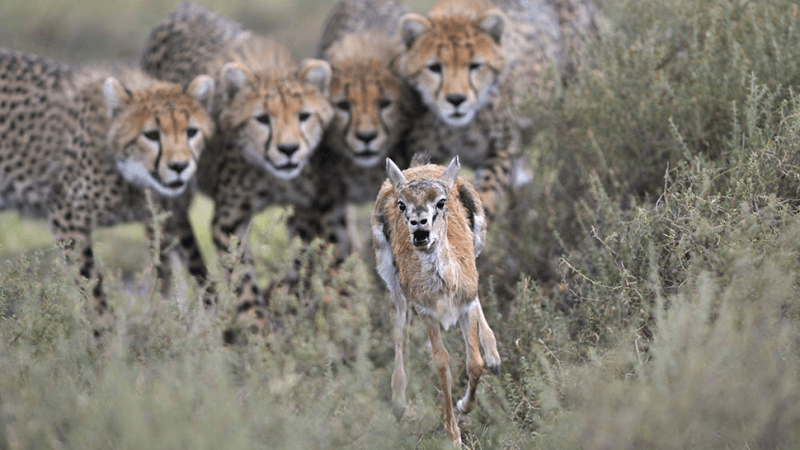
Hawks and owls eat the same type of food and struggle with one another to get their food. What is this an example of?
Competition
Biotic factor
Symbiosis
Population
14
Multiple Choice
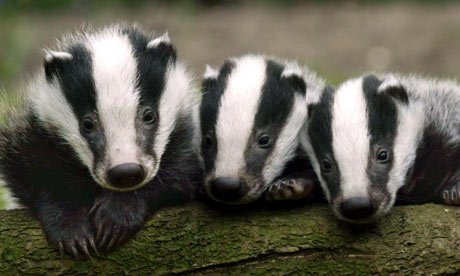
In an ecosystem, what do organisms and populations with similar needs compete over?
food
water
shelter
all of the above
15
What Affects Population Growth?
Population size depends on:
Environment – weather, temperature, or natural disasters.
Resources – food, water, and space.
Genetics – some organisms are better at surviving or adapting.
16

Every environment can only hold so many living things.
If there’s not enough food or space, some will die or move away.
This limit is called carrying capacity.
Carrying Capacity
17

Limiting Factors are things that keep a population from growing too big:
Not enough food or water
Too many predators
Disease
Not enough space
Limiting Factor
18
Multiple Choice
What is a limiting factor?
Factors that always increase a population
Factors that always decrease a population
Resources that are unlimited
Factors/resources that limit how many organisms can live in an area at the same time
19
Interspecies Competition - members of the different species in an ecosystem compete for limited resources such as water, food, shelter, & mates
Intraspecies Competition- members of same species in an ecosystem compete for limited shared resources such as food, shelter, water
20
Multiple Choice
21
Multiple Choice

22
Fill in the Blanks

What type of relationship is shown in the picture?
Type answer...
23
A predator is an organism that eats another organism.
The prey is the organism which the predator eats.
Predator and prey often coevolve together.
Predator and prey relationship is dependent on each other.

24
There is a close relationship between the population of predators and prey.
When the prey population increases, the predator population will increase in the coming years.
The increase in predators will cause the prey population to go down.

25
Multiple Choice
What is a predator-prey relationship?
A predator-prey relationship is a symbiotic interaction between two organisms, where both organisms live together and depend on each other for survival.
A predator-prey relationship is a mutualistic interaction between two organisms, where both organisms benefit from each other.
A predator-prey relationship is a biological interaction between two organisms, where one organism (the predator) hunts, kills, and consumes the other organism (the prey) for food.
A predator-prey relationship is a competitive interaction between two organisms, where both organisms fight for the same resources.
26
Multiple Choice
How does predation affect the population size of the prey species?
Predation only affects the population size of the predator species.
Predation increases the population size of the prey species.
Predation has no effect on the population size of the prey species.
Predation reduces the population size of the prey species.
27
Multiple Choice
28
Multiple Choice
29
Multiple Choice

A bear catching and eating a salmon from a river is an example of...
predation
commensalism
mutualism
parasitism
Resource Availability
Show answer
Auto Play
Slide 1 / 29
SLIDE
Similar Resources on Wayground

22 questions
Cell Cycle
Presentation
•
7th Grade
21 questions
The Nervous System
Presentation
•
7th Grade
21 questions
FOSSILS and the FOSSIL RECORD
Presentation
•
7th Grade
24 questions
Human Impact on Biodiversity
Presentation
•
7th Grade
24 questions
7th science- Human Impact (Air edition)
Presentation
•
7th Grade
24 questions
Potential and Kinetic Energy
Presentation
•
7th Grade
20 questions
Pollution due to human activity
Presentation
•
7th Grade
25 questions
Classification
Presentation
•
7th Grade
Popular Resources on Wayground
10 questions
How much do you know about our Portrait of an Eagle?

Quiz
•
10th Grade
10 questions
Fast Food Slogans
Quiz
•
6th - 8th Grade
21 questions
Continents and Oceans
Quiz
•
6th Grade
20 questions
Parts of Speech
Quiz
•
5th Grade
16 questions
Subject & Predicate
Quiz
•
5th Grade
25 questions
Multiplication Facts
Quiz
•
5th Grade
12 questions
Map Skills
Quiz
•
3rd Grade
22 questions
Continents and Oceans
Quiz
•
5th Grade
Discover more resources for Science
17 questions
7.6D Aqueous Solutions
Quiz
•
7th Grade
20 questions
Claim, Evidence and Reasoning (CER)
Quiz
•
6th - 8th Grade
18 questions
Counting Atoms
Quiz
•
7th - 8th Grade
10 questions
Exploring Chemical and Physical Changes

Interactive video
•
6th - 10th Grade
20 questions
Food Chains & Food Webs
Quiz
•
5th - 7th Grade
10 questions
Decoding the Periodic Table of Elements
Interactive video
•
6th - 10th Grade
16 questions
Photosynthesis and Cellular Respiration Review
Quiz
•
7th Grade
10 questions
Exploring the Periodic Table
Interactive video
•
6th - 10th Grade