

3.1 Continental Drift - Study Guide (Quizizz)

Presentation
•
Science
•
6th Grade
•
Medium
+7
Standards-aligned

Michael Gothelf
Used 5+ times
FREE Resource
19 Slides • 73 Questions
1

2

3


4
Multiple Choice
What is continental drift?
The sudden movement of tectonic plates
The gradual movement of continental plates over the Earth's surface over time
The rotation of the Earth on its axis
The movement of ocean currents
5
Multiple Choice

Which of the following best describes the movement involved in continental drift?
Rapid and unpredictable
Gradual and consistent
Circular and repetitive
Erratic and random
6
Multiple Choice
What is the primary focus of the concept of continental drift?
Movement of ocean water
Movement of air currents
Movement of continental plates
Movement of the moon
7
Multiple Choice
Continental drift involves the movement of which type of geological structure?
Mountains
Rivers
Continental plates
Volcanoes
8
Multiple Choice
What is the time frame over which continental drift occurs?
Instantly
Over a few days
Over millions of years
Over a few months
9


10
Multiple Choice
Which clue suggests that the coastlines of continents fit together like puzzle pieces?
Fossil Clues
Rock Clues
Puzzle Clues
Climate Clues
11
Multiple Choice
What type of evidence is found in warm regions that supports the continental drift theory?
Fossil evidence
Rock evidence
Climate evidence
Puzzle evidence
12
Multiple Choice
Which clue involves finding identical fossils on either side of the ocean?
Puzzle Clues
Fossil Clues
Rock Clues
Climate Clues
13
Multiple Choice
What does the Rock Clues suggest about the continents?
They have similar climates
They have identical fossils
They have identical rocks and mountain structures
They fit together like a puzzle
14
Multiple Choice
Which of the following is NOT a clue supporting the continental drift theory?
Puzzle Clues
Fossil Clues
Ocean Current Clues
Climate Clues
15


16
Multiple Choice
What is seafloor spreading?
The formation of new areas of oceanic crust due to the upwelling of magma as oceanic parts pull apart.
The erosion of oceanic crust by ocean currents.
The movement of tectonic plates over the ocean floor.
The sinking of oceanic crust into the mantle.
17
Multiple Choice
What causes the formation of new oceanic crust in seafloor spreading?
Erosion by ocean currents
Upwelling of magma
Sinking of tectonic plates
Cooling of ocean water
18
Multiple Choice
Where does seafloor spreading typically occur?
At ocean trenches
At mid-oceanic ridges
At continental shelves
At volcanic islands
19
Multiple Choice
Which oceanic feature is associated with the youngest oceanic crust?
Ocean trenches
Mid-oceanic ridges
Continental shelves
Volcanic islands
20
Multiple Choice
What is the role of convection currents in seafloor spreading?
They cause the oceanic crust to erode.
They pull tectonic plates together.
They drive the movement of magma to the surface.
They cool the oceanic crust.
21

22
Multiple Choice
Which of the following is evidence of seafloor spreading?
Fractures in the lithosphere
Patterns of river erosion
Mountain formation
Volcanic eruptions
23
Multiple Choice
What does the age of seafloor rock indicate in the context of seafloor spreading?
It shows the seafloor is static.
It indicates the seafloor is shrinking.
It provides evidence of seafloor spreading.
It suggests the seafloor is melting.
24
Multiple Choice
How does the thickness of the layer of sediments support the theory of seafloor spreading?
Thicker layers indicate older seafloor.
Thicker layers indicate younger seafloor.
Thicker layers indicate no movement.
Thicker layers indicate volcanic activity.
25
Multiple Choice
What role do patterns of seafloor magnetism play in supporting seafloor spreading?
They show the seafloor is cooling.
They demonstrate the seafloor is expanding.
They reveal the seafloor is eroding.
They indicate the seafloor is stable.
26
Multiple Choice
Which of the following is NOT evidence of seafloor spreading?
Age of seafloor rock
Patterns of seafloor magnetism
Thickness of the layer of sediments
Patterns of river flow
27

28
Multiple Choice
What is one type of evidence for seafloor spreading?
Fractures in the lithosphere
Decrease in ocean temperature
Increase in ocean salinity
Changes in ocean currents
29
Multiple Choice
How do the fractures in the lithosphere provide evidence for seafloor spreading?
They show a decrease in ocean depth.
They mimic shapes of continental coastlines.
They indicate a rise in ocean temperature.
They cause an increase in ocean salinity.
30
Multiple Choice
What happens to the age of seafloor rock as you move away from the mid-ocean ridge?
It decreases.
It remains the same.
It increases.
It fluctuates randomly.
31
Multiple Choice
Which of the following is NOT a type of evidence for seafloor spreading mentioned in the text?
Fractures in the lithosphere
Age of seafloor rock
Ocean salinity levels
Continental coastline patterns
32
Multiple Choice
What pattern do the fractures in the lithosphere follow?
Random distribution
Shapes of ocean currents
Shapes of continental coastlines
Patterns of ocean salinity
33

34
Multiple Choice
What happens to the thickness of sediment on the ocean floor as you move away from the mid-ocean ridge?
It decreases
It remains the same
It increases
It disappears
35
Multiple Choice
What is one type of evidence for seafloor spreading related to magnetism?
Changes in water temperature
Patterns of seafloor magnetism
Variations in ocean salinity
Differences in ocean depth
36
Multiple Choice
How do the magnetic patterns on either side of the mid-ocean ridges compare?
They are completely different
They match up with one another
They are random
They are identical to the patterns on land
37
Multiple Choice
Which of the following is NOT evidence of seafloor spreading?
Sediment thickness increases away from ridges
Magnetic patterns match on either side of ridges
Ocean currents change direction
New crust forms at mid-ocean ridges
38
Multiple Choice
What does the thickness of the sediment layer indicate about seafloor spreading?
It shows the age of the ocean floor
It indicates the temperature of the water
It reveals the depth of the ocean
It suggests the salinity of the water
39


40
Multiple Choice
What is a rift?
A large crack, or opening, in Earth's crust
A small hill
A type of rock
A weather pattern
41
Multiple Choice
Where is a rift typically found?
In the ocean
In Earth's crust
In the atmosphere
In a forest
42
Multiple Choice
Which of the following best describes a rift?
A mountain range
A large crack in the ground
A river
A desert
43
Multiple Choice
What natural feature is shown in the image related to a rift?
A volcano
A rift
A glacier
A canyon
44
Multiple Choice
Which of the following is NOT related to a rift?
Earth's crust
Large crack
Ocean wave
Opening
45


46
Multiple Choice
What was Pangaea?
A single landmass or supercontinent that existed long ago
A large ocean that covered the Earth
A mountain range in Europe
A desert in Africa
47
Multiple Choice
What ocean now separates South America and Africa?
Pacific Ocean
Indian Ocean
Atlantic Ocean
Arctic Ocean
48
Multiple Choice
Which of the following continents was part of Pangaea?
Antarctica
Australia
All present-day continents
None of the above
49
Multiple Choice
What is a key characteristic of Pangaea?
It was a single landmass
It was a large ocean
It was a volcanic island
It was a desert
50
Multiple Choice
What ocean now separates South America and Africa?
Arctic Ocean
Atlantic Ocean
Indian Ocean
Pacific Ocean
51
52
Multiple Choice
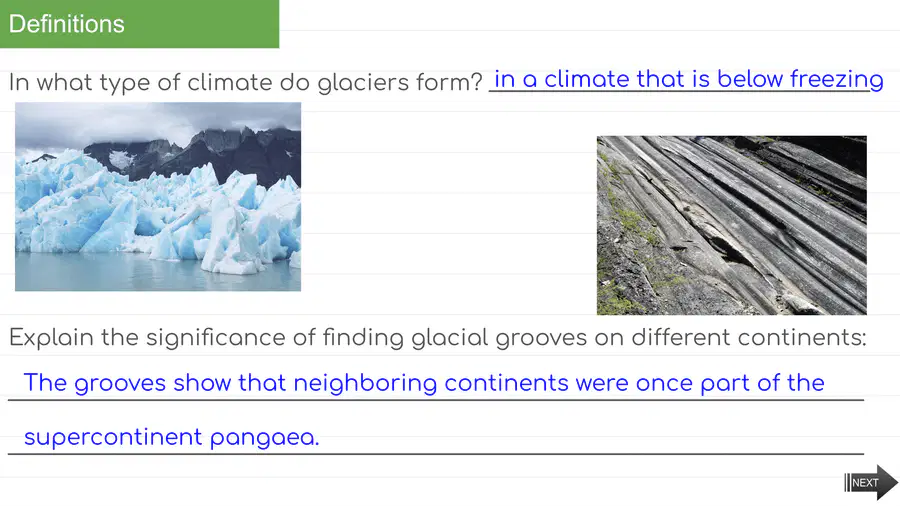
In what type of climate do glaciers form?
In a tropical climate
In a desert climate
In a climate that is below freezing
In a temperate climate
53
Multiple Choice
What is the significance of finding glacial grooves on different continents?
They indicate recent volcanic activity
They show that neighboring continents were once part of the supercontinent Pangaea
They suggest the presence of ancient rivers
They are evidence of meteor impacts
54

55
Multiple Choice
What do glacial grooves on different continents indicate?
They are formed by wind erosion.
They indicate past glacial movement.
They are caused by volcanic activity.
They show the direction of river flow.
56
Multiple Choice
What happens to the grooves if the rock is cut and separated?
The grooves disappear.
The grooves remain unchanged.
The grooves move with the rocks.
The grooves become deeper.
57
Multiple Choice
What does it mean if separated rocks with grooves are pushed back together and line up?
They were formed by different processes.
They came from the same rock or landmass.
They were affected by different glaciers.
They were originally part of different continents.
58
Multiple Choice
What is the significance of glacial grooves lining up when rocks are rejoined?
It shows the rocks are from different time periods.
It indicates the rocks have different mineral compositions.
It suggests the rocks were once part of the same landmass.
It proves the rocks were formed underwater.
59
Multiple Choice
What can be inferred if glacial grooves on rocks from different continents match?
The continents were once connected.
The grooves were formed by ocean currents.
The rocks are from different geological eras.
The grooves were created by human activity.
60


61
Multiple Choice
Why did Wegener suggest that continents in the southern hemisphere had a cooler climate long ago?
He found evidence of glaciers in normally warm places.
He discovered fossils of tropical plants.
He observed volcanic activity.
He measured high temperatures in the past.
62
Multiple Choice
What evidence did Wegener find to support his theory about the climate of the southern hemisphere?
Fossils of dinosaurs
Evidence of glaciers
Volcanic rocks
Ancient riverbeds
63
Multiple Choice
What does the presence of glaciers in the white areas on the map suggest?
The areas were once deserts.
The areas were once covered by oceans.
The areas were once much colder.
The areas were once tropical forests.
64
Multiple Choice
According to the document, where were glaciers found that are too warm today?
North America
Africa
Antarctica
Europe
65
Multiple Choice
What does the document suggest about Africa's position hundreds of millions of years ago?
It was near the equator.
It was at the South Pole.
It was in the northern hemisphere.
It was in the middle of the ocean.
66

67
Multiple Choice
What type of glacial evidence did Wegener talk about?
Glacial grooves
Icebergs
Snowflakes
Frost patterns
68


69
Multiple Choice
Why did scientists argue against Wegener's continental drift hypothesis?
He had no evidence of continents moving.
He could not explain how continents moved.
He believed continents were stationary.
He thought continents moved due to wind.
70
Multiple Choice
What is the actual reason continents move?
Due to ocean currents.
Due to wind patterns.
Due to convection currents between Earth's layers.
Due to gravitational pull from the moon.
71
Multiple Choice
Who proposed the continental drift hypothesis?
Isaac Newton
Charles Darwin
Alfred Wegener
Albert Einstein
72
Multiple Choice
What was Alfred Wegener unable to explain about the continents?
Their size
Their shape
Their movement
Their color
73
Multiple Choice
What scientific concept explains the movement of Earth's continents?
Plate tectonics
Oceanography
Meteorology
Astronomy
74

75
Multiple Choice
What was Glossopteris?
A type of dinosaur
A plant that grew in swamps long ago
A species of fish
A kind of bird
76
Multiple Choice
Approximately how many years ago do fossils suggest the South Pole was covered by a rainforest?
about
500 years ago
about
7 billion years ago
about
90 million years ago
about
1 million years ago
77
Multiple Choice
What type of environment did the South Pole have 90 million years ago according to fossils?
Cold and dry
Hot and humid
Windy and arid
Icy and barren
78
Multiple Choice
What does the presence of Glossopteris fossils suggest about the ancient South Pole?
It was a desert
It was covered by ice
It was a green expanse of rainforest
It was a volcanic region
79
Multiple Choice
What kind of environment is described as perfect for life in the document?
Cold and dry
Hot and humid
Windy and arid
Icy and barren
80
81
Multiple Choice
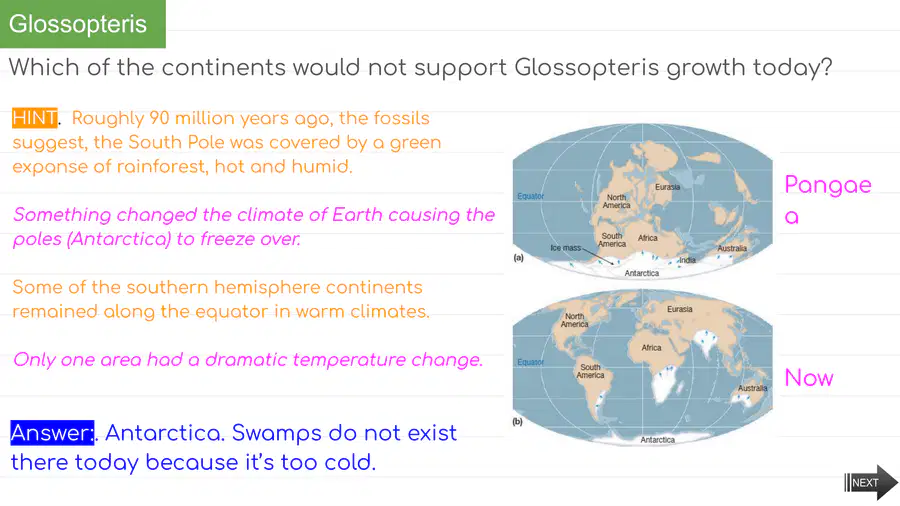
Which of the continents would not support Glossopteris growth today?
Africa
Australia
Antarctica
South America
82
Multiple Choice
What was the climate like at the South Pole roughly 90 million years ago according to fossils?
Cold and icy
Hot and humid
Dry and arid
Mild and temperate
83
Multiple Choice
What caused the poles, including Antarctica, to freeze over?
A shift in the Earth's orbit
A change in the Earth's climate
A volcanic eruption
A meteor impact
84
Multiple Choice
Which area experienced a dramatic temperature change?
South America
Africa
Antarctica
Australia
85
Multiple Choice
Why do swamps not exist in Antarctica today?
It is too dry
It is too cold
It is too hot
It is too windy
86
87
Multiple Choice
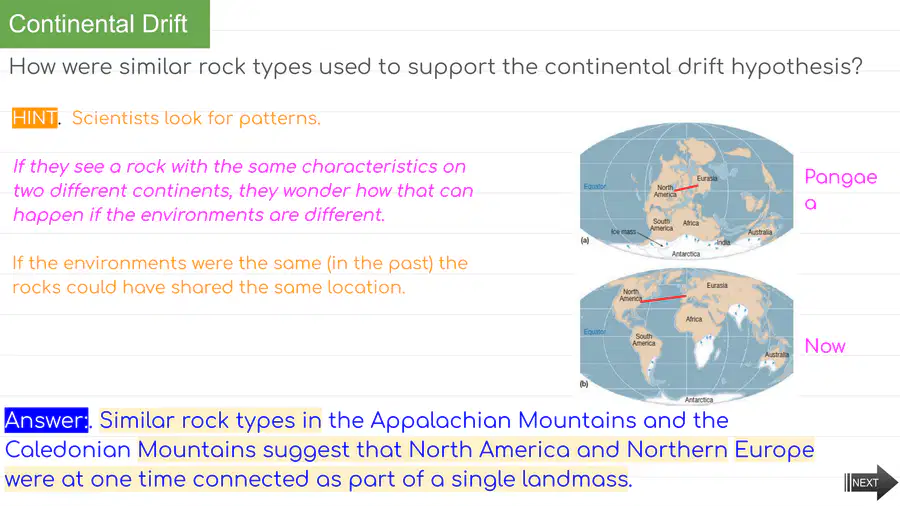
How do scientists use rock patterns to support the continental drift hypothesis?
By comparing rock colors
By looking for similar rock types on different continents
By measuring rock temperatures
By analyzing rock sizes
88
Multiple Choice
What do scientists wonder when they find rocks with the same characteristics on different continents?
How the rocks became different
How the environments could have been the same
Why the rocks are colorful
Why the rocks are heavy
89
Multiple Choice
What does the presence of similar rock types in the Appalachian and Caledonian Mountains suggest?
The continents were always separate
North America and Northern Europe were once connected
The rocks formed underwater
The rocks are from different time periods
90
Multiple Choice
What is the significance of finding similar rocks in different locations according to the continental drift hypothesis?
It suggests different climates
It indicates past connections between continents
It shows volcanic activity
It proves the rocks are man-made
91
Multiple Choice
What is the term used to describe the ancient supercontinent mentioned in the document?
Atlantis
Gondwana
Pangea
Laurasia
92

Show answer
Auto Play
Slide 1 / 92
SLIDE
Similar Resources on Wayground

87 questions
Brown Girl Dreaming Part III
Presentation
•
5th - 7th Grade
89 questions
Math 7 SOL Review
Presentation
•
7th Grade
91 questions
Math 7 SOL Review
Presentation
•
7th Grade
86 questions
Easter
Presentation
•
7th Grade
92 questions
GEOGRAPHY YEAR 7 REVIEW PACKET
Presentation
•
6th Grade
88 questions
Lesson 3: Weather Patterns
Presentation
•
6th Grade
90 questions
East and Southeast Asia
Presentation
•
5th - 6th Grade
82 questions
Forces Review
Presentation
•
5th Grade
Popular Resources on Wayground
10 questions
Safety Day 2026 – Student Review

Quiz
•
9th Grade
21 questions
Continents and Oceans
Quiz
•
6th Grade
20 questions
Parts of Speech
Quiz
•
5th Grade
16 questions
Subject & Predicate
Quiz
•
5th Grade
25 questions
Multiplication Facts
Quiz
•
5th Grade
12 questions
Map Skills
Quiz
•
3rd Grade
22 questions
Continents and Oceans
Quiz
•
5th Grade
15 questions
Rounding Decimals
Quiz
•
5th Grade
Discover more resources for Science
20 questions
Elements, compounds, and mixtures
Quiz
•
6th Grade
10 questions
6.6D - Relative Density Review
Quiz
•
6th Grade
10 questions
Exploring Chemical and Physical Changes

Interactive video
•
6th - 10th Grade
20 questions
CONDUCTION,CONVECTION AND RADIATION
Quiz
•
6th Grade
20 questions
Rocks and The Rock Cycle
Quiz
•
6th Grade
19 questions
Describing and Classifying Matter
Presentation
•
6th Grade
21 questions
Waves and Wave Properties
Quiz
•
6th - 8th Grade
20 questions
Phases of the Moon
Quiz
•
6th Grade