Subject Pronouns - English and Spanish Review
Presentation
•
World Languages
•
8th Grade
•
Easy
Melissa Marema
Used 9+ times
FREE Resource
27 Slides • 64 Questions
1

Subject Pronouns
Can you change nouns and replace them with pronouns?

2
Pronouns replace Nouns
Pronouns are helpful because we won't have to keep repeating the same nouns again and again.
For example:
Mrs. Marema is a teacher.
Mrs. Marema teaches Spanish.
Instead of repeating Mrs. Marema we can use the pronoun = she
She teaches Spanish.
Mrs. Marema and Mrs. McAlister work at Lake Denoon.
Mrs. Marema and Mrs. McAlister teach Spanish 1 & 2.
Instead of repeating Mrs. Marema and Mrs. McAlister we can use the pronoun = they
They teach Spanish 1 & 2.
3
There are many types of Pronouns
Today, we will be looking at Subject Pronouns!
A subject pronoun is a word that takes the place of a noun and acts as the subject of a verb in a sentence.
Subject pronouns are usually placed at the beginning of a sentence, before the verb, to indicate the person or thing performing the action.
Mrs. Marema teaches at Lake Denoon. = Mrs. Marema is the subject
She teaches at Lake Denoon = she replaces Mrs. Marema
4
I is a pronoun which is used when we are talking about ourselves.
For example...
I am cool.
I eat eggs.
5
Multiple Select
Choose the best subject pronoun for the picture
WE
IT
SHE
I
6
He is used for 1 male, such as a boy or a man.
For example...
David is cool.
He eats eggs.
7
Multiple Choice
This is Mr Lee. _____ is my math teacher.
She
They
I
He
8
Multiple Choice
Tom is 70 years old. Tom lives in Florida. _____ is my grandfather.
I
You
He
She
9
Multiple Choice
talking ABOUT your uncle
he
she
we
you
10
Multiple Choice
talking ABOUT your male teacher
he
she
I
we
11
She is used for 1 female, such as a girl or a woman.
For example...
Dana is cool.
She eats eggs.
12
Multiple Choice
I like to read with my mom. ______ tells me a lot of funny stories.
We
He
I
She
13
Multiple Choice
Amy is my best friend. I have long hair, but _____ has short hair.
we
she
they
he
14
Multiple Choice
Paul has a little sister, but _____ does not attend our school yet.
She
Her
He
I
15
We is a special pronoun. It is used for talking about yourself along with one or many people together in a group.
For example...
We are a happy family.
We eat eggs.
16
Multiple Choice
My friends and I go to the same school. ______ play together at recess.
I
We
You
They
17
Multiple Choice
talking about another person and myself (____ and I)
you
we
you all
they
18
Multiple Choice
My sister and I share a room. _____ take turns vacuuming and dusting.
she
I
they
we
19
They is another special pronoun. It is used to speak about many people but you are not part of that group.
For example...
The children are young.
They are students.
20
Multiple Choice
Which pronoun would take the place of the words Will and Amy?
we
you
they
21
Multiple Choice
Which pronoun should you use?
John and Jake are twins. _____ look just alike!
they
you
he
we
22
Multiple Choice
David, Sara, Sam and Katie are at school.
We are at school
They are at school
You are at school
He is at school
23
Multiple Choice
CHOOSE THE CORRECT OPTION:
"LIAM AND MARY"
THEY
WE
I
24
Multiple Choice
_____ are young.
She
He
It
They
25
You is used when you are speaking TO a single person.
For example...
You are cool.
You eat eggs.
26
Multiple Choice
Sara sees Tim in the hallway. She says TO him:
"Hello! How are _____ doing?"
I
you
she
he
27
Multiple Choice
Matt sees Anna after school. He says TO her:
"Are _____ going to the basketball game today?"
I
she
he
you
28
You is used when you are speaking TO many people. In English, sometimes we say "you all".
For example...
You all are cool.
You all eat eggs.
29
Multiple Choice
The teacher looks at her students. She says TO them:
"Are ______ doing your classwork?"
I
you all
she
he
30
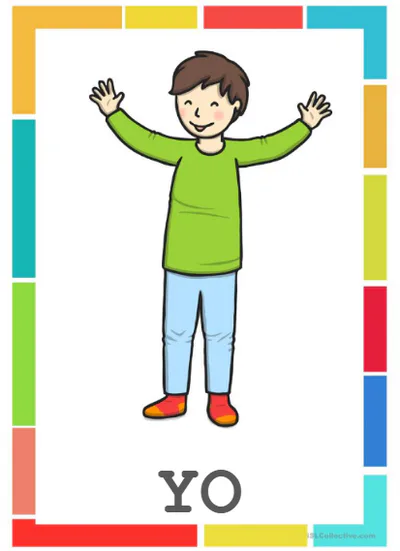
YO is a pronoun which is used when we are talking about ourselves. In English, it is "I".
For example...
YO soy alto.
YO soy inteligente.
31
Multiple Select
Choose the best subject pronoun for the picture
Nosotros
Yo
Ella
Tú
32
Multiple Select
Choose the best subject pronoun for the picture
él
ella
yo
usted
33
Multiple Choice
34
Él is used for 1 male, such as a boy or a man. In English, it is "he".
For example...
David es alto.
Él es inteligente.
35
Multiple Choice
Talking ABOUT your male science teacher
36
Multiple Choice
Talking ABOUT "mi amigo".
37
Multiple Choice
38
ELLA is used for 1 female, such as a girl or a woman. In English, it is "she".
For example...
Dana es alta.
Ella es inteligente.
39
Multiple Choice
How do you say "she" in Spanish?
40
Multiple Choice
ella
he
she
we
they
41
Multiple Choice
What pronoun would you use to talk ABOUT this person?
42
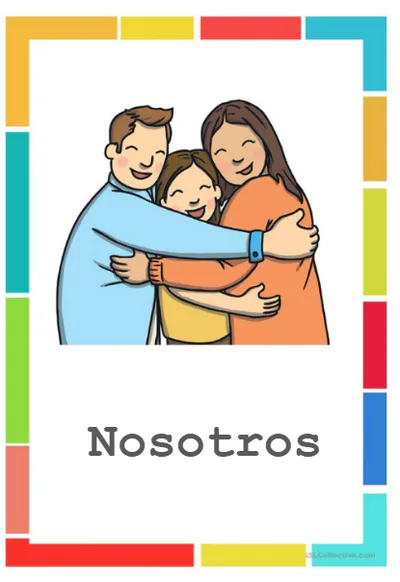
NOSOTR@S is used for talking about yourself along with one or many people. In English, it is "we".
If you say "_______ and I" you will use nosotr@s.
For example...
Nosotros somos artísticos.
Nosotros somos simpáticos.
43
Multiple Choice
44
Multiple Choice
45
Multiple Choice
46
Multiple Choice
talking about another person and myself (____ y yo)
tú
nosotros
ustedes
usted
47
Multiple Choice
talking about someone and I (____ y yo)
48
Ellos and Ellas are used to speak about many people but you are not part of that group. It is "they" in English.
For example...
Ellos son inteligentes.
Ellos son altos.
49
Multiple Choice
50
Multiple Choice
What does "ellos" mean in English?
we
they (mixed male and female)
you all (formal)
51
Multiple Choice
What pronoun would you use to talk ABOUT these people?
yo
ellos
ella
tú
52
Multiple Choice
Talking ABOUT
"LIAM AND MARY"
Ellos
Nosotros
Yo
53
Tú is used when you are speaking TO a single person. In English, it is the informal or familiar "you".
For example...
Tú eres inteligente.
Tú eres joven.
54
Multiple Choice
talking TO your sister
ella
tú
yo
ustedes
55
Multiple Choice
talking TO a classmate
56
Multiple Choice
talking TO your friend
57
USTED is used when you are speaking TO a single person. It is formal, used with adults and people you only know through their job. In English, this is also "you"
For example...
Usted es simpática.
Usted es inteligente.
58
Multiple Choice
talking TO your teacher
tú
usted/Ud.
ustedes/Uds.
nosotros
59
Multiple Choice
talking TO a cashier at the grocery store
tú
usted/Ud.
ustedes/Uds.
él
60
Multiple Choice
talking TO your bus driver
ella
usted
yo
ustedes
61
USTEDES is used when you are speaking TO many people. In English, we might say "you all".
For example...
Ustedes son inteligentes.
Ustedes son bajos.
62
Multiple Choice
talking to several friends
ella
tú
usted/Ud.
ustedes/Uds.
63
Multiple Choice
talking to a group of classmates
ellas
nosotros
ustedes/Uds.
usted/Ud.
64
Multiple Choice
Talking TO Susana, Louise, and Jane
tú
ustedes
65
Tú vs. Usted vs. Ustedes
Use tú with one person you're more familiar with (friends, family, peers) Use usted with adults, elders, or people of authority (again only with one person)
Use ustedes when speaking to two more people (You All)
66
Multiple Choice
tú
vosotros
ustedes
usted
67
Multiple Choice
"usted" means
I
you (formal)
you (informal)
68
Multiple Choice
"tú" means
she
they
you (informal)
69
Multiple Choice
talking TO several friends (in Latin America)
ellos
ellas
ustedes
nosotros
70
Multiple Select
talking TO a group of soccer players (Latin America)
Ustedes
Usted
ellos
nosotros
71
What's up with "vosotros"?
In Spain, instead of ustedes, you will hear "vosotros" (when talking to males) and "vosotras" (when talking to females). Vosotros, like ustedes, means "You all"
72
Multiple Choice
What is the only country uses vosotros/vosotras?
mexico
spain
madrid
columbia
73
Multiple Choice
Which pronoun would you use if you were talking TO these players (in Spain)?
tú
vosotros
ustedes
yo
74
SINGULAR PRONOUNS = 1 person/thing/animal
Singular pronouns refer to 1 person/thing/animal doing an action.
75
Singular Pronouns
YO = I
TÚ = YOU INFORMAL (used when talking with friends/family and people your same age)
USTED = YOU FORMAL (used when talking with people you don´t know/professionals)
ÉL = HE
ELLA = SHE
76
Match
Match the SINGULAR PERSONAL PRONOUNS
YO
ÉL
ELLA
TÚ
USTED
I
HE
SHE
You informal
You formal
I
HE
SHE
You informal
You formal
77
PLURAL SUBJECT PRONOUNS
refer to MORE THAN 1 person/thing/animal doing an action.
PLURAL PERSONAL PRONOUNS
= more than 1 person/thing/animal
78
PLURAL SUBJECT PRONOUNS
NOSOTROS = We (masculine or mixed male/female)
NOSOTRAS = We (feminine)
VOSOTROS = You all informal (masculine or mixed male/female)
VOSOTRAS = You all informal (feminine)
ELLOS = They (masculine or mixed male/female)
ELLAS = They feminine
USTEDES = You all FORMAL
79
Multiple Choice
NOSOTROS
We feminine
We masculine (or mixed male female)
80
Multiple Choice
NOSOTRAS
We feminine
We masculine (or mixed male female)
81
Multiple Choice
ELLOS
They masculine (or mixed male female)
They feminine
82
Multiple Choice
Ellas
They masculine (or mixed male female)
They feminine
83
Multiple Choice
VOSOTROS (*Spain only)
You all informal (feminine)
You all informal (masculine or mixed male/female)
84
Multiple Choice
VOSOTROS (*Spain only)
You all informal (feminine)
You all informal (masculine or mixed male/female)
85
Nosotros/ Nosotras
Means "we" or "us" in English
Plural
Nosotros is masculine or mixed male/female
Nosotras is feminine
86
Multiple Choice
What pronoun can replace "Linda, Robert y yo"?
ellos
ustedes
nosotros
87
Ustedes
Means "you all" or "y'all" in English
Plural
Used in Latin America
88
Multiple Choice
If you are talking TO a group of kids, which subject pronoun would you use? (*In Latin America)
ustedes
vosotros
ellos
89
PLURAL SUBJECT PRONOUNS
ELLOS = They (masculine or mixed male/female)
ELLAS = They feminine
90
Multiple Choice
If you are talking ABOUT "Lola y Carlos", which pronoun would you use?
ellas
91
Multiple Choice
If you are talking ABOUT "Anna and María", which pronoun would you use?
ellos
ellas
Subject Pronouns
Can you change nouns and replace them with pronouns?

Show answer
Auto Play
Slide 1 / 91
SLIDE

Similar Resources on Wayground
87 questions
Unit 3 Influential People/Documents
Presentation
•
7th Grade
85 questions
Lesson: Simple Machines and MA
Presentation
•
9th Grade
87 questions
8.11A,B,C
Presentation
•
8th Grade
87 questions
LESSON #4: Discrete vs Non-Discrete Functions
Presentation
•
8th Grade
88 questions
Introduction to Factoring Polynomials
Presentation
•
8th Grade
88 questions
Waves
Presentation
•
8th Grade
86 questions
TEKNOLOGI INFORMASI DAN KOMUNIKASI
Presentation
•
9th Grade
83 questions
Graphing Inequalities Review
Presentation
•
8th - 9th Grade
Popular Resources on Wayground
20 questions
"What is the question asking??" Grades 3-5
Quiz
•
1st - 5th Grade
20 questions
“What is the question asking??” Grades 6-8
Quiz
•
6th - 8th Grade
10 questions
Fire Safety Quiz
Quiz
•
12th Grade
20 questions
Equivalent Fractions
Quiz
•
3rd Grade
34 questions
STAAR Review 6th - 8th grade Reading Part 1
Quiz
•
6th - 8th Grade
20 questions
“What is the question asking??” English I-II
Quiz
•
9th - 12th Grade
20 questions
Main Idea and Details
Quiz
•
5th Grade
47 questions
8th Grade Reading STAAR Ultimate Review!
Quiz
•
8th Grade
Discover more resources for World Languages
20 questions
REGULAR Present tense verbs
Quiz
•
8th - 9th Grade
20 questions
preterito vs imperfecto
Quiz
•
5th - 12th Grade
15 questions
Practice: Spanish Imperfect Tense
Quiz
•
7th - 12th Grade
19 questions
ser vs estar
Quiz
•
8th - 12th Grade
20 questions
La nourriture
Quiz
•
6th - 8th Grade
20 questions
la ropa
Quiz
•
8th Grade
20 questions
Tener Expressions
Quiz
•
6th - 12th Grade
20 questions
Preterite v Imperfect
Quiz
•
8th Grade