
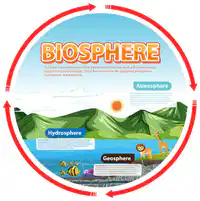
Intro to Biosphere

Presentation
•
Science
•
9th - 12th Grade
•
Practice Problem
•
Easy
+11
Standards-aligned

Ferdinand Estrella
Used 20+ times
FREE Resource
9 Slides • 4 Questions
1
1. This animal can sleep standing up, has a kick strong enough to break bones, and has a baby called a foal.
What animal is it?
2. This tiny creature can lift objects up to 50 times its own body weight and lives in highly organized colonies.
What animal is it?
3. This animal has no vocal cords, but communicates using body language and hissing. It also has a forked tongue to smell.
What animal is it?
4. This ocean animal has three hearts, blue blood, and can squirt ink to escape predators.
What animal is it?
5. This bird can mimic car alarms, chainsaws, and even human voices. It is known for its amazing ability to copy almost any sound.
What animal is it?
6. This massive animal spends up to 22 hours a day eating and has ears that help regulate body temperature.
What animal is it?
7. (Open-ended)
If you could create your own mystery animal, what special ability or adaptation would it have? Explain why.
2

3

3
-
1 What is Ecology?
Studying Our Living Planet
• Ecology is the scientific study of
interactions among organisms and
between organisms and their
environment, or surroundings.
• Ecology is the study of nature’s
“houses” and the organisms that live
in those houses.
4

The Biosphere
• The biosphere consists of all life on Earth
and all the parts of the Earth in which life
exists including land, water, and air or
atmosphere.
It extends
8 km
above
earth and
11 km
below
ocean.
5
6
Open Ended
What is BIOSPHERE, in your own words?
7

Interactions and Interdependence
Organisms and their environment are interdependent. These
giraffes could not survive without plants to eat, and the
plants could not grow unless bacteria and other organisms
help recycle nutrients in the water and soil.
8
Categorize
Living things
Match the following terms.
9

Levels of Organization
The study of ecology ranges from
individual organisms to populations,
communities, ecosystems, biomes, and
the entire biosphere.
10

Levels of Organi
zation
• A
biome
is a group of ecosystems that have the
same climate and similar dominant communities.
• An
ecosystem
is a collection of all the organisms
that live in a particular place, together with their
nonliving, or physical, environment.
• A
community
is composed of different populations
that live together in a define area.
• A
population
is a group of individuals that belong
to the same species and live in the same area.
• A
species
is a group of individual organisms similar
to one another.
Biology.com – Activities: Art in Motion
11
Reorder

Change the following from a single organism to a collection of organisms in chronological order.
Individual
Population
Community
Ecology
Biosphere
12

Biotic and Abiotic Factors
•
Biotic Factor
– any living part of the environment
with which an organism might interact. (animals,
plants, bacteria)
•
Abiotic Factor
– any nonliving part of the
environment. ( sunlight, heat, precipitation, wind)
13
Categorize
spider plant
dry eraser
Sort the following terms into biotic and abiotic categories.
1. This animal can sleep standing up, has a kick strong enough to break bones, and has a baby called a foal.
What animal is it?
2. This tiny creature can lift objects up to 50 times its own body weight and lives in highly organized colonies.
What animal is it?
3. This animal has no vocal cords, but communicates using body language and hissing. It also has a forked tongue to smell.
What animal is it?
4. This ocean animal has three hearts, blue blood, and can squirt ink to escape predators.
What animal is it?
5. This bird can mimic car alarms, chainsaws, and even human voices. It is known for its amazing ability to copy almost any sound.
What animal is it?
6. This massive animal spends up to 22 hours a day eating and has ears that help regulate body temperature.
What animal is it?
7. (Open-ended)
If you could create your own mystery animal, what special ability or adaptation would it have? Explain why.
Show answer
Auto Play
Slide 1 / 13
SLIDE
Similar Resources on Wayground

10 questions
Domain 2 Lesson 3
Presentation
•
9th - 12th Grade
9 questions
Y = MX + B Review
Presentation
•
9th - 12th Grade
12 questions
Food Web
Presentation
•
9th - 12th Grade
10 questions
Model matter, for 5th (recap of atoms, molecules and compunds)
Presentation
•
1st - 3rd Grade
10 questions
PR1 QUALITATIVE RESEARCH INTRODUCTION & BACKGROUND OF THE STUDY
Presentation
•
9th - 12th Grade
12 questions
Living Things
Presentation
•
KG
11 questions
Ch. 12.3 - Limiting Reagent and Percent Yield
Presentation
•
9th - 11th Grade
10 questions
Writing an equation from a graph
Presentation
•
9th - 12th Grade
Popular Resources on Wayground
21 questions
Continents and Oceans

Quiz
•
6th Grade
20 questions
Parts of Speech
Quiz
•
5th Grade
16 questions
Subject & Predicate
Quiz
•
5th Grade
25 questions
Multiplication Facts
Quiz
•
5th Grade
12 questions
Map Skills
Quiz
•
3rd Grade
22 questions
Continents and Oceans
Quiz
•
5th Grade
15 questions
Rounding Decimals
Quiz
•
5th Grade
20 questions
Brand Labels
Quiz
•
5th - 12th Grade
Discover more resources for Science
10 questions
Exploring Chemical and Physical Changes

Interactive video
•
6th - 10th Grade
20 questions
Atomic Structure
Quiz
•
9th Grade
10 questions
Exploring the Periodic Table
Interactive video
•
6th - 10th Grade
14 questions
Periodic Trends
Interactive video
•
11th Grade
10 questions
Exploring Earth's Spheres and Their Interactions
Interactive video
•
6th - 10th Grade
20 questions
The Cell Cycle and Mitosis
Quiz
•
9th Grade
15 questions
Cell Cycle
Quiz
•
9th Grade
10 questions
Exploring Chemical Changes
Interactive video
•
6th - 10th Grade