

Sample chem lesson demo

Presentation
•
Science
•
10th Grade
•
Hard

SARAH STRILCHUK
FREE Resource
14 Slides • 4 Questions
1
Discover new features in Lessons!
Finish all phases of “I-do ; We-do ; You-do” with Quizizz
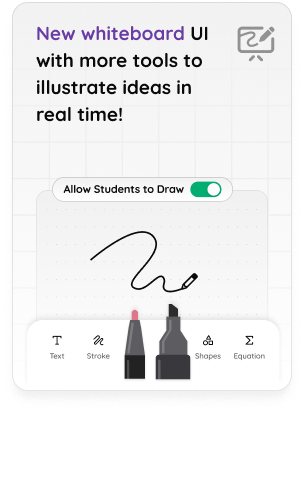
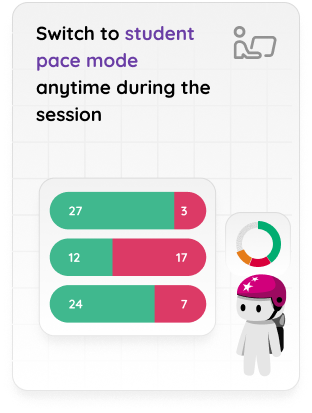
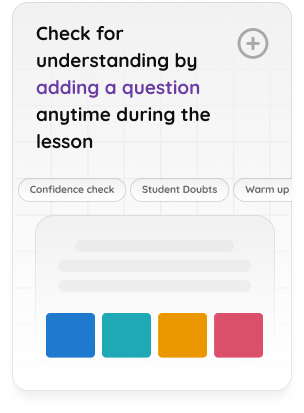

You can also create lessons directly on Google Slides using “Quizizz Extension”.
Read more about it here
2

Covalent Bonding
An introductory presentation
F
F
3
Multiple Choice
What is the charge on an anion?
Positive
Nutral
4
Multiple Choice
Which two elements will form a covalent bond?
Magnesium and Chlorine
Sodium and Bromine
Iron and Sulfur
Carbon and Oxygen
5
Multiple Select
What is true about covalent compounds? (Check all that apply.)
bonds are generally weak
formed between metals and nonmetals
low melting and boiling points
solids are usually soft
6
Multiple Choice
How are covalent compounds formed?
when electrons are gained or lost
when electrons are transferred
when electrons are shared
none of the above
7

Learning Points
State which types of
elements covalent
bonds can exist
between.
Describe what
happens to electrons
when a covalent
bond is formed.
Explain some key
properties of simple
covalent substances.
8

Covalent bonds form in most non-metal elements
and in compounds formed between non-metals.
Elements
Non-metals can be found on
the right hand side of the
periodic table.
Non-metals
9
Discover new features in Lessons!
Finish all phases of “I-do ; We-do ; You-do” with Quizizz
You can also create lessons directly on Google Slides using “Quizizz Extension”.
Read more about it here
10

These are examples of covalent
molecules. Some are elements
(substances made of the same type of
atom) and some are compounds
(substances made of two or more types
of atom).
Molecules
H
H
H
Cl
H
H
O
Cl
Cl
11

The shells must be filled in order of
closest to the nucleus, to furthest from
the nucleus. When reacting, the aim is
for an atom to achieve a full outer
shell. This means the desired electron
configuration is the same as a noble
gas e.g. like helium and neon shown to
the left.
Electron Rules
Recap
He
Two electrons
can occupy the
first shell.
Ne
Eight electrons
can occupy the
other shells.
12

H
A covalent bond is formed when two atoms share a pair of electrons. The
electrons which contribute towards a covalent bond, are found in the outer shells
of the atoms. Usually each atom contributes one electron, but some atoms can
react to make multiple covalent bonds.
What are covalent bonds?
H
13

Each fluorine atom has 7 electrons in
the outer shell. Each atom needs to
achieve a full outer shell of 8. They
can each contribute one electron to a
covalent bond. Sharing the electrons,
means both atoms now have a full
outer shell and a simple covalent
molecule is made.
Flourine
F
F
14

Water is made of two hydrogen atoms
and one oxygen atom. Oxygen has 6
electrons in its outer shell and needs to
achieve 8 to make a full outer shell.
Each hydrogen has 1 electron and needs
to achieve 2 to have a full shell.
Two covalent bonds can be formed to
make the simple covalent water
molecule.
Water
O
H
H
15

Fluorine has 7 electrons in its outer
shell and needs to achieve 8 to have a
full outer shell. Hydrogen has one
electron. As this electron is in the first
shell, hydrogen needs to achieve 2
electrons to have a full shell. The
simple covalent molecule of hydrogen
fluoride is made by sharing electrons.
Hydrogen
fluoride
F
H
16


Simple covalent substances can not
conduct electricity. This is because
charged particles and free movement
are required for electrical conduction
to occur. Covalent bonds are fixed
and the electrons can not move.
Conduction
17

Covalent bonds are very strong but
there are weak intermolecular forces
between molecules which do not
require a lot of thermal energy to be
overcome. This means that simple
covalent substance have low melting
points and are often liquid or gas at
room temperature.
Melting Point
Cl
Cl
Cl
Cl
Cl
Cl
18

Covalent Bonding
The end of the presentation
F
F
Discover new features in Lessons!
Finish all phases of “I-do ; We-do ; You-do” with Quizizz
You can also create lessons directly on Google Slides using “Quizizz Extension”.
Read more about it here
Show answer
Auto Play
Slide 1 / 18
SLIDE
Similar Resources on Wayground

13 questions
Volcanoes
Presentation
•
10th Grade
11 questions
Soluté et solvant
Presentation
•
9th Grade
15 questions
CER - Reasoning Analysis
Presentation
•
10th Grade
10 questions
konsep mol
Presentation
•
10th Grade
15 questions
Ionic Bond
Presentation
•
9th - 10th Grade
12 questions
Molar Mass
Presentation
•
11th Grade
16 questions
Cell Membrane
Presentation
•
9th - 10th Grade
15 questions
Intro to Moles
Presentation
•
10th Grade
Popular Resources on Wayground
10 questions
Safety Day 2026 – Student Review

Quiz
•
9th Grade
21 questions
Continents and Oceans
Quiz
•
6th Grade
20 questions
Parts of Speech
Quiz
•
5th Grade
16 questions
Subject & Predicate
Quiz
•
5th Grade
25 questions
Multiplication Facts
Quiz
•
5th Grade
12 questions
Map Skills
Quiz
•
3rd Grade
22 questions
Continents and Oceans
Quiz
•
5th Grade
15 questions
Rounding Decimals
Quiz
•
5th Grade
Discover more resources for Science
10 questions
Exploring Chemical and Physical Changes

Interactive video
•
6th - 10th Grade
10 questions
Exploring the Electromagnetic Spectrum for Middle School Science
Interactive video
•
6th - 10th Grade
10 questions
Exploring Force and Motion Concepts
Interactive video
•
6th - 10th Grade
10 questions
Exploring Air Masses and Weather Fronts
Interactive video
•
6th - 10th Grade
10 questions
Exploring the States of Matter
Interactive video
•
6th - 10th Grade
10 questions
Exploring Forces: Net Force, Normal Force, Gravity, and Friction
Interactive video
•
6th - 10th Grade
10 questions
Differentiating Thermal Energy and Temperature
Interactive video
•
6th - 10th Grade
10 questions
Exploring the States of Matter and Thermal Energy
Interactive video
•
6th - 10th Grade