
DEC10 Inference

Presentation
•
English
•
4th Grade
•
Practice Problem
•
Medium
+32
Standards-aligned

Nicolas Garcia
Used 2+ times
FREE Resource
40 Slides • 12 Questions
1

1
Grade 4 Read/Write
Teacher Facing
December 10, 2024
Informational
2

Student Assistance Form (SAF)
2
What is a SAF?
A SAF is an electronic referral form submitted when a Houston ISD student’s need
has been identified. Information provided in a SAF is immediately sent to a caring
professional to be processed.
Wraparound
Team
Campus
Staff
Students
Parents
Community
Members
School
Counselors
District
Personnel
Service
Providers
Who can submit a SAF?
SAF
Instructions
Scan
3

Submit a Student Assistance Form (SAF) to notify a caring professional about a
student’s need. A SAF can be submitted to connect a student to
resources/services for:
Identified a Need? Submit a SAF
www.HoustonISDsaf.com
•Housing
•Transportation
•and more!
•School Supplies
•Attendance/Truancy
Submit a SAF by scanning the QR code or by typing
•Mental Health
•Food/Clothing
4

Submit a Student Assistance Form (SAF) to notify a caring professional
about your needs. A SAF can be submitted to connect you to
resources/services for:
Do You Have a Need? Submit a SAF
www.HoustonISDsaf.com
•Housing
•Transportation
•and more!
•School Supplies
•Attendance
Submit a SAF by scanning the QR code or typing
•Mental Health
•Food/Clothing
5

MRS Icons
5
6

Materials
Student
Teacher
● What Can We Infer About
Elephants?
● ELA Notes
● “The Science Behind Sight”
HMH My Book: Module 2 Week 1
● Whiteboards
● Response cards
● Slide Deck
●
HMH MyBook: Module 2 Week
1 “The Science Behind Sight”
6
7

7
Do Now
1. He always talked like this. He was always
drawing plans for flying machines that would
never leave the ground, no matter how carefully
he built them. For all of his tries, he still had not
changed the world. Martha hoped he would—and
she loved him for trying. If only she believed as
deeply as he did.
Remember that -ful means to be full of.
Remember that –ly means in the manner of.
In the paragraph, the suffix -ful in the word
carefully helps the reader understand that
the word means –
A. without concern
B. full of inattention
C. carelessness
D. with great care
2. He was always drawing plans for flying
machines that would never leave the ground, no
matter how carefully he built them. For all of his
tries, he still had not changed the world. Martha
hoped he would—and she loved him for trying. If
only she believed as deeply as he did.
Remember that –ly means in the manner of.
In the paragraph, the suffix -ly in the word
deeply helps the reader understand that the
word means –
A. complete
B. little
C. low
D. serious
8
Multiple Choice

In the paragraph, the suffix -ful in the word carefully helps the reader understand that the word means -
The suffix -ful helps the reader understand that the word carefully means -
a
b
c
d
9
Multiple Choice

In the paragraph, the suffix -ly in the word deeply helps the reader understand that the word means –
The suffix -ly helps the reader understand that the word deeply means -
a
b
c
d
10

8
LO: SWBAT make inferences
and use evidence to support
understanding.
DOL: Given a text, students will correctly make
inferences and use evidence to support
understanding in at least 4 of 5 questions.
Informational
Ⓡ 4.6(F) make inferences and use evidence to support understanding DEC10
11

9
HOT Question: How
can making inferences based
on textual evidence support
reading comprehension?
.
Informational
Ⓡ 4.6(F) make inferences and use evidence to support understanding DEC10
12

10
information
(noun)
text evidence
(noun)
use information directly
from texts to justify
responses
inference
(noun)
is an educated guess
based on clues in the
text and what readers
already know
Academic Vocabulary
facts provided or learned
about someone or
something
13
Dropdown

14
Draw
Draw a picture of the word inference.
15

Implicit
Response
Stated
Response
an idea that must be
inferred by analyzing the
details in a text
an idea that is directly
quoted from the text
The difference between implicit and stated
responses is…
16

12
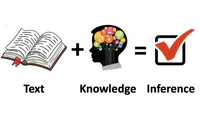
Text
Evidence
Background
Knowledge
Inference
(Text and
graphic features)
17

13
Text evidence is important because
it…
helps readers confirm their interpretations and
understandings of the text.
strengthens critical thinking skills as readers must
distinguish which parts of the text are relevant.
keeps readers engaged and actively
involved with the text.
18

14
How can we make inferences in
informational texts?
We can make
inferences in
informational texts by…
“Informational Text” Anchor Chart from HMH Into Reading! Texas with permission © Houghton Mifflin Harcourt Publishing Company
What clues do we need to look
for to make an inference in
informational texts?
19

15
What can you
conclude from
these
sentences?
I can infer that…
I notice…
It reminds me of…
The sky is filled with dark, thick clouds,
and the wind is picking up speed.
People outside are quickly closing their
umbrellas and seeking shelter.
● The dark clouds
● The wind
picking up
speed
● People closing
umbrellas
a storm is
approaching
● Previous storms
I've experienced
● Getting caught in
the rain
● Weather
warnings on TV
20

16
What can the
reader infer
about how
elephants take
care of their
family members?
I can infer that…
I notice…
It reminds me of…
African elephants have a fascinating way of helping
injured family members. When an elephant is hurt and
can't walk well, the other elephants in the herd slow
down their pace to match it. They often bring food and
water to the injured elephant using their trunks. The
younger elephants will stay close to the hurt elephant,
touching it gently with their trunks to provide comfort.
● Elephants
changing their
speed
● Helping with food
and water
● Families helping
each other
● Working as a team
● Showing kindness
● elephants have
have strong
family bonds
21
Multiple Choice

Based on information in this sentence, what can the reader conclude about elephant herds?
The reader can conclude that -
a
b
c
d
22

17
Read this sentence from the paragraph:
When an elephant is hurt and can't walk well, the other
elephants in the herd slow down their pace to match it.
Based on information in this sentence, what can the
reader conclude about elephant herds?
A.They prefer traveling in large groups
B.They know the fastest routes to travel
C.They adapt their behavior to help others
D.They follow the strongest elephants
A is incorrect, the sentence
doesn't tell us anything
about group size
B is incorrect the sentence
actually shows them going
slower, not faster
C is correct the
sentence shows
elephants changing to
help
D is incorrect nothing tells us
about following strong
elephants
O?
23

18
How does making inferences
help us better understand what
we read?
Making inferences while reading helps us better
understand the text by...
24

19
The Science
Behind
Sight
25

Read
Stop
Jot!
Page 113
●What is happening in the
text?
●What inferences can you
make?
●What evidence can support
your inference?
This is important!
Underline key words
or details.
I don’t understand.
Readers are expected to…
1
2
3
26

21
Based on the heading “How Eyes Work,” the
reader can tell…
What can the
reader tell about
the section “How
Eyes Work” based
on its heading?
27
Multiple Choice

What can the reader tell about the section “How Eyes Work” based on its heading?
Based on the heading I can tell the section is about -
a
b
c
d
28

22
A.The section will most likely discuss
the different parts of the eye that you
can see.
B.The section will most likely explore
the messages sent from the retina to
the brain.
C.The section will most likely explain
how eyelids protect the eyes from
dust.
D.The section will most likely focus on
how light passes into the eye through
a lens.
What can the
reader tell
about the
section “How
Eyes Work”
based on its
heading?
29
Multiple Choice

What happens when an eyelid blinks?
When you blink the -
a
b
c
d
30

A.The tears wash the surface of the eye clean
B. The pupils change size to let in light
C. The tears travel into the eyelids
D.The eyes close for several seconds
23
What happens when an eyelid blinks?
31

24
Real Life Connection:
Your diet affects your
eyesight as well.
Informational
Ⓡ 4.6(F) make inferences and use evidence to support understanding DEC10
32

Read
Stop
Jot!
Page 114-115
Stop and ask yourself:
●What is happening in the
text?
●What inferences can you
make?
●What evidence can support
your inference?
This is important!
Underline key words
or details.
I don’t understand.
Readers are expected to…
1
2
3
33

Based on information in paragraph 10, the
reader can infer…
Based on information in
paragraph 10, what can
the reader infer about
eye care?
34
Multiple Choice

Based on the information in paragraph 10, what can the reader infer about eye care?
The reader can infer -
a
b
c
d
35

27
A. Eyelids close slowly to protect the
eyes.
B. Blinking helps wash the surface of the
eye with tears.
C. Eyelids are not involved in the
protection of the eyes.
D. Dust and other things on the eye do
not get washed off by tears.
Based on information in paragraph
10, what can the reader infer about
eye care?
36

The diagram of the eye (page 114) and the
information in paragraphs 13 and 14 best support
the idea that…
The diagram of the eye
(page 114) and the
information in paragraphs
13 and 14 best support the
idea that —
37
Multiple Select

The diagram of the eye (page 114) and the information in paragraphs 13 and 14 bust support the idea that -
Select TWO answers
The diagram and pages 13 and 14 best support the idea that -
a
b
c
d
e
38

29
The diagram of the eye (page 114) and the information in
paragraphs 13 and 14 best support the idea that —
Select TWO correct answers.
A.the lens of the eye functions similarly to a camera lens
B.the retina works independently of the lens to process
visual information
C.light from an object passes through the retina
D.the lens of the eye focuses light to create a clear image
on the retina
E. the brain turns the image on the retina upside down
39
Multiple Choice

This question has two parts. First, answer Part A. Then answer Part B.
Part A
What can the reader conclude about the brain?
The reader can conclude about the brain -
a
b
c
d
40
Multiple Choice

Part B
Which sentence from the selection does NOT support the answer to Part A?
a
b
c
d
41

This question has two parts. First, answer Part A. Then answer Part B.
30
A. The brain is responsible for turning
the image on the retina upside
down.
B. The brain is an essential
component in understanding what
the eyes see.
C. The brain sends signals to the
retina to process colors and
shapes.
D. The brain is not involved in the
process of interpreting visual
signals.
Part A
What can the reader conclude
about the brain?
A. The brain turns it the right way up, so
we know what we are looking at!
(paragraph 14)
B. The retina sends messages about
what your eyes see to your brain.
(paragraph 15)
C. Then, it sends these signals to the
brain along a pathway called the
optic nerve. (paragraph 15)
D. The brain figures out what the signals
mean. (paragraph 15)
Part B
Which sentence from the selection does
NOT support the answer to Part A?
42
Multiple Choice

Read this sentence from the paragraph:
You will not feel it, but the shape of your lenses changes.
Based on information in this sentence, what can the reader conclude about the lens?
The reader can conclude about the lens that -
a
b
c
d
43

31
Read this sentence from the paragraph:
You will not feel it, but the shape of your lenses changes.
Based on information in this sentence, what can the reader conclude
about the lens?
A.The body does not change in any way throughout your
life.
B.The lenses change shape without you noticing.
C.Things happen in your body automatically to help you in
daily life.
D.The lens changes shape, becoming thicker.
44

32
What can the reader conclude about how eyes function? Support
your answer with evidence from the article.
SCR
Look-fors in SCR responses:
❏ A complete response will provide
one of the possible responses.
❏ Evidence is accurately used to
support the response.
❏ The response and the evidence to
support it are based on the text.
1 point
2 points
45

33
The reader can conclude that eyes function as a team of
different parts that help us see. The text shows this by
explaining how "eyelids protect the eyes by closing quickly"
and "tears help wash away dust." Also, it tells us that "the
pupil gets bigger or smaller to let in just the right amount of
light." These examples show how each part of the eye has
an important job. All these parts working together help us
see the world clearly.
What can the reader conclude about how eyes function? Support
your answer with evidence from the article.
46
33
The reader can conclude that eyes function
What can the reader conclude about how eyes function? Support
your answer with evidence from the article.
47
33
The reader can conclude that eyes function as a team of
different parts that help us see.
What can the reader conclude about how eyes function? Support
your answer with evidence from the article.
48
33
The reader can conclude that eyes function as a team of
different parts that help us see. The text shows this by
explaining how "eyelids protect the eyes by closing quickly"
and "tears help wash away dust."
What can the reader conclude about how eyes function? Support
your answer with evidence from the article.
49
33
The reader can conclude that eyes function as a team of
different parts that help us see. The text shows this by
explaining how "eyelids protect the eyes by closing quickly"
and "tears help wash away dust." Also, it tells us that "the
pupil gets bigger or smaller to let in just the right amount of
light."
What can the reader conclude about how eyes function? Support
your answer with evidence from the article.
50
33
The reader can conclude that eyes function as a team of
different parts that help us see. The text shows this by
explaining how "eyelids protect the eyes by closing quickly"
and "tears help wash away dust." Also, it tells us that "the
pupil gets bigger or smaller to let in just the right amount of
light." These examples show how each part of the eye has
an important job. All these parts working together help us
see the world clearly.
What can the reader conclude about how eyes function? Support
your answer with evidence from the article.
51

34
HOT Question
52

35
DOL: Given a text,
students will
correctly make
inferences and use
evidence to
support
understanding in
at least 4 of 5
questions.
10 MINUTE TIMER - COUNTDOWN TIMER (MINIMAL)
This 10-minute countdown timer is made for professional use and has some minimal sound effects in the last 5 seconds.
Demonstration of
Learning
1
Grade 4 Read/Write
Teacher Facing
December 10, 2024
Informational
Show answer
Auto Play
Slide 1 / 52
SLIDE
Similar Resources on Wayground

47 questions
The Day the Bulldozers Came
Presentation
•
4th - 5th Grade
44 questions
Context Clues 4th and 5th
Presentation
•
4th Grade
47 questions
TA 5 - Unit 6 - How many lessons do you have today?
Presentation
•
5th Grade
47 questions
Review Past Structures
Presentation
•
4th Grade
46 questions
Treasure Island: The Plan
Presentation
•
4th Grade
45 questions
Lesson 1.2.2 Constitution Day
Presentation
•
4th Grade
49 questions
CKLA Treasure Island Chapter 7
Presentation
•
4th Grade
45 questions
Word Study Lesson
Presentation
•
4th Grade
Popular Resources on Wayground
10 questions
Safety Day 2026 – Student Review

Quiz
•
9th Grade
21 questions
Continents and Oceans
Quiz
•
6th Grade
20 questions
Parts of Speech
Quiz
•
5th Grade
16 questions
Subject & Predicate
Quiz
•
5th Grade
25 questions
Multiplication Facts
Quiz
•
5th Grade
12 questions
Map Skills
Quiz
•
3rd Grade
22 questions
Continents and Oceans
Quiz
•
5th Grade
15 questions
Rounding Decimals
Quiz
•
5th Grade
Discover more resources for English
20 questions
Inferences
Quiz
•
4th Grade
15 questions
Subject/Verb agreement
Quiz
•
4th Grade
8 questions
Context Clues Practice
Quiz
•
4th Grade
15 questions
Singular and Plural Nouns
Quiz
•
4th Grade
12 questions
Figurative Language
Quiz
•
4th Grade
20 questions
4 Types of Sentences
Quiz
•
4th - 5th Grade
11 questions
Theme
Quiz
•
4th Grade
15 questions
Character Traits
Quiz
•
4th Grade