Speed, Velocity, and Acceleration
Presentation
•
Science
•
9th - 12th Grade
•
Medium
+9
Standards-aligned
Christopher Powers
Used 4+ times
FREE Resource
25 Slides • 33 Questions
1
Acceleration, Velocity, Speed
Lesson #2 taking velocity and speed and adding acceleration to our understanding.... PHYSICS IS GETTING PHUN!!!
2
3
Multiple Choice
Speed is a measure of
distance covered in an amount of time
distance divided by time
both of the other choices are correct
none of the choices are correct....speed is a vector
4
Multiple Choice
The velocity of a car heading 100 miles west in a time of two hours will be
50 miles/ hour West
50 miles/ hour
0.5 miles/ hour
0.5 meters/ second West
5
ACCELERATION
Acceleration is a vector quantity that is defined as the rate at which an object changes its velocity. An object is accelerating if it is changing its velocity.
6
EXAMPLES OF ACCELERATION
Acceleration could mean speeding up....that is the obvious one of course.
7
EXAMPLES OF ACCELERATION CONTINUED
Acceleration can also mean to SLOW DOWN! Yes....acceleration actually means any change in speed even if that means slowing down.
8
HERE IS THE WEIRDEST THING ABOUT ACCELERATION....
Acceleration not only means a change in speed (either speed up or slow down) it also means a change in DIRECTION.....Yes, when you go around a curve or turn one way or another even if you do it slowly you are considered accelerating!!!
9
Multiple Choice
A car is safely speeding up from 10 miles per hour to 50 miles per hour. what is the car doing?
accelerating
speeding
stopping
10
Multiple Choice
A car is slowing down from 50 miles per hour to 20 miles per hour...what is the car doing?
accelerating
accelerating
accelerating
Yes....the correct answer is accelerating! Pick this one!
11
Multiple Choice
A car comes to a curve in the road and proceeds to safely follow the curve and keep on going...what did the car do in the curve even though it never changed its speed?
the car accelerated by simply changing direction and keeping its speed the same
the car simply turned...it has nothing to do with acceleration
12
13
Multiple Choice
According to the video you just watched, What is the units for acceleration?
M / s2
Meters per second squared
meters per second per second
all of these are correct
14
Multiple Choice
If a car goes from zero to 50 meters/ second in 30 seconds, what is its acceleration?
1.7 meters / second squared
0.6 meters / second squared
15
Multiple Choice
If a car goes from 10 meters a second to 50 meters a second in 6 seconds, what is its acceleration? (remember to subtract the final speed from the initial speed to get your actual speed)
6.7 meters per second squared
0.15 meters per second squared
6.7 miles per hour
0.15 miles per hour
16
17
Multiple Choice
What does initial velocity and mean?
Initial velocity is the starting value of an objects velocity before something happens to change it
Initial velocity is the speed when something changes
initial means the letters of my name
initial is the last velocity something has
18
Multiple Choice
A bicycle and rider are rolling along at a velocity of 15 meters per second and crash into a brick wall reducing their velocity to zero meters per second in 0.5 seconds. What was their negative acceleration in this instance?
0 s m − 15 sm ÷0.5 s =-30 meters / second squared
30 meters/ second squared
15 meters/ second squared
-15 meters/ second squared
19
20
Multiple Choice
If an object is speeding up what is the value of the acceleration?
positive acceleration means speeding up
positive acceleration means slowing down
21
Multiple Choice
If an object is slowing down what is the value of acceleration?
slowing down will give us a negative acceleration value
slowing down will give us a positive acceleration value
22
examples of acceleration review
speeding up is considered a positive acceleration
slowing down is considered a negative acceleration
changing direction could be either a negative or positive acceleration depending on the change that takes place
23
Calculating acceleration
24
Multiple Choice
Δv=45 sm
t=5s
What is the acceleration of this system?
9 s2m
5 s2m
25
Motion Graphs
At the end of lesson, you should be able to interpret and analyze data about speed, distance, velocity, acceleration and time from graphs.
by Ms. Taylor
Use to aid with the completion of the Graphs Foldable
**ALWAYS pay attention to the labels on Axes!!
26
Motion graphs-
This is a graphical display of the relationship between speed, velocity, distance and time and acceleration. Just as a reminder, the definitions of common terms are below:
Acceleration - the rate of change of velocity per unit of time. (Vector quantity)
Displacement - the amount by which a thing is moved from its original position. (Vector quantity)
Distance - an amount of space between two things or people. (Scalar quantity)
Mass - the amount of matter in an object. (Scalar quantity)
Speed - distance an object travels per unit of time. (Scalar quantity)
Velocity - speed and direction of a moving object. (Vector quantity)
27
28
PART A
29
30
Multiple Choice
31
Multiple Choice
On this position vs time graph, describe the motion of A.
constant positive velocity
constant negative velocity
positive acceleration
negative acceleration
velocity is zero
32
Multiple Choice
What is occurring from point A to point B?
33
34
Multiple Choice
Steady speed; moving away from the starting position
35
36
Multiple Choice
37
Multiple Choice
38
39
Multiple Choice
Susie went to the store, when she got there she realized that she forgot her wallet and returned home.
Which graph matches this motion?
40
Multiple Choice
41
Multiple Choice
42
Calculating from graph
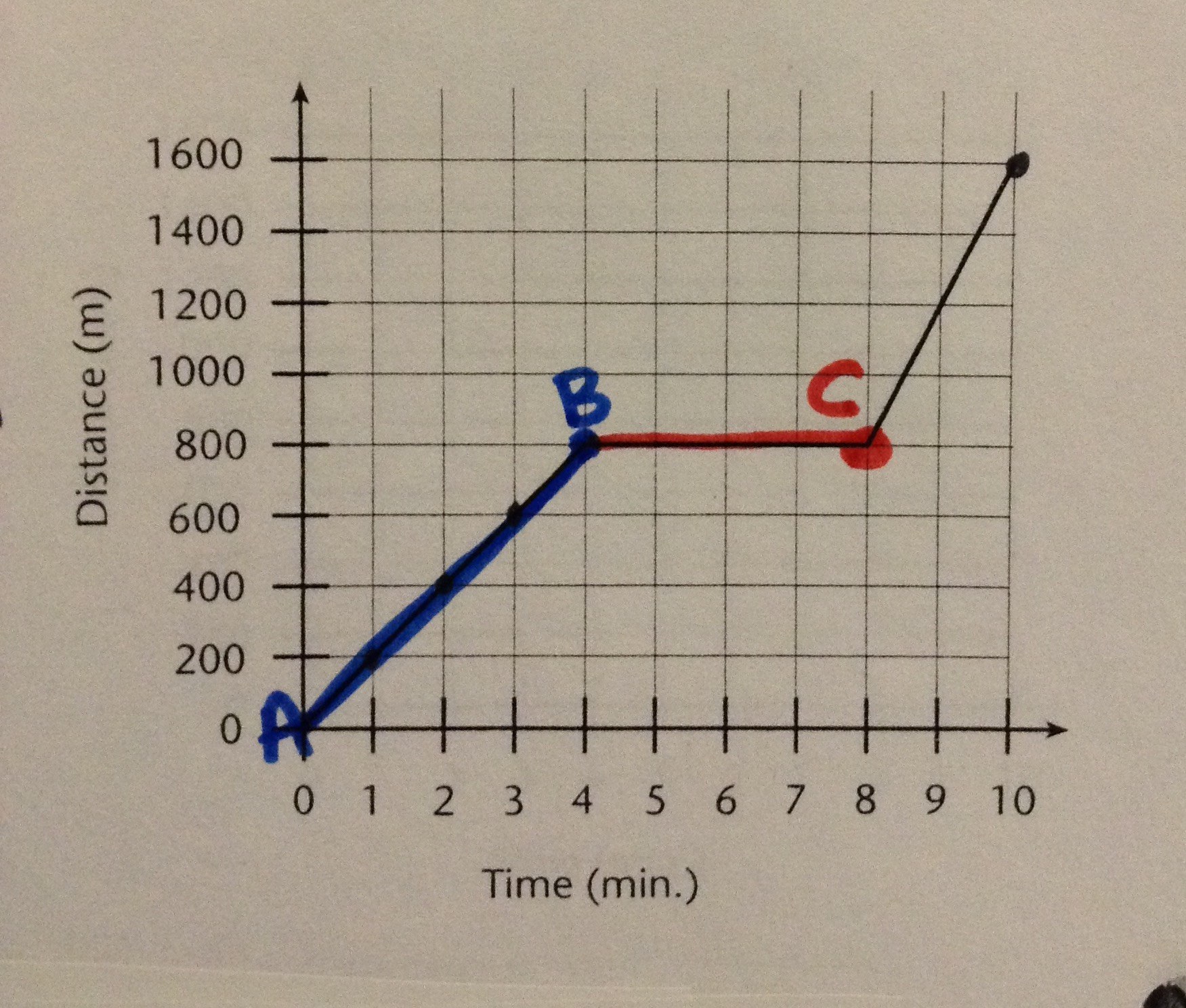
You can calculate the average speed/velocity from a distance time graph. To do this:
1. determine the total distance
2. divide by the total time it takes to reach final
distant (final time -starting time)
ex. Calculate the speed of the object in graph.
speed= distance/time
speed =200/4
hence, speed = 50 m/s
43
Multiple Choice
On this position vs time graph, what is the velocity?
40 m/s
8 m/s
5 m/s
0 m/s
44
Multiple Choice
45
Multiple Choice
Anne cycles from Bristol to Salisbury.
The diagram shows the distance-time graph of her journey.
What is Anne's speed for the first two hours of her journey?
40 mph
30 mph
20 mph
10 mph
46
PART B
47
48
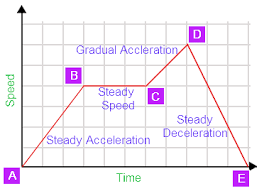
Steeper the diagonal means faster acceleration.
Deceleration means negative acceleration-diagonal line going down
49
50
Summary
51
Multiple Choice
What is this graph showing?
At rest
Acceleration
Constant speed of 1 m/s
Gradually speeding up
52
Multiple Choice
What is this graph showing?
Fast constant speed
Slow constant speed
At rest
Accelerating
53
Multiple Choice
What is this graph showing?
Constantly slowing down
Constantly speeding up
Acceleration
Returning to starting point
54
Multiple Choice
Accelerating gradually
Stopping
Slowing down constantly
Speeding up constantly
55
Multiple Choice
At what point is the speed the greatest?
C-D
B-C
A-B
D-E
56
Multiple Choice
Match the graph to the description:
"The car is accelerating at a constant rate."
57
Multiple Choice
58
Multiple Choice
In which of the following graphs below are both runners moving at the same speed?
Acceleration, Velocity, Speed
Lesson #2 taking velocity and speed and adding acceleration to our understanding.... PHYSICS IS GETTING PHUN!!!
Show answer
Auto Play
Slide 1 / 58
SLIDE

Similar Resources on Wayground
51 questions
Muscular System
Presentation
•
9th - 12th Grade
53 questions
Populations Notes - EES
Presentation
•
9th - 12th Grade
52 questions
Development Across the Lifespan Pt.2
Presentation
•
9th - 12th Grade
53 questions
Untitled Lesson
Presentation
•
KG
53 questions
The Nucleus
Presentation
•
9th - 12th Grade
52 questions
HC08.2 Limiting Reactant Lecture
Presentation
•
9th - 12th Grade
53 questions
Biomolecules
Presentation
•
9th - 12th Grade
54 questions
Gilded Age
Presentation
•
9th - 12th Grade
Popular Resources on Wayground
10 questions
5.P.1.3 Distance/Time Graphs
Quiz
•
5th Grade
10 questions
Fire Drill
Quiz
•
2nd - 5th Grade
20 questions
Equivalent Fractions
Quiz
•
3rd Grade
22 questions
School Wide Vocab Group 1 Master
Quiz
•
6th - 8th Grade
20 questions
Main Idea and Details
Quiz
•
5th Grade
20 questions
Context Clues
Quiz
•
6th Grade
20 questions
Inferences
Quiz
•
4th Grade
12 questions
What makes Nebraska's government unique?
Quiz
•
4th - 5th Grade
Discover more resources for Science
10 questions
Exploring the Layers of the Earth
Interactive video
•
6th - 10th Grade
25 questions
Naming Ionic and Covalent Compounds
Quiz
•
9th Grade
20 questions
Balancing Chemical Equations
Quiz
•
9th Grade
15 questions
Protein synthesis
Quiz
•
9th Grade
20 questions
Human Impact on the Environment Review #2
Quiz
•
9th Grade
20 questions
Newton's Laws of Motion
Quiz
•
9th Grade
20 questions
Mendelian Genetics Review
Quiz
•
9th Grade
16 questions
Balancing Chemical Equations and Types of Reactions
Quiz
•
9th - 10th Grade