
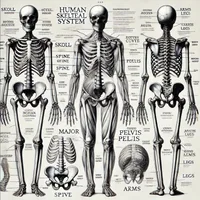
Skeletal System Explained

Presentation
•
Health Sciences
•
11th Grade
•
Easy

DANNA PALACIOS
Used 3+ times
FREE Resource
9 Slides • 4 Questions
1

Skeletal System Explained
By:Cecilia,Audrey,Kylie,Laine,Danna
2


The structure of bones & bone cells
Bones are rigid structures composed of a dense
outer layer of compact bone for strength,an
inner spongy bone with marrow form lightweight
support and blood cell production
Between the rings of matrix,the bone
cells(osteocytes) are located in spaces called
lacunae
3


Physiology of bones
The physiology of bones encompasses their role in providing structural support to
the body.This makes it easy for movement by serving as attachment points for
muscles, protecting vital organs, storing and releasing minerals such as calcium
and phosphorus, producing blood cells in the bone marrow (hematopoiesis), and
contributing to metabolic regulation through interactions with hormones like
parathyroid hormone and vitamin D.Bones get attached to bones by ligaments.
4
Multiple Choice
What structure attaches bone to bone?
Ligaments
Tendon
Spongy Bone
5


Joints
Joints are structures where two or more bones meet,allowing for movement and
flexibility in the skeleton. The main function of joints is to facilitate the body
movements,provide support, stability,and connect bones while maintaining their
alignment.There is lots of joints but the one with the most range of motion is the
ball and socket joint.
6
Multiple Choice
What type of synovial joint has the greatest range of motion?
Plane Joint
Pivot Joint
Ball and Socket Joint
7

Diseases of the Skeletal System
°Osteoporosis-reduced bone density,making bones fragile and prone to fractures
°Arthritis-inflammation of joints causing pain,stiffness and reduce mobility
°Osteomalacia-Softening of bones due to vitamin D deficiency
°Paget’s Disease-Abnormal bone remodeling leading to deform and weakened
bones
°Osteomyelitis-Bone infection caused by bacteria or fungi
8

Diseases of the Skeletal System PT.2
°Bone Cancer:Abnormal growth of cells in bone
°Scoliosis: Abnormal curvature of the spine
°Osteogenesis Imperfecta:Genetic disorder causing brittle bones
°Herniated Disc:A spinal condition where a disc between vertebrae bulges or
ruptures,causing pain
°Gout:Build-up of Uric acid crystals in joints,leading to inflammation and pain
9


Functions
°Support
°Protection
°Movement
°Mineral Storage
°Blood Cell Production
°Energy Storage
°Hormonal Regulation
The Skeletal System grows old as well as we
do,and the functions in our body deteriorate
.When we grow older our bones do not work
the same and our Articular Cartilage
deteriorates and makes grinding noises as
they move past each other.
10
Multiple Choice
As adults age, this covering on the ends of their bones deteriorates,causing bones to make grinding noises as they move past each other?
Bone Resorption
Articular Cartiolage
Osteoporosis
11


Skeletal System Diagram
The skeletal system provides
structural support, protects vital
organs, and facilitates movement
in the body. Each end of a long
bone is called the epiphysis, which
is covered by articular cartilage to
aid in joint movement. The central
shaft of the long bone, known as
the diaphysis, connects the
epiphyses and contains the
medullary cavity for marrow
storage.
12
Multiple Choice
What is the name given to each end of a long bone?
Diaphysis
Epiphyses
Condyle
13

Homeostasis
°Mineral Balance
°Blood Cell production
°Fat Storage
°Acid-Base Balance
°Repair and Remodeling
°Hormonal Interactions
Skeletal System Explained
By:Cecilia,Audrey,Kylie,Laine,Danna
Show answer
Auto Play
Slide 1 / 13
SLIDE
Similar Resources on Wayground

12 questions
Prepositions
Presentation
•
3rd Grade
12 questions
Dimensional Analysis
Presentation
•
11th Grade
9 questions
First 5 Presidents - REVIEW
Presentation
•
11th Grade
10 questions
MATERI 6 : Modal in English
Presentation
•
10th Grade
12 questions
READING COMPREHENSION
Presentation
•
10th - 11th Grade
10 questions
Sleep
Presentation
•
10th - 11th Grade
10 questions
Genetic Engineering
Presentation
•
10th - 11th Grade
9 questions
Arts and Crafts
Presentation
•
KG - 10th Grade
Popular Resources on Wayground
10 questions
Safety Day 2026 – Student Review

Quiz
•
9th Grade
21 questions
Continents and Oceans
Quiz
•
6th Grade
20 questions
Parts of Speech
Quiz
•
5th Grade
16 questions
Subject & Predicate
Quiz
•
5th Grade
25 questions
Multiplication Facts
Quiz
•
5th Grade
12 questions
Map Skills
Quiz
•
3rd Grade
22 questions
Continents and Oceans
Quiz
•
5th Grade
15 questions
Rounding Decimals
Quiz
•
5th Grade
Discover more resources for Health Sciences
26 questions
SLIME!!!!!
Quiz
•
KG - 12th Grade
20 questions
Cell Transport
Quiz
•
9th - 12th Grade
20 questions
Budgeting
Quiz
•
9th - 12th Grade
20 questions
Investing
Quiz
•
9th - 12th Grade
8 questions
DNA vs. RNA
Presentation
•
9th - 12th Grade
12 questions
Identify Rigid Transformations
Quiz
•
8th - 12th Grade
10 questions
Complementary, Supplementary, Vertical, and Linear Pairs
Quiz
•
9th - 12th Grade
20 questions
Managing Credit
Quiz
•
9th - 12th Grade