
The Port of New York

Presentation
•
English
•
Professional Development
•
Practice Problem
•
Medium
+8
Standards-aligned

Lera Sadovskaya
Used 2+ times
FREE Resource
4 Slides • 7 Questions
1
The Port of New York
New York Harbor is one of the greatest natural deep-water ports in the world. Its wide bays and waterways are open all year round with a tidal range of only 4,5 feet.
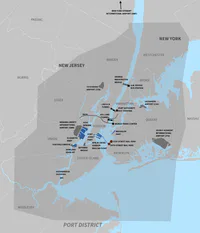
Within the port district, a circle radiating 25 miles, in all directions from the Statue of Liberty as its center and covering 1,500 square miles, there is 650 miles of developed water-front with some 400 deep-sea vessel berths suited to handle all types of ships.
2
The Port of New York
The Port of New York is the leading port of the USA, and its annual turn round of ocean-borne foreign trade of bulk and general cargoes is about 180 000 000 tons.
In most cases outbound ships sail directly from New York to destinations overseas, having already called at intervening United States ports. The same is true for inbound cargo-ships that call at New York first.
3
The Port of New York
The Port of New York District is a complex of ports within a port. It is composed of eight distinct areas, all melting one into other: The East River Piers, the North River Piers, Port Newark, etc.
Traditionally, the East River is the heart of the Port of New York. The Hudson River (North River) lies to the west of Manhattan. The North River Piers is a tremendous row of trans-ocean terminals stretching along the west side of Manhattan.
4
The Port of New York
The Port Authority operates six marine terminals: the Brooklyn Piers, the Grain Terminal and Columbia Street Piers, the Erie-Basin-Piers, the Elizabeth Piers, the Hoboken Piers and Port Newark. Port Newark handles millions of tons of cargo annually at 31 deep-water berths, it is served by all the railroads and is adjacent to Newark Airport.
The Port of New York District is ringed by four regional airports operated by the Port Authority.
The Port of New York's terminal and transportation facilities are supplemented by headquarters for international trade built in Low Manhattan.
5
Multiple Choice
What is the key advantage of New York Harbor as a port?
Its deep water
Its large size
Its year-round accessibility
Its modern facilities
6
Multiple Choice
Which of the following best describes the Port of New York District?
A single, unified port
A complex of multiple distinct ports
A port with limited terminal facilities
A port focused solely on container shipping
7
Multiple Choice
What is the main function of the Port Authority in relation to the Port of New York?
To operate the marine terminals
To handle all cargo loading and unloading
To provide on-site security and customs services
To coordinate the activities of the different port areas
8
Multiple Choice
How do ships typically travel to and from the Port of New York?
They only stop at New York
They call at other US ports before or after New York
They always sail directly to and from international destinations
They primarily transport bulk cargoes rather than general goods
9
Multiple Choice
Which of the following is not mentioned as one of the distinct areas within the Port of New York District?
The East River Piers
The North River Piers
Port Elizabeth
Port Chicago
10
Multiple Choice
What mode of transport is particularly important for the operations of Port Newark?
Air
Rail
Road
Maritime
11
Multiple Choice
What is the primary geographical feature that separates Manhattan from the other port areas?
Times New Roman
The Hudson River
The Statue of Liberty
The Atlantic Ocean
The Port of New York
New York Harbor is one of the greatest natural deep-water ports in the world. Its wide bays and waterways are open all year round with a tidal range of only 4,5 feet.
Within the port district, a circle radiating 25 miles, in all directions from the Statue of Liberty as its center and covering 1,500 square miles, there is 650 miles of developed water-front with some 400 deep-sea vessel berths suited to handle all types of ships.
Show answer
Auto Play
Slide 1 / 11
SLIDE
Similar Resources on Wayground

6 questions
ATIN2_Part3_Session18
Presentation
•
Professional Development
10 questions
Daily Routines
Presentation
•
University
8 questions
What's your specialty?
Presentation
•
Professional Development
10 questions
Adjectives and Adverbs
Presentation
•
Professional Development
8 questions
PREPOSITIONS
Presentation
•
Professional Development
8 questions
Causative verbs
Presentation
•
Professional Development
9 questions
Pete the Cat easter questions
Presentation
•
KG
Popular Resources on Wayground
6 questions
PRIDE Always and Everywhere
Presentation
•
12th Grade
20 questions
Lab Safety Quiz

Quiz
•
6th Grade
26 questions
KOR Review Kahoot Questions
Quiz
•
8th Grade
21 questions
Continents and Oceans
Quiz
•
6th Grade
12 questions
Unit Zero lesson 2 cafeteria
Presentation
•
9th - 12th Grade
20 questions
Parts of Speech
Quiz
•
5th Grade
10 questions
Riddles Riddles fun Riddles
Quiz
•
6th - 12th Grade
16 questions
Subject & Predicate
Quiz
•
5th Grade
Discover more resources for English
10 questions
Soup, Salad, or Sandwich?
Quiz
•
1st Grade - Professio...
20 questions
Employability Skills
Quiz
•
Professional Development
9 questions
How to Email your Teacher
Quiz
•
Professional Development
25 questions
2023 Pop Culture Trivia
Quiz
•
Professional Development
20 questions
Cinema Camera Angles
Quiz
•
9th Grade - Professio...
20 questions
Sports trivia
Quiz
•
Professional Development
21 questions
Shop Safety
Quiz
•
Professional Development