

6.7 Landmark Supreme Court Cases

Presentation
•
Social Studies
•
12th Grade
•
Hard

Amy Schneider
Used 2+ times
FREE Resource
23 Slides • 0 Questions
1

L A N D M A R K S U P R E M E C O U RT
C A S E S
Unit 6-5
2

L E S S O N OV E RV I E W
Students Will Be Able To:
Identify characteristics of racial segregation in the United States in the nineteenth and twentieth
centuries.
Identify legal arguments in Plessy v. Ferguson and Brown v. Board of Education.
Draw conclusions about segregation based on a museum exhibit.
Evaluate why different sets of justices may have formed different conclusions about similar issues.
Vocabulary:
Brown v. Board of Education of Topeka, Kansas, Jim Crow Laws, Landmark Case, Plaintiff, Plessy v.
Ferguson
3

J U D I C I A L R E V I E W
Article III of the Constitution created
the judicial branch and the Supreme
Court
• brief and does not provide much
detail about the judicial branch, nor
does it mention the federal court
system.
How is the judicial branch so influential
then?
4

J U D I C I A L R E V I E W
Review allows the Supreme Court to review the
actions of the states, the president, bureaucratic
agencies, and Congress.
Judicial review was first exercised as a legal principle
in the 1803 Supreme Court case Marbury v. Madison.
Using the power of judicial review and its power to
interpret the Constitution, the Supreme Court has
made decisions that significantly reshaped American law and increased the power of the judicial branch.
Example: school segregation Supreme Court decision provided protection against racial segregation
Moton High School, pictured here
around 1951, was a school for Black
students in Virginia during the era of
segregation.
5

I M PA C T O F S U P R E M E C O U RT
D E C I S I O N S O N P U B L I C P O L I C Y
Since Marbury v. Madison established the
power of judicial review, the Supreme Court
has had the power to interpret the meaning of
laws
•Supreme Courts cannot make laws, but it
can rule that Congressional laws or the
president’s actions violate the
Constitution.
•In this way, the judicial branch can check
the power of the legislative and executive
branches.
•These branches can also check the power
of the federal judiciary.
6

W H A T I S A L A N D M A RK C A S E ?
• Supreme Court cases are especially important because they set precedents for all other courts in the United States.
• Landmark Cases- ones that are especially important, have great historical
significance, further define the meaning of the Constitution, and affect a large number of people
•Because the Supreme Court has the final say on questions related to federal law, lower courts will follow the precedents set by the Supreme Court
•known as stare decisis, which is Latin for “to stand upon decisions.”
• Reversing decisions: The Supreme Court does reverse their decisions but
it doesn’t happen often
Examples of Landmark Cases-
Marbury v. Madison (1803): set the precedent that the Supreme Court has the
power of judicial review.
•McCulloch v. Maryland (1819): historically important because it shaped the degree of power Congress could exercise.
•Plessy V. Ferguson (1896) and Brown v. Board of Education (1954) - Both of these cases are directly linked even though they are nearly 60 years apart from one another (reversal)
Justice Henry Billings who wrote the majority opinion in Plessy v. Ferguson
7

I N F L U E N C E O F L A N D M A R K C A S E S
Supreme Court decides a limited number of cases.
• Most of those cases involve its appellate jurisdiction over cases that begin in the lower courts.
• These cases are appealed from federal appeals courts and state courts, and they must meet certain criteria to be heard by the Supreme Court.
• Landmark cases often contain language that influences future legal decisions.
Examples:
Schenck v. United States (1919)
•the majority opinion and included a phrase in the decision: “clear and present
danger.”
•subsequent cases under similar circumstances, other judges used the
“clear and present danger” test.
•Tests such as these are common in landmark decisions. These tests
continue to influence debate about interpreting the law.
8

L A N D M A R K C A S E S A N D S E G R E G AT I O N
Plessy v Ferguson - 1896
Brown v Board of Education - 1954
9

E S S E N T I A L Q U E S T I O N - What were the events surrounding Plessy vs Ferguson and Brown vs Board of Education cases?
W H A T W A S T H E I M P A C T O F T H E S U P R E M E
C O U R T ' S D E C I S I O N I N T H E S E C A S E S ?
Study/Analyze these
visuals and what do
you notice?
10

H I S T O RI C A L C O N T E X T : S E G RE G A T I O N
A F T E R T H E C I V I L W A R
• After the Civil War three new amendments were added to the Constitution:
•The 13th Amendment- outlawed slavery
•The 14th Amendment- Prohibited states from denying anyone "equal protection of the law"
Also, citizenship for all people born in the US- citizenship protections now applied to African- Americans
•The 15th Amendment- Prohibited voting restrictions based on race
11
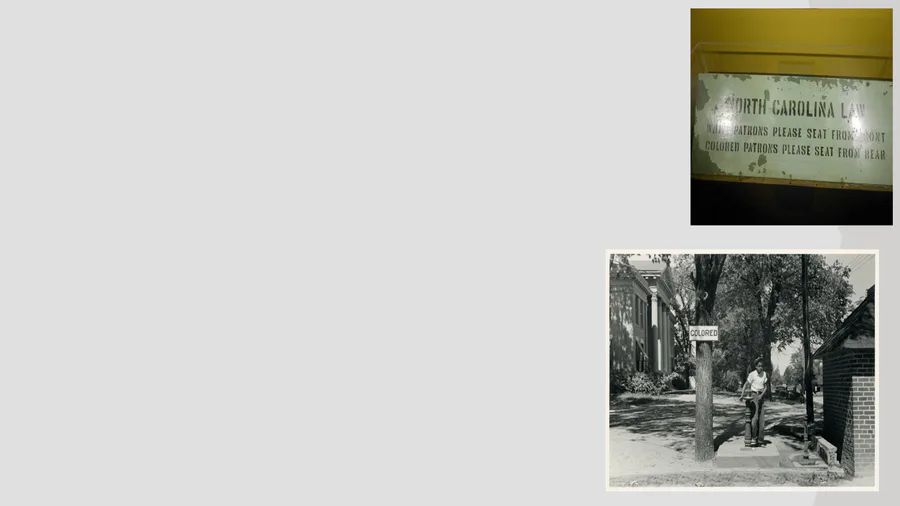
Historical Context : Segregation After the Civil War
Despite these amendments, deep racial inequality continued in the
United States
• Civil Rights Act of 1875
made it a crime for an individual to deny someone access to public places or businesses on account of race.
• 1883: Supreme Court used judicial review to strike down this
legislation
ruled that the 14th Amendment did not give Congress authority to prevent discrimination by private individuals.
According to the court, victims of racial discrimination should seek relief from the states, not the federal government.
• finding this relief from the states was unlikely because state govts
were passing legislation that codified (made into law) racial
discrimination
Laws requiring the establishment of separate schools for children of each race were most common
called Jim Crow laws. (Jim Crow was a stage character from the 1830s who was a racist depiction of a Black man.)
12

P L E S S Y V. F E RG U S O N
• 1890s, a group in Louisiana
brought a case about racial
segregation to the Supreme Court in Plessy v. Ferguson.
• Watch the video to learn about
the case.
• Pay attention to the legal
arguments the petitioners used.
13
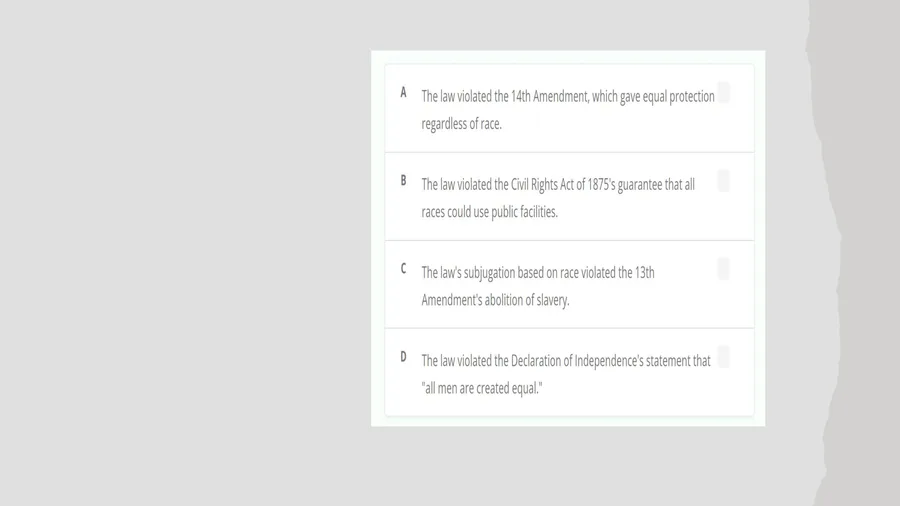
W H A T L E G A L
A RG U M E N T S D I D
P L E S S Y ' S L A W Y E RS
U S E T O O P P O S E
L O U I S I A N A ' S
S E P A RA T E C A R
A C T ?
14

P L E S S Y V. F E RG U S O N
In Plessy v. Ferguson, the Supreme Court
ruled that segregation did not violate the
Constitution
•reasoning that simply separating
people based on race did not mean the
races were being treated unequally
•used strict constructionism to interpret
the Constitution, taking a narrow
interpretation of "equality under the
law."
phrase "separate but equal" became a
common descriptor of the Court's ruling
15

P L E S S Y V. F E RG U S O N
• In the Plessy v. Ferguson case the Supreme Court ruled that segregation did not violate the Constitution saying that
separating people based on race did not mean being treated unequally
• This is a strict constructionism view to interpret the
Constitution that came to be known as " Separate but Equal"
16

" S E PA R AT E B U T E Q U A L "
Segregation was already widespread, but the court's ruling gave the federal government's official approval of the practice and set the precedent that racial segregation was legal
• the court's decision assumed that separate facilities were equal - they were far from equal.
•Business owners and public services often put Black people in shoddily built facilities and reserved facilities in better condition for White people.
• the history of slavery in the United States meant that for generations, Black people did
not have the same opportunities as White people
•This history placed Black people at a disadvantage in access to education, employment, and property ownership.
•Codifying racial segregation put up another barrier for the Black community's efforts for social equality.
• Opponents of segregation continued to challenge segregation through the courts. Many of their efforts focused especially on schools.
17

' E Q U A L ' F A C I L I T I E S
18

Brown vs. Board of Education
• This case arose as a direct challenge to the precedent set by the Plessy v. Ferguson case dealing with " Separate but Equal"
• All the Supreme Court justices agreed unanimously that
segregation was unconstitutional by applying loose
constructionism to the phrase, " Equality under the law"
•Overturned Plessy v Ferguson and the 'separate but equal doctrine'
• Plaintiffs- party pursuing legal action against another party
•in this case, were school children who wanted to attend school
19

B ROW N V. B O A R D O F E D U C AT I O N
In the video, you will hear about the National
Association for the Advancement of Colored
People, or NAACP. (Colored was the accepted
word for Black at the time of the association's
foundation.)
•The NAACP is a civil rights organization that is
still active today.
•You will also hear the word plaintiff, which is
the party pursuing legal action against another
party in a court case.
As you watch the video, pay attention to the legal
reasoning for the court's decision.
20

W H A T I D E A S S U P P O RT E D T H E C O U RT ' S D E C I S I O N
I N B RO W N V. B O A R D O F E D U C A T I O N ?
21

B ROW N V. B O A R D O F E D U C AT I O N
22

Effects of Brown vs. Board of Education
Although Brown v. Board of Education was an
important step toward civil rights, the struggle for
equality was far from over.
•Violence against Black people increased
after Brown v. Board of Education.
•Some scholars presented legal reasons to oppose
the ruling of Brown v. Board of Education.
•Brown v. Board of Education led to increased
activity from the civil rights movement.
•Discrimination against Black Americans
continued after Brown v. Board of Education.
23

E S S E N T I A L Q U E S T I O N - What were the events surrounding Plessy vs. Ferguson and Brown vs. Board of Education?
• Plessy v. Ferguson codified "separate but equal" racial segregation.
• Brown v. Board of Education overturned the earlier ruling and declared racial
segregation unconstitutional.
L A N D M A R K S U P R E M E C O U RT
C A S E S
Unit 6-5
Show answer
Auto Play
Slide 1 / 23
SLIDE
Similar Resources on Wayground

18 questions
Lesson 7.5 - Roosevelt's New Deal
Presentation
•
8th - 9th Grade
17 questions
KETIMPANGAN SOSIAL
Presentation
•
12th Grade
18 questions
JANJANG
Presentation
•
12th Grade
17 questions
Food Chain/Food Web Recap
Presentation
•
12th Grade
19 questions
DEPLESI ASET SDA
Presentation
•
12th Grade
20 questions
Get Smart Plus 3 Topic 8 was/were
Presentation
•
1st - 4th Grade
19 questions
ECONOMICS TOPIC 1 LESSON 2
Presentation
•
12th Grade
18 questions
The Road to the Civil War
Presentation
•
11th - 12th Grade
Popular Resources on Wayground
6 questions
PRIDE Always and Everywhere
Presentation
•
12th Grade
20 questions
Lab Safety Quiz

Quiz
•
6th Grade
26 questions
KOR Review Kahoot Questions
Quiz
•
8th Grade
21 questions
Continents and Oceans
Quiz
•
6th Grade
12 questions
Unit Zero lesson 2 cafeteria
Presentation
•
9th - 12th Grade
20 questions
Parts of Speech
Quiz
•
5th Grade
10 questions
Riddles Riddles fun Riddles
Quiz
•
6th - 12th Grade
16 questions
Subject & Predicate
Quiz
•
5th Grade
Discover more resources for Social Studies
6 questions
PRIDE Always and Everywhere
Presentation
•
12th Grade
6 questions
PRIDE in the Hallways and Bathrooms
Presentation
•
12th Grade
30 questions
AP Human Geography Unit 1
Quiz
•
9th - 12th Grade
64 questions
USHC 4 Key Terms 22-23
Quiz
•
11th Grade - University
10 questions
Federalism Quiz
Quiz
•
12th Grade
27 questions
MR. DROHAN'S RECONSTRUCTION REVIEW (SY25)
Quiz
•
9th - 12th Grade
22 questions
American Revolution Review
Quiz
•
9th - 12th Grade
16 questions
Unit 1-2 Quiz
Quiz
•
12th Grade